


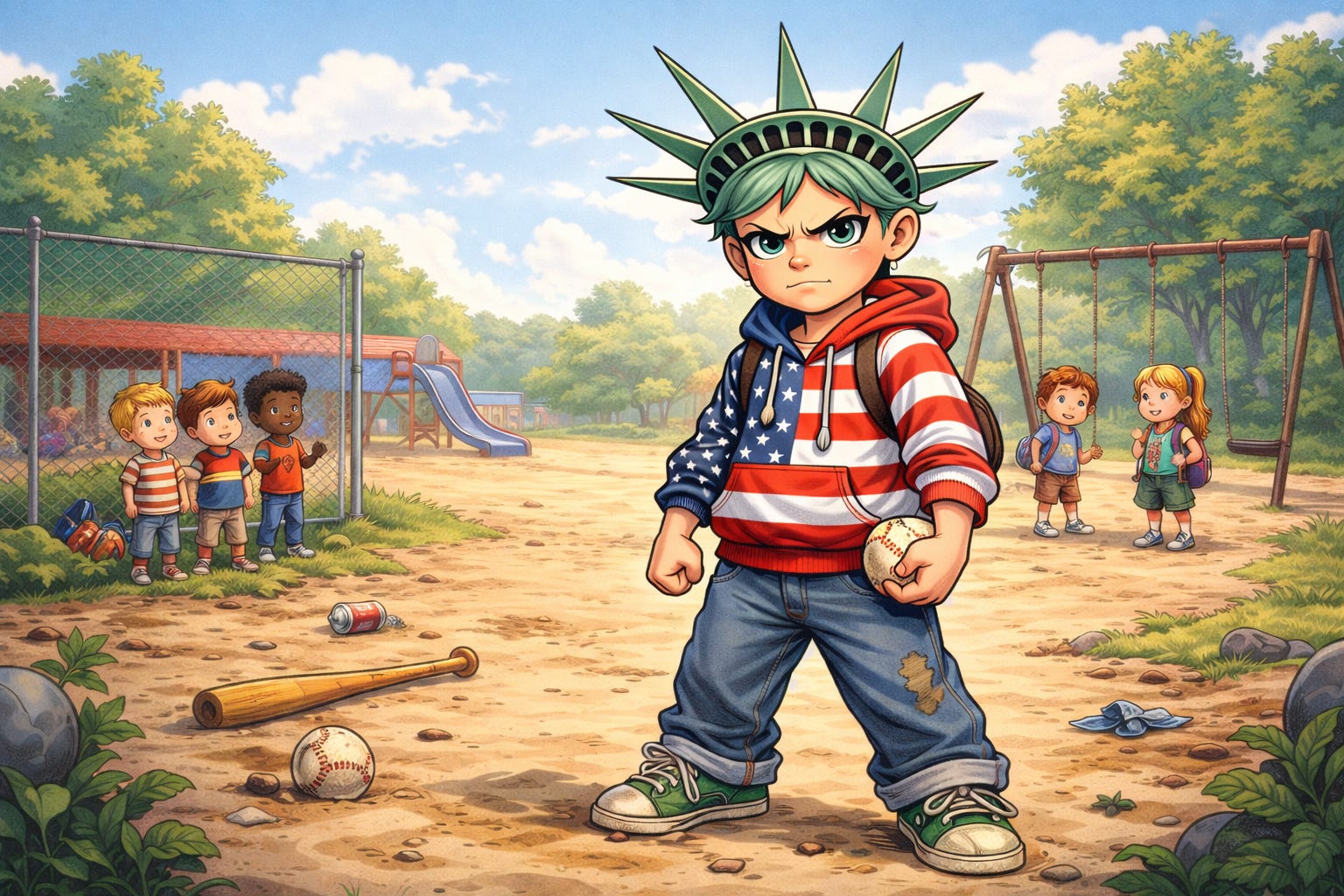
Across elementary schools, kids gather around the playground and the sandlot. That’s where games form, friendships are built, and rules, formal or informal, matter.
But almost every school has that kid.
The kid who doesn’t want to play by the rules. Who picks on others. Who insists they’re the one being wronged. The motivations are murky—maybe insecurity, maybe trouble at home—but the pattern is familiar.
The kid feels misunderstood. They believe others started it. Their retaliation, in their mind, is justified.
The parents step in, arguing the school isn’t protecting their child.
Meanwhile, the rest of the kids adapt quietly.
They stop showing up at the sandlot. They drift to the swings, the blacktop, anywhere else. Not because they don’t value the game, but because the environment has become unpredictable.
The playground bully feels even more isolated. More frustrated. More convinced everyone else is the problem.
This is what happens when unpredictability replaces trust.
And that’s how much of the world now views the United States.
Reliability Is an Economic Asset
This week at Davos, Mark Carney delivered one of the clearest signals yet that the global order is shifting. Countries are coordinating around the U.S., not with it.
Not because the U.S. isn’t powerful. Not because the U.S. isn’t important. But because its reliability has diminished.
Allies no longer know what motivates U.S. policy. Trade rules have shifted from their norm and now appear ad hoc. Commitments wobble, and deals are backtracked. Long-standing relationships are treated as transactional rather than institutional.
When reliability erodes, trust follows.
And in economics, trust isn’t abstract. It’s infrastructure. It is part of the institutions we cherish and those that facilitate economic activity.
Reliability functions like capital. It lowers transaction costs. It reduces risk. It encourages long-term investment. When firms and countries trust that the rules won’t change overnight, they commit resources. When that trust fades, they hedge, or worse, leave.
We talked about isolationism back in April 2025. How Liberation Day felt like the first signs of isolationism. At the time, it felt like a warning. This week’s speeches at Davos felt like confirmation.
Isolation doesn’t always start with withdrawal. Often, it starts with volatility. With policies that feel reactive rather than principled. With partners deciding it’s safer to build alternatives than to wait for clarity.
Just like the playground, the game doesn’t stop.
It just moves somewhere else.
History Doesn’t Repeat, But It Often Rhymes
Back in April, soon after Liberation Day, I wrote:
As we watched the implementation of new tariffs and the rise of economic nationalism, I was reminded of a similar moment nearly a century ago. In the 1920s and early 1930s, U.S. policy shifted sharply toward economic isolation, culminating in the Smoot–Hawley Tariff Act of 1930, which raised tariffs on over 20,000 imported goods.
What followed wasn’t prosperity; it was pain.
U.S. imports fell from $4.4 billion in 1929 to $1.3 billion in 1932. Exports dropped from $5.4 billion to $1.6 billion. Trading partners retaliated, and global trade collapsed by roughly 25%.
The damage didn’t come solely from tariffs. It came from the signal: the U.S. was no longer committed to predictable rules.
In both the 1930s and today, isolationist policies emerged from similar political dynamics:
Economic anxiety is fueling support for protectionism
The belief that trade barriers shield domestic workers
Rhetoric framing trade as zero-sum
Retreat from multilateral cooperation in favor of unilateral action
The lesson from the 1930s is clear. Economic isolation did not solve the problems it promised to fix. It deepened them.
Back to Davos
Since that post in April, the U.S. has taken further steps towards isolation. It is provoking the EU by demanding that it purchase Greenland. Its trading partners aren’t waiting. They’re finding new allies and building systems that bypass the U.S. altogether.
There’s a deeper cost to this that doesn’t show up immediately in monthly data or quarterly earnings.
Economic leadership isn’t just about size. It’s about reliability.
For decades, the U.S. benefited from being the world’s most predictable economic partner. Firms invested here because the rules were stable. Countries traded with the U.S. because access came with fewer political strings. The dollar sat at the center of the global system not by force, but by trust.
That advantage is eroding.
When tariffs become leverage rather than policy tools, partners adapt. Europe signs new trade agreements. Asian supply chains deepen regional ties. Middle powers build parallel systems that reduce exposure to U.S. policy swings.
None of this happens overnight. But once it starts, it compounds.
This is how influence fades not through collapse, but through substitution.
The Bottom Line
Isolation doesn’t make the U.S. stronger. It makes everyone else more independent.
And once the world learns how to operate without you, earning your seat back at the table is far harder than keeping it in the first place.
This is the cost of isolationism that never makes the tariff headlines, but it’s the one that matters most. This week’s Davos speech made that clear.
Trust is what keeps people showing up.
On playgrounds.
And in the global economy.
Watch the speech. Then ask yourself: how much unreliability can the system absorb before the game moves on for good?
Share the Knowledge: If you found this analysis valuable, please forward it to colleagues and classmates who would benefit from understanding these economic patterns. Economic literacy is our best defense against repeating the mistakes of the past.
Wonderful article, and it addressed concisely the warning thoughts that have been swirling in my head. Prime Minister Carney's speech was eloquent and crystal clear, and that speech and your post leave me with two questions (for now):
1. Is there anything we the people can do now to get back toward what I'd call a better course? Midterm elections are coming, and posts such as this one should be shared far and wide to help all of us understand what is at stake now and in the future. And...that seems uncertain and slow when the change to economic isolationism has been so quick and devastating.
2. Similar to your question about how much unreliability can the system absorb...: Will there be any coming back from this in a future administration that is not economically isolationist? How do we rebuild trust with other economies and leaders who have gotten dizzy (and fed up) from constantly changing US policies/actions? Rhyming history seems as bad as repeated history.
Thanks for the timely explanation!
Great article, definitely bringing back memories and making connections!