



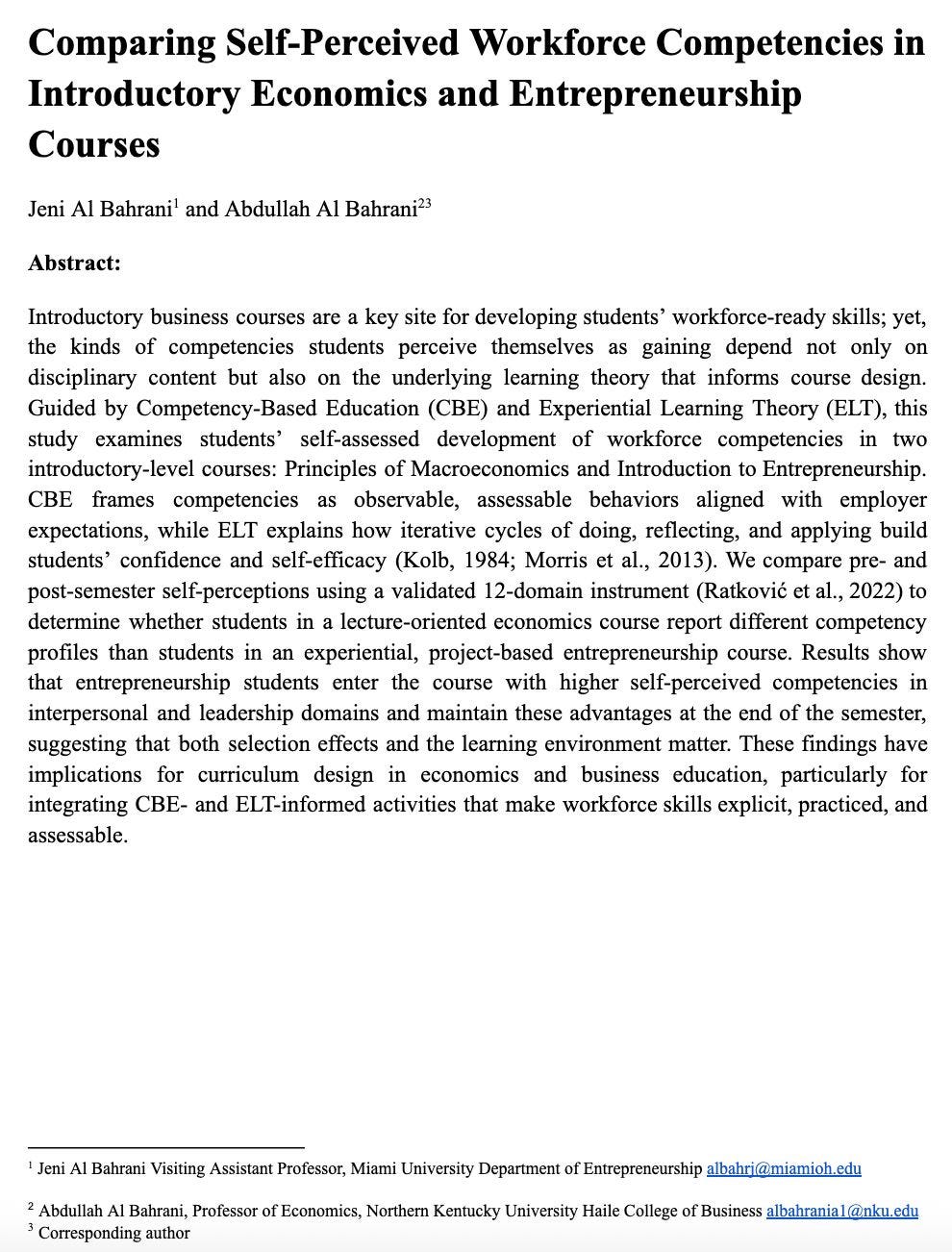
Next week, I’m heading to the Southern Economic Association conference to present new joint work with Dr. Jeni Al Bahrani from Miami University. The Southern is one of the conferences I try to make every year. It’s large enough to attract a wide range of research, but small enough that you can still walk into a hallway, bump into someone you haven’t seen in years, and immediately fall into a meaningful conversation.
This year, we’re presenting a project that sits at the intersection of economics education, entrepreneurship, and workforce readiness. This is a topic that many of you frequently ask about, and we discuss it here on Decode Econ.
What We Studied
We wanted to understand: What workforce competencies do students believe they develop in introductory economics versus introductory entrepreneurship?
Both courses sit at the front of the business curriculum, but they’re taught and experienced very differently.
Our study used a validated 12-domain workforce competency instrument, which asked students in both courses to evaluate themselves at the start and end of the semester. The competencies include decision-making, initiative, teamwork, leadership, empathy, integrity, conflict resolution, and more.
What We Found
1. Entrepreneurship students start the semester more confident.
Across several domains, leadership, teamwork, initiative, integrity, empathy, and decision-making, entrepreneurship students rated themselves significantly higher before taking the course.
This pattern suggests a strong selection effect: students who choose experiential, project-based courses tend to arrive with higher self-efficacy and interpersonal confidence.
2. Those differences persist through the semester.
By the end of the course, the entrepreneurship students still rated themselves higher in nearly every domain, especially:
Leadership
Initiative
Teamwork
Empathy
Achieving results
Both groups improved, but the relative gap between the two remained remarkably stable.
3. Gains within each course were modest.
Neither course produced large jumps in self-perceived competencies over a single semester. This aligns with broader research indicating that short-term courses tend to reinforce existing strengths rather than transform them. Future research should examine changes over more extended periods, for instance, from the first year to graduation.
4. Pedagogy matters, but selection matters more.
Entrepreneurship courses use project work, iteration, teamwork, and feedback. These are design elements tied to Experiential Learning Theory (ELT) and Competency-Based Education (CBE). Economics courses still rely heavily on traditional lectures.
But the fact that the pre-course differences nearly match the post-course differences tells us: Students’ self-concept walks in the door with them. The course then shapes, but does not rewrite, that baseline. One semester might be too short to notice a difference, or teaching styles might not have as significant an impact on self-perceptions as we had hypothesized.
Why This Matters
As business schools push for better alignment with employer expectations, we need to think carefully about where workforce competencies are actually being built, and where students perceive them to be built.
Our takeaway isn’t that economics should become entrepreneurship. It’s that economics, if it wants to build student confidence in communication, teamwork, and decision-making, may need more moments of authentic application, projects, reflection, iteration, and collaboration, to match what entrepreneurship naturally provides. By doing so, Economics might be able to attract students to intro courses that have higher perceived competencies.
This research is part of a larger conversation happening across business education: How do we prepare students not just to know things, but to do things?
If you’re attending SEA, come say hello.
And if you’re curious about the full paper or would like to discuss embedding workforce competencies into economics courses, I’d be happy to connect.
For me entrepreneurship and innovation are synonymous. It is hard to have one without the other. I tell my students that critical thinking and problem solving are the most important technical skill you will ever learn.
Abdullah- It is pretty much a given that the strongest students at the beginning of the class will remain the strongest students by the end. The only way I can think of to change that would be a wholesale change of the model of higher education. As we know, in K-12, students from higher income, higher education households on average do much better than those from lower-income, lower education homes. There is a debate about whether this is due to innate ability or to environmental factors, but at this time we ascribe much of the difference to the environment. The problem is that schools in areas in which students are more likely to succeed also have more resources. There is a fight about allocation of resources, but realistically, after the failure of busing by the 80s it was clear that better-off, largely White parents won that battle, and we were back to very significant inequality. At this time, it has become clear that more investment in schools and better-prepared teachers should start in pre-school and continue without a break until graduation to adequately reduce this gap. That is largely not happening in our current educational environment. So. If you want higher-performing students, someone would have had to have started in pre-school. I say this not as an incentive to give up, but as a recognition of the real hurdle we must leap. Given the current status, some clearly capable students who have had inadequate preparation would have to demand much more of our time and effort to develop their potential on an individual basis. I regularly do this. It is crude, but in some cases knowing how much potential is being wasted is a significant motivation. Even better would be if Universities could recognize this as an issue and devote resources across departments and courses to help individuals of capacity to target for tutoring/coaching needed to help them succeed.