


This semester, I’m back in the undergraduate classroom, and I couldn’t be more excited.
I’ve built my teaching career on a simple belief: if economics is going to matter to students, it has to feel relevant. Economics can’t live only in models or exams. It has to connect to the questions students are already asking about their lives, their careers, and the world they’re entering.
That belief has shaped my teaching, research, and public work for nearly two decades, and it’s been recognized with the Ken Elzinga Distinguished Teaching Award (2020) and the National Association of Economic Educators (NAEE) Rising Star Award (2021) —two honors that carry deep meaning in economics education. But the recognition itself isn’t the point. It comes from a consistent commitment to making economics relevant to real audiences, in classrooms, boardrooms, and through Decode Econ.
What Educators Told Us
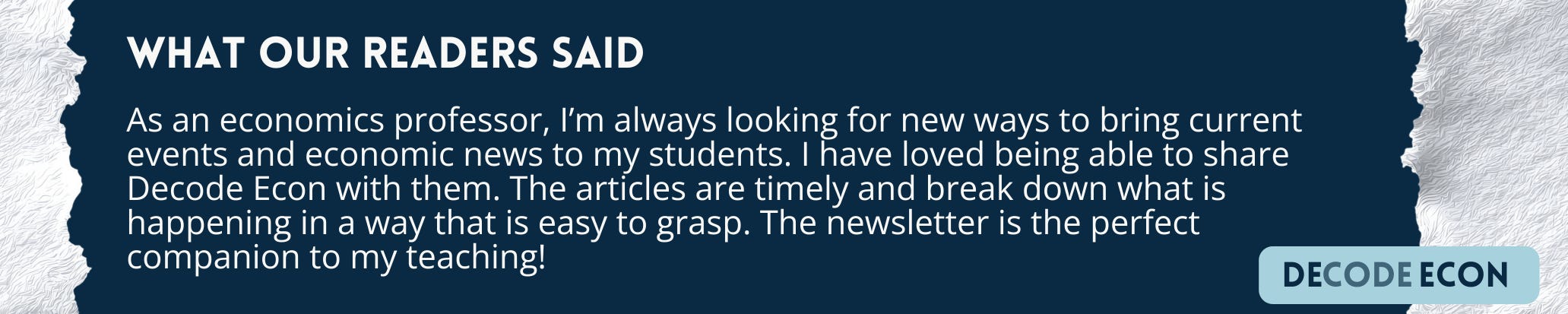
Last month, we surveyed Decode Econ readers, and many of you are educators.
You told us you come to Decode Econ for two main reasons:
To stay current on economic news so classroom examples remain timely and meaningful
To recommend Decode Econ to students as a way to extend applied economics beyond the textbook
That feedback made clear: instructors are actively seeking tools that make economics feel current, human, and usable.
Why We’re Launching the Decode Econ Educator Network (DEEN)
This is why we are kicking off the Decode Econ Educator Network (DEEN).
The goal is simple: partner with educators who want to increase students’ exposure to real-world economics while staying connected to economic news. The program establishes a formal link between classrooms and Decode Econ, teaching informs the platform, and the platform supports teaching.
Are You The Next Decode Econ Educator?
Faculty agree to two things:
Recommend Decode Econ in their classroom as optional reading, discussion starters, or a bridge between theory and current events. We have a gift subscription for your students.
Connect once per semester in an advisory role, sharing classroom insights and feedback to help Decode Econ better serve students and educators. The 60-minute meeting will be held via Zoom, and we will do our best to accommodate all time zones. This is an opportunity to meet, connect, and share your thoughts on using Decode Econ in their classrooms.
This is intentionally a light lift. Our goal is to help the Econ Ed community grow and leverage the work we already do at Decode Econ.
What Faculty Get
This program is about impact, but we also want to say thank you.
Faculty receive:
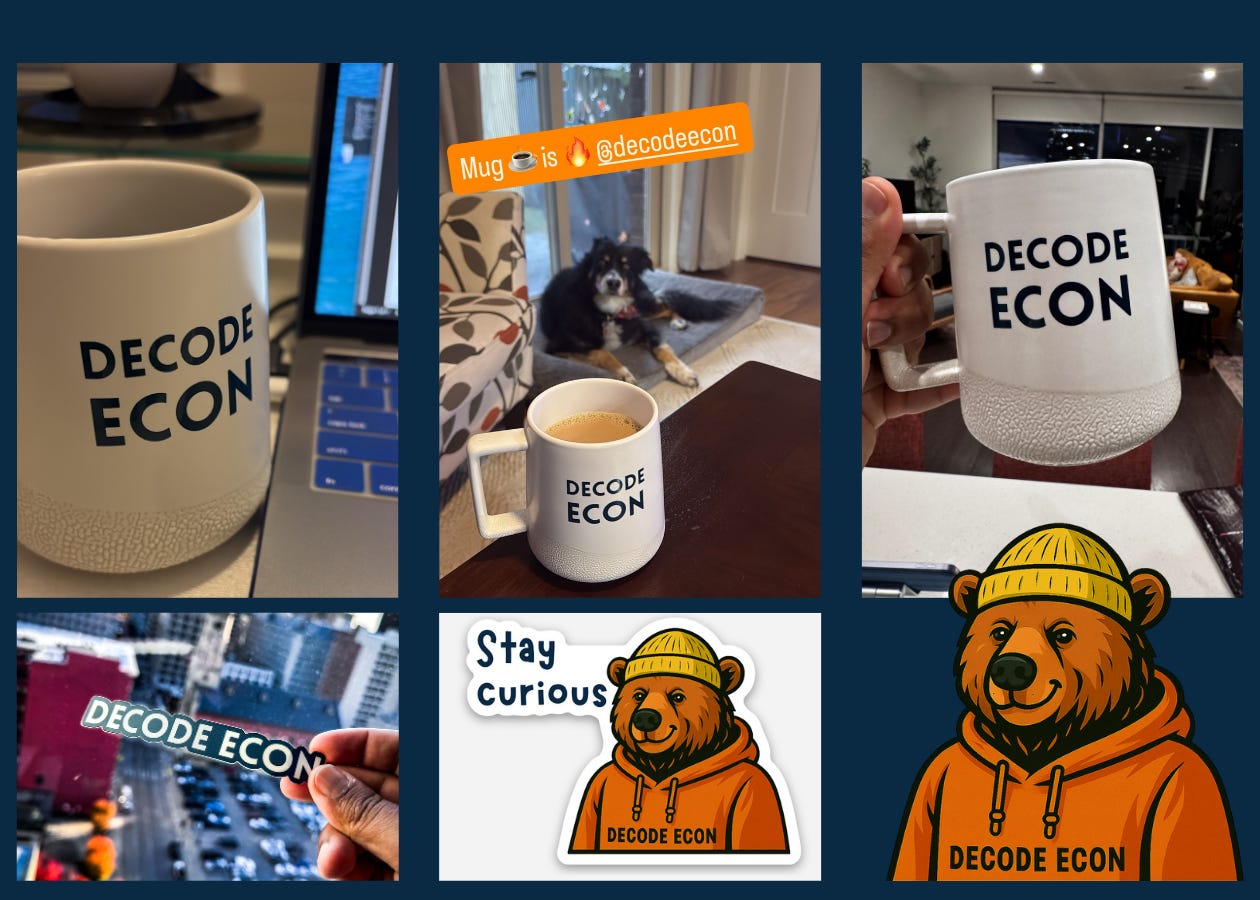
A Decode Econ mug
Decode Econ stickers for offices, laptops, or classrooms
A direct voice in shaping Decode Econ’s educational direction
Recognition as part of a growing community committed to economic literacy
A community of like-minded colleagues
Gift Subscription: your students receive a 6-month gift subscription to Decode Econ.
Decode Econ in Your Syllabus
Not participating in the Decode Econ Educator Network (DEEN) program, but interested in sharing Decode Econ with your students? You can include the language below in your syllabus under Recommended Resources.
Decode Econ is a supplemental economics newsletter that connects core economic concepts to current events and everyday decision-making. The publication supports class discussion, reflection, and economic literacy by translating economic research into concise, accessible analysis.
Students can subscribe for free at www.DecodeEcon.com.
The Bottom Line
If we want students to value economics, we have to show them that economics speaks to their reality. For my students, it will help them stay connected to the economic news.
The Decode Econ Educator Network is an invitation to help make economics more relevant, more visible, and more human for the next generation of students.
Our pilot program will be limited to five faculty. Please do apply below. Final selection of the Spring 2026 faculty will be made by January 12th!
Let’s expand students’ exposure to economics, together.
More on Why Relevance Matters
Many students walk into economics classes believing the subject is outdated, overly theoretical, or disconnected from their reality. They learn supply and demand, GDP, and inflation, but struggle to see how those tools explain rising rent, job searches, AI anxiety, or why everything feels more expensive.
As educators, we know economics has never been more important.
Students live inside economic systems every day, yet rarely encounter economics explained in a way that feels timely, human, and usable. When that gap persists, students disengage, not because they don’t care, but because they don’t see the connection.
The Economics
Students learn best when ideas appear repeatedly in contexts that matter to them. Economics is uniquely positioned to benefit from this because the real world constantly produces teachable moments: headlines, policy debates, workplace decisions, and household tradeoffs.
But most courses can only do so much within limited class time.
Decode Econ was created to extend economic thinking beyond the classroom. Each post offers a short, accessible explanation of a real-world economic issue—designed to take 3–5 minutes, written in plain language, and grounded in current events.
It doesn’t replace your curriculum. It reinforces it.
Over time, something changes. Students stop asking, “Why does this matter?”
They start asking, “How does economics explain what I’m seeing?”
Some Research on Relevance
Al-Bahrani, A. (2022). Classroom management and student interaction interventions: Fostering diversity, inclusion, and belonging in the undergraduate economics classroom. The Journal of Economic Education, 53(3), 259-272
Al-Bahrani, A., Holder, K., Moryl, R. L., Murphy, P. R., & Patel, D. (2016). Putting yourself in the picture with an ‘ECONSelfie’: Using student-generated photos to enhance introductory economics courses. International Review of Economics Education, 22, 16-22.
Sheridan, B. J., Patel, D., Al-Bahrani, A., & Ducking, J. (2025). Students’ perspectives of social media use in economics courses. The Journal of Economic Education, 1-15.
Wooten, J., Al-Bahrani, A., Holder, K., & Patel, D. (2021). The role of relevance in economics education: A survey. Journal for Economic Educators, 21(1), 11-34.
Bayer, A., Bhanot, S. P., Bronchetti, E. T., & O’Connell, S. A. (2020, May). Diagnosing the learning environment for diverse students in introductory economics: An analysis of relevance, belonging, and growth mindsets. In AEA Papers and Proceedings (Vol. 110, pp. 294-298). 2014 Broadway, Suite 305, Nashville, TN 37203: American Economic Association.
A great initiative and all the best . I cannot wait to see the outcome. Have a great semester and keep enjoying teaching, inspiring, guiding and mentoring students by making Economics relevant to their lives .
“You have to know yourself before you can say something about yourself or about what you can know” Socrates...
I'm interested in seeing how you move your students from being Irrational Subjects towards becoming Rational Actors. That point where it clicks in their throught process and you see it in their expression when it connects.
Good Luck!