



In every relationship — in business, in leadership, in negotiation — there is what is said and what is meant. The space between those two things is where careers are built or quietly stalled.
You can have the right data, the right strategy, and even the right answer. But if you misread the room, you lose influence. And in today’s economy, influence is the language of business.
We often treat emotional intelligence as a “soft skill,” something nice to have once the technical work is mastered. That framing is wrong. Emotional intelligence is an economic skill because modern work requires coordination. It is persuasion. It is collaboration under pressure.
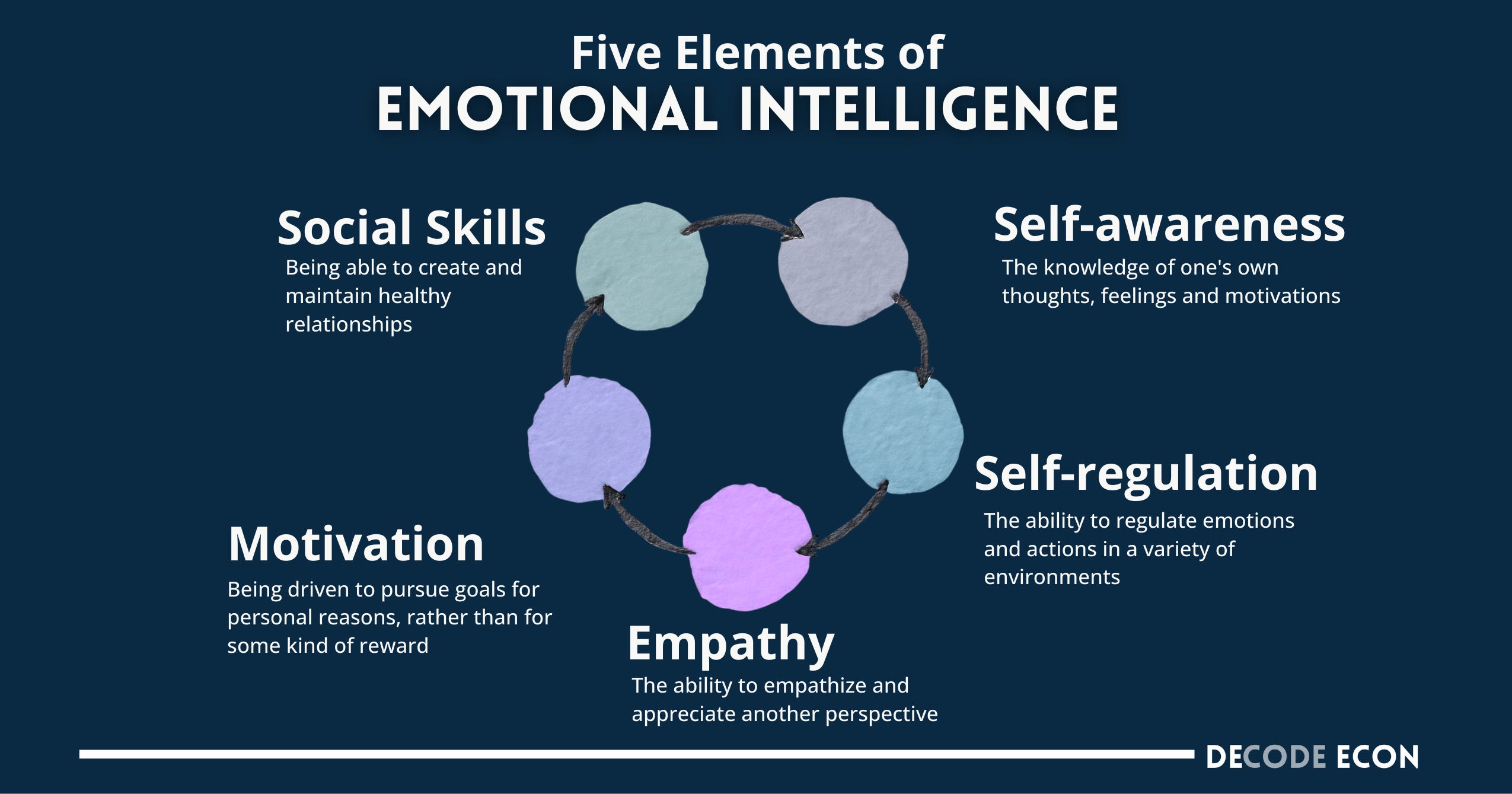
The term was popularized by psychologist Daniel Goleman, who defined emotional intelligence as the ability to recognize, understand, and manage your own emotions while perceiving and influencing the emotions of others. It includes self-awareness, self-regulation, motivation, empathy, and social skills. In simple terms, it is the ability to understand what is happening emotionally, in you and in others, and adjust accordingly.
That ability is a skill that makes a big difference in the labor market and impacts your financial well-being. Today’s post is about the economic importance of EI and how to build this skill.
Why does this matter economically?
Because friction is costly.
In economics, we call the hidden costs of coordination “transaction costs.” These are the frictions that make teamwork expensive: miscommunication, mistrust, defensiveness, disengagement, and turnover. When a leader overreacts in a meeting, trust declines. When feedback is delivered without awareness, morale drops. When someone misreads a stakeholder’s hesitation as opposition rather than concern, negotiations stall.
These are not personality quirks. They are productivity drains.
High emotional intelligence reduces those frictions. It improves communication clarity. It strengthens relationships. It lowers conflict costs. It increases retention and engagement. It improves team dynamics. In other words, it makes human capital more effective, and it increases productivity.
Low emotional intelligence
Low emotional intelligence, on the other hand, shows up in predictable ways. People get stressed easily. They defend assumptions aggressively. They hold grudges. They blame others for how they feel. They are easily offended. They struggle to assert themselves appropriately. They lack awareness of their triggers. Over time, these behaviors isolate them professionally. We all know that one person who reacts the wrong way every time.
Here is the uncomfortable truth: most people who plateau in their careers are not lacking intelligence. They are lacking awareness.
And awareness is trainable.
Unlike IQ, which tends to remain relatively stable over time, emotional intelligence can be developed. It requires reflection, feedback, and practice. It requires the humility to ask,
How did I show up in that room?
It requires the discipline to pause before reacting. It requires curiosity about other people’s perspectives.
In a labor market increasingly built on collaboration and idea exchange, this skill compounds. The engineer who can explain complex ideas without condescension. The manager who delivers hard feedback without humiliation. The executive who senses uncertainty before it becomes resistance. These individuals are not just emotionally mature; they are also economically valuable.

A minor change to improve your emotional intelligence
You cannot control inflation, interest rates, or global trade policy. But you can control how you show up in meetings, negotiations, and difficult conversations.
According to Sandra Spataro, Professor of Management at Haile College of Business, and a leading researcher in emotional intelligence, improvement starts with a pause. When you're in your next challenging interaction, ask yourself:
Am I listening to understand, or just waiting to speak? Have I thought about what this person actually needs? Am I aware of my emotions and using this awareness to respond intentionally?"
Reading the room is not about being agreeable. It is about being effective.
And effectiveness, over time, compounds into influence. Every change, business, or movement needs someone to influence and lead. If you want to be effective at managing people and leading change, building your emotional intelligence is critical to your success.
The Bottom Line
You invest in your education, your retirement, and your technical skills. But have you invested in how you treat and work with people?
One of the biggest gripes of the workforce and education is teamwork. People hate working in teams, and most of the time, it’s because they haven’t learned to have difficult conversations.
Emotional intelligence is not about being nice. It is about being intentional. It is about understanding that every interaction either builds trust or erodes it. Every conversation either lowers friction or increases it.
In a world where collaboration drives economic value, how you make people feel is not separate from performance; it is performance.
If you have not invested in your emotional intelligence, it is time to do so.
I think this is one of my strongest skills, but I really can only say that because I can see it disappear when I'm burned out. I can visibly feel the difference in my ability to connect with people when I'm tired.
Thank you for sharing this post, Dr. Al-Bahrani. In times when everything moves so fast, many people do not pause to reflect on topics like this. I truly believe these conversations matter.
In recent years, alongside my work in economics, I have spent a great deal of time reading about emotional intelligence. It has helped me significantly in my role as a mentor. It is not always easy to regulate your own emotions in order to help regulate those of others, but it is incredibly rewarding to see emotional intelligence at work in the office.
From my perspective, this is something we should be intentionally sharing with younger generations. These skills are not only valuable in the labor market, they are essential for life.