


This is a graph I want you to study!
It shows the share of Canadian trade with the United States. It tells us a lot about what economists fear about trade wars and tariffs.
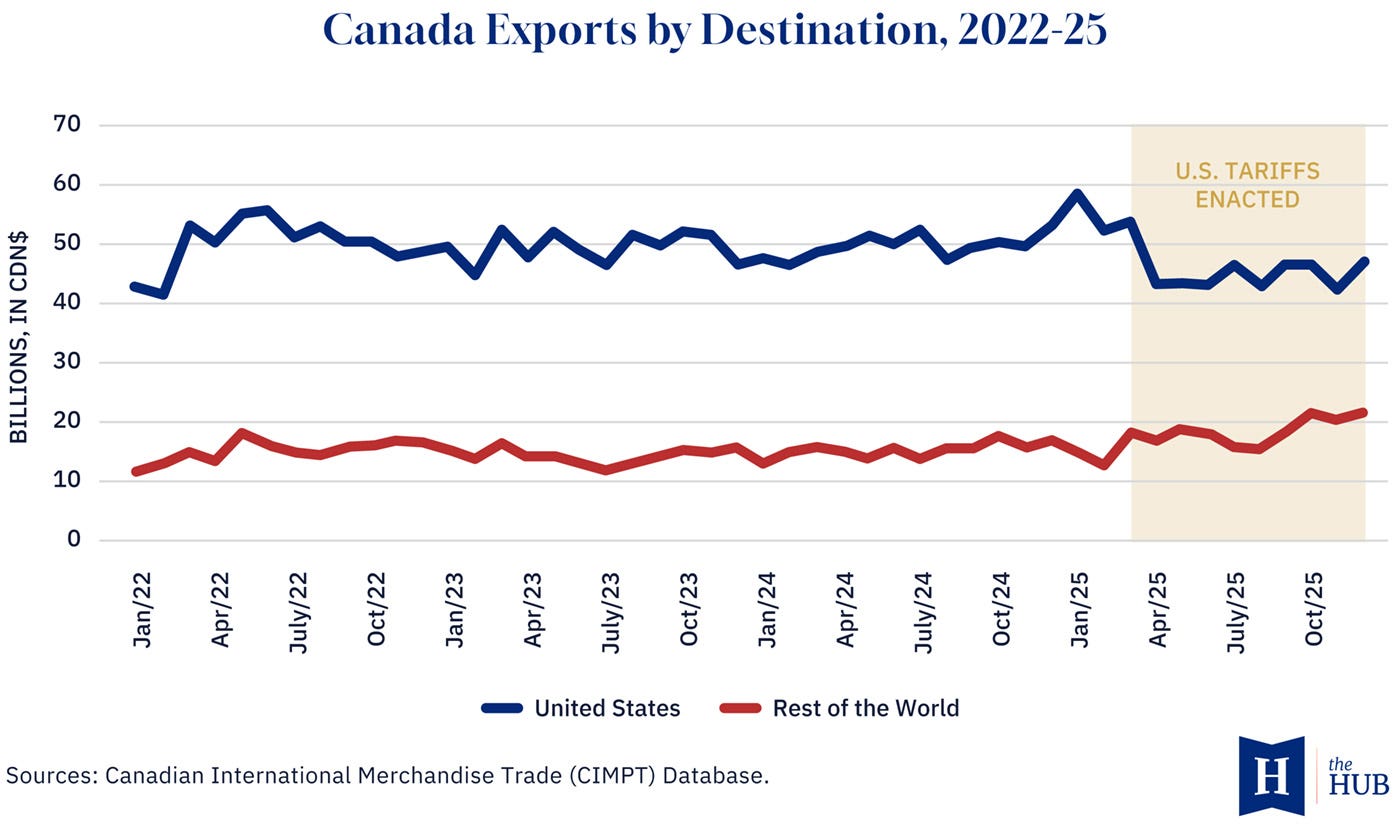
Canada’s total exports were flat at $780 billion in 2025. Underneath that headline was a major shift. Exports to the U.S. fell by about $30 billion, or 5 percent, to $566 billion, while exports to the rest of the world rose 16 percent from $185 billion to $214 billion.
This is a good example of how trade partners shift their behavior to avoid working with tariffs.
How Did We Get Here?
A reminder of what this administration’s tariff proposal was presented as
Protect U.S. producers
Bring manufacturing home
Generate revenue for the U.S. Treasury
Protect the U.S. consumer from being taken advantage of
Even taking that at face value, and assuming good intentions all around, economists were clear that this policy would not work. Canada is proof.
The Economics
Tariffs don’t just tax goods; they change behavior. A decade ago, 80% of Canada’s exports went to the U.S. Since Trump took office, Canada has spent that time finding other buyers. They have built relationships with other countries to reduce reliance on the U.S. Today, the U.S accounts for 60% of Canada’s exports. This is a great example of trade diversion. When trade becomes more expensive and the relationship less reliable, your partners don’t eat the costs; they find new customers that treat them better.
So what does this mean for the promises?
Tariff revenue, if collected, will be lower than anticipated because the economic base has shrunk
Customers lose because American consumers lose access to Canadian goods they used to value, and if they get access to them, they have to pay more.
Reshoring is a long-term capital investment. Companies don’t build plants based on 4-5 year forecasts; they need to forecast 20-50 years out. This administration’s trade policy doesn’t clearly indicate that its position will be a long-term U.S. policy.
U.S. producers aren’t really winning because the current trade policy doesn’t account for retaliatory tariffs that make it harder for U.S. producers to reach international markets.
Economists modeled this from the start. Tariff wars don’t produce winners; they produce redirected trade, foregone revenue, and a permanent break in relationships that had previously made us all better off.
From Marketplace
