


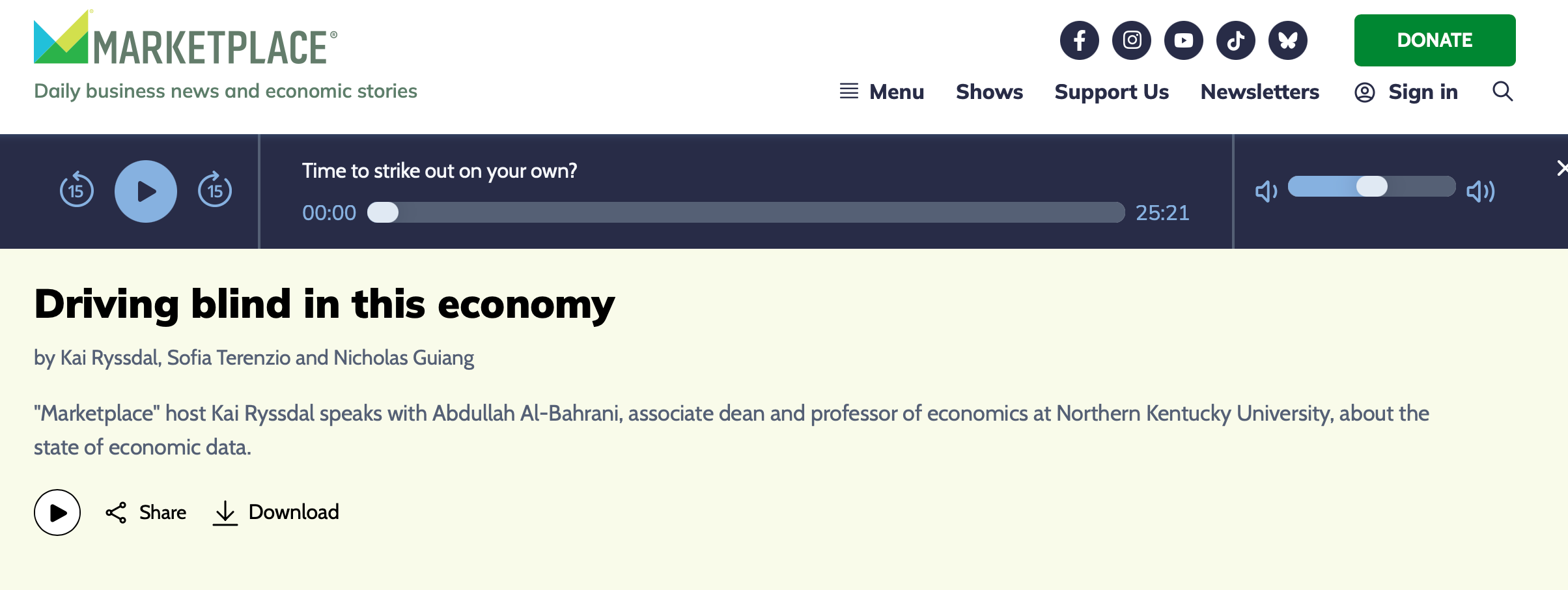
Before Decode Econ and before I ever thought about building my own daily economics newsletter, I used to recommend that my students listen to Marketplace. I still do. It remains one of the best examples of how economics can be explained clearly, responsibly, and with respect for the audience.
But now, I also recommend that they follow my writing.
Economics and business students must remain informed about the economy in which they live, about policy, markets, and how rapidly things change. That was true when I was a student, and it is even more true today.
When I was a young assistant professor, I remember listening to Marketplace in awe.
I was struck by the economists they invited on the show, not just by what they knew, but by how well they communicated and by the trust the public placed in them. They made economics feel accessible and important at the same time.
Last night, as I listened to Marketplace, I felt something different. Pride, not the loud kind, but the quiet kind. Pride in the work I have done and in the trust I have earned from readers and listeners like you. As Dr. Jeni Al Bahrani and I listened, I caught her smiling when she heard my voice on the radio. That moment stayed with me.
I am grateful for the opportunity to share what I know, for the trust you place in me, and for the responsibility that comes with being visible. I am proud that Northern Kentucky University and the Haile College of Business are mentioned on national radio.
Somewhere right now, there is a young economist just starting their journey. Being a role model for them matters to me more than any byline ever could.
The younger version of me would never believe this story if I told it to him.
My parents still collect every media appearance, so below is the clip from yesterday’s episode, along with a link to the full show. After that, I dig deeper into the topic we discussed: data trust and the deterioration of confidence in the reports we receive.
Thank you for being part of this journey.
What We Talked About on Marketplace: Data Trust
The conversation centered on a simple but uncomfortable question: once all the economic data finally arrives, will it give us clarity about where the economy is headed?
My answer was no, at least not in the way people hope.
Right now, the problem is not a single bad data release. We are operating in an environment filled with noise. Pandemic disruptions, delayed government releases, growing reliance on private data sources, and political rhetoric have eroded confidence in economic data. Even when the numbers are produced by capable, trustworthy economists, uncertainty about who is included, what is missing, and how delayed the data are makes interpretation more difficult.
This is not about data being manipulated. It is about trust and confidence.
When trust erodes, data becomes less effective. Policymakers hesitate. Economists struggle to communicate clearly. The public feels confused and frustrated. During the government shutdown, I felt this personally. Without timely data, doing my job became harder, and understanding the economy became murkier.
The solution is not to give up on data. It is to recommit to it.
Trust is rebuilt through transparency, repetition, and communication. No single data point will give us an epiphany. But taken together, multiple signals can still guide better decisions. Data works best when we treat it as a system.
We may not get a moment of perfect clarity. But with investment, openness, and trust, we can still make sense of the economy we live in.
We need data, and we need to rebuild trust in data.
Transcript
Marketplace episode aired on December 15th, 2025
Kai Ryssdal: This is Marketplace. I’m Kai Ryssdal. There I was, early this morning, barely halfway through my first cup of coffee, listening as I do to the Marketplace Morning Report, when I heard Sabri Ben-Achour ask this question.
Sabri Ben-Achour (clip): Once we get all this data, is that going to be some great moment of clarity, or or is the the big picture still going to be kind of murky?
Kai Ryssdal: Imitation being the sincerest form of flattery, I am going to rip that question right off and pose it to Abdullah Al-Bahrani. He’s a professor of economics at Northern Kentucky University. Welcome back to the program.
Abdullah Al-Bahrani: My pleasure.
Kai Ryssdal: So, same question to you that Sabri asked Julia this morning. We’re going to get all this data. Are we going to have some kind of epiphany and go, “Oh, yeah, okay, now we know where the economy is going.”?
Abdullah Al-Bahrani: probably not. I don’t think that’s going to happen. we’ve got a lot of noise in the air these days.
Kai Ryssdal: Well, say more about that.
Abdullah Al-Bahrani: Well, we because of the gap in the data and because we’ve started to rely a little bit more on the private data and there’s a little bit of mistrust about data today. I don’t think we’re going to get as much clarity and confidence, more importantly, with the numbers that are provided to us. Lags, what is—who actually is in the data. These are all questions that are creeping up in our analysis these days.
Kai Ryssdal: I’m sure you were on this when it happened during the pandemic, but one of the things that happened was we didn’t know exactly what the economy was doing ‘cause the data was completely ctywampus, right? And now we just haven’t had data or it’s coming out late. And it seems to me this might be sort of the new normal-ish that the economy is kind of “meh” and and we can’t figure out what’s going on. What do you think?
Abdullah Al-Bahrani: I think we are going through a structural change and part of it is really developed because of the mistrust that has been introduced in government data. And it’s going to take us a while to either regain the trust or we’re going to start to find alternative ways to build confidence in the data that we see.
Kai Ryssdal: We should say here just to be clear that no matter what the president says and no matter who he fires at the Bureau of Labor Statistics, there is zero indication, zero, that the data is being politically manipulated. That said, to your point, how do we regain the trust?
Abdullah Al-Bahrani: Well, first of all, I want to say I have a lot of friends—economists working on this and they are trustworthy individuals and they take their responsibility seriously. unfortunately, it’s not them in this situation. It’s the system, the the lack of information that has been presented, the shutdown has allowed this narrative that to develop that we cannot trust the data that’s coming to us. So, whether they’re doing a fantastic job or not, which they are, the people processing this information are not feeling as confident about it. And that reduces how effective we can communicate what the data is telling us and what we do with it after that.
Kai Ryssdal: Right, right. No matter what the president tries to do to politicize it. Let me ask you this though. The first time—I think it was the first time, maybe it was the second time we had you on—we talked about your Econ 101 classes and economic literacy and and you know, how this is your life’s work. How do we get things back on track where we know what the economy is doing um and that people can have confidence that we know what the economy is doing? ‘Cause we’re kind of in a different place right now.
Abdullah Al-Bahrani: Yeah, and and this is something I’m personally struggling with. I mean when the data went absent during the shutdown, I found it really difficult to do my job um and I found myself having a really difficult time processing what’s happening in the economy. And we need the government and, you know, the the president to build the the trust in the data again.
Kai Ryssdal: Do you think we can do it?
Abdullah Al-Bahrani: I think we can do it. We just have to be loud about it. We have to continuously communicate. Transparency is really important and the more we invest in it, the more reliable it is and the better our decisions are going to be in the long run.
Kai Ryssdal: Back to where we started and that great moment of clarity that Sabri was talking about, the epiphany of when this data comes we’re finally going to know. I guess we’re just going to have to get used to not knowing.
Abdullah Al-Bahrani: I I don’t know if that’s where I want to go. I think the the approach is—the approach that we should be taking is we need to recognize that every data point is just one data point and the more signals that we have the eventually the easier it is for us to trust the data.
Kai Ryssdal: Abdullah Al-Bahrani at Northern Kentucky University. Professor, thanks for your time sir. I appreciate it.
Abdullah Al-Bahrani: Thank you, Kai. My pleasure.
Abdullah, I rarely listen to NPR anymore as I no longer commute, but I did happen to catch your segment, not realizing it was you. So neat for you and your family for "making it". As a former young (political) economist who left the academy for the business world, I appreciate your work. Keep it going!
There is a huge elephant in this room, and we do our students a disservice if we do not point it out to them. Fundamentally, we cannot be 100% sure in our understanding, and it would be misleading for us to say so. I hear Neal DeGrasse Tyson talk about how "science tells us objective reality", and I think that he ought to learn more about Critical Thinking. One aspect is that there is a crisis in the sciences -- not only is there very significant question about the interpretation of data -- in economics we see ideological or paradigmatic bias which can mislead researchers in interpreting data, but the data itself is subject to subtle bias in the way it is collected, the form in which census questions are worded, the collations that are made or not made, the instruments by which information is collected and the ways it is measured, and on and on. This is before we even touch on deliberate falsehoods, which are uncomfortably present in some economic theory, in research papers on which economists depend in order to obtain tenure and respect in the profession, in the work of "think-tanks", which somehow never publish results that clash with their underlying liberal or conservative bias... We should not talk about this as an incentive for students to believe in nothing -- as Hannah Arendt famously said, this is the end of democracy -- we should point out pitfalls that they should avoid, that the responsible economists you mention are fully aware of and do their best to avoid. It is very interesting to me that at the end of the day, along with thinking critically about the data itself we need to examine the character of the person we are listening to -- not whether what they are saying agrees with our pre-existing bias or not, but are they attentive to the well-being of other people, even people who are not like them? Are they more interested in finding out what is really there, rather than in confirming what they think? Do they take cultural and other context into account? In other words: are they people of honor and integrity, empathy and deep understanding? Such old-fashioned words, which express aspects of character we need to look for, even in those who report our economic data.