


My Notes app has 1,461 entries. That’s where I write down ideas, save random images, and drop links to videos I want to return to. It is not organized.
From time to time, I get overwhelmed by the notes and tags and feel like I should devote more time to creating structure. But random ideas need a place to land. They do not need organization.
There is something exciting about scrolling through old notes on random dates. It reminds me of the range of ideas I come across and the ones I thought were worth holding onto.
I will keep it messy, because I think that is the point. This newsletter and blog will hold the more organized version of my thoughts. Notes are messy by design.
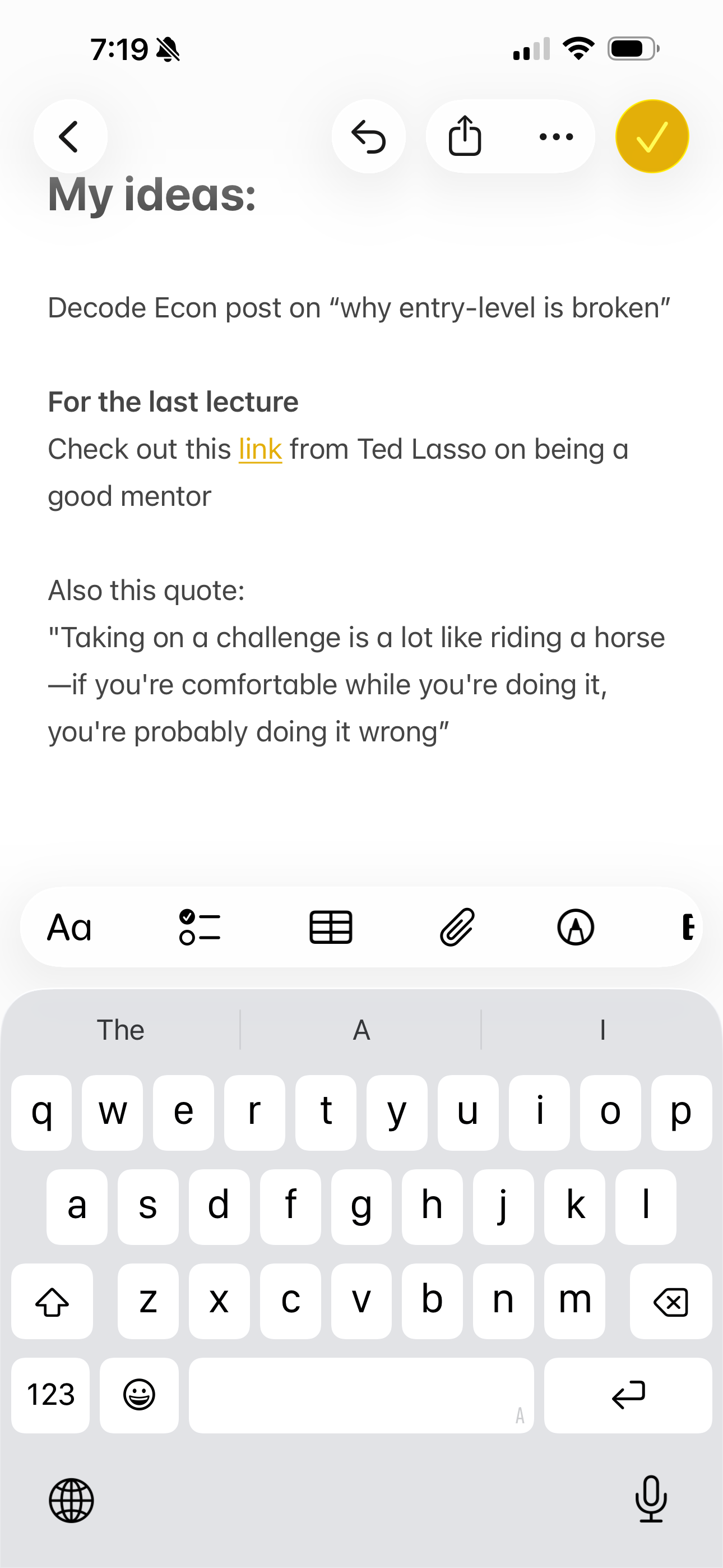
Recently, I came across a note I wanted to flesh out. It was about a book I once thought I might write.
What Book Would You Write?
Three years ago, someone asked me what I would write about if I wrote a book. I jotted down three ideas:
Conversations with Students — based on mentorship discussions and topics related to professional development, growth in college, and the early years of a career.
A textbook built around my method of teaching economics and financial literacy.
Economic policies impacting you.
The first two are still in the running, but I am giving up on the third.
Why I Gave Up
There are two main reasons I gave up on the third book.
First, my friend Hoov (Dr. Gary Hoover) has already written an excellent version of that book, and I highly recommend it. I was happy to serve as a peer reviewer, and it is now in print.
Gary A. “Hoov” Hoover is Executive Director of the Murphy Institute, Professor of Economics, and Affiliate Professor of Law at Tulane University. He is also just a great guy. His book, Ladder or Lottery: Economic Promises and the Reality of Who Gets Ahead, would make a strong supplement in a macroeconomics course, a special topics course, or even a senior seminar focused on policy implications. If you are studying economics, this is a must-read.
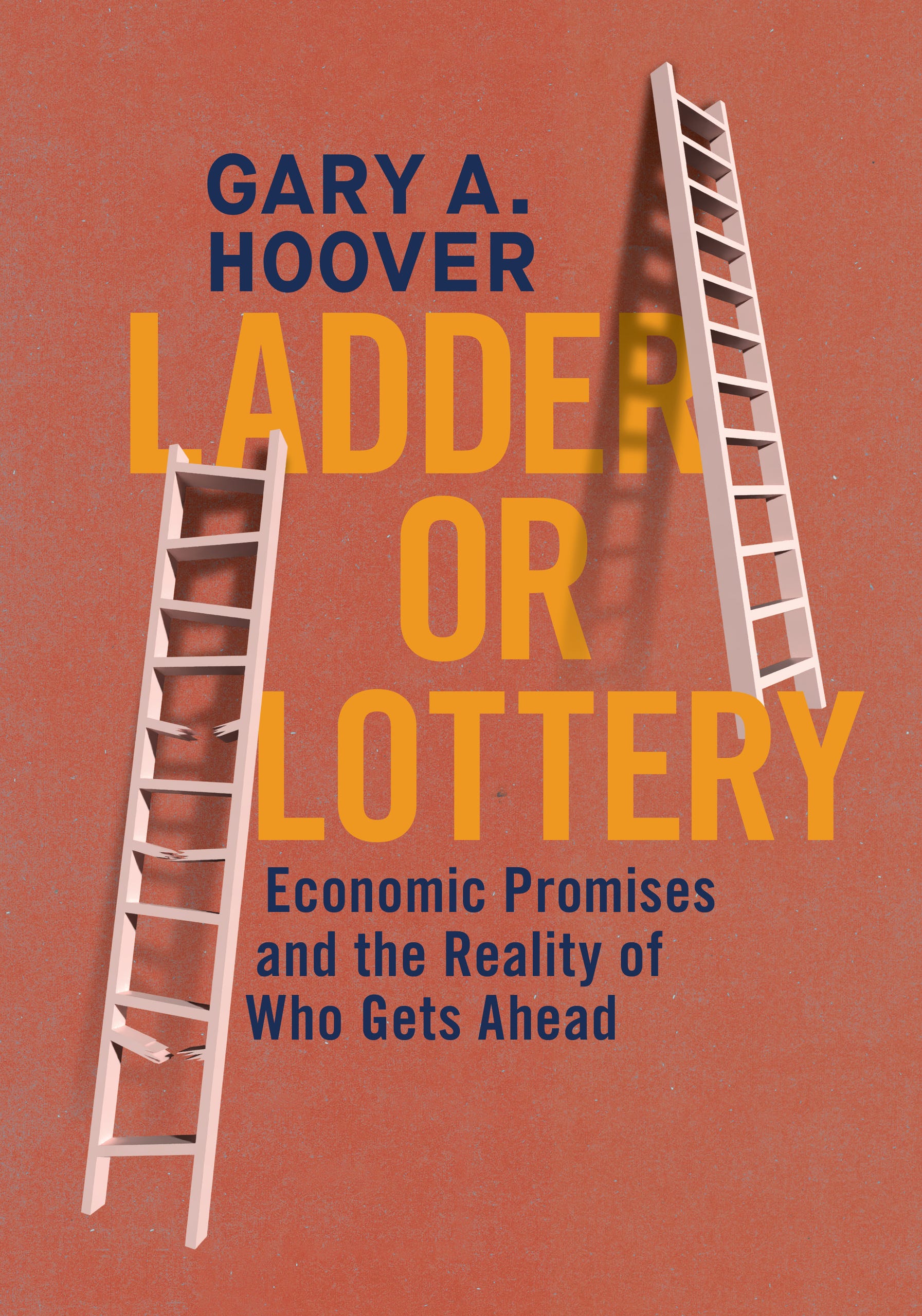
The UC Press blog includes a great discussion with Hoov about why he wrote the book:
“Why did I write this book? Mainly to shed light on a simple question about placement on the social and economic scale, namely were people at lower or higher strata by their own choice or actions?”
“My argument was that there were approximately 45 million individuals at substantially lower rungs of the economic ladder, and that it was statistically inconceivable that so many were suffering from a culture or pathology that kept them from climbing the ladder. I stated that it was hard to fathom that some of those millions did not attempt to use the system as intended but did not get the desired result. If that was the case, then the economic system was not working as intended, and instead of a ladder, the economic system much more resembled a lottery.”
The second reason I gave up on the book is that I heard kyla scanlon on Marketplace a week ago discussing the book she is working on, and it sounds very close to what I had in mind. I can’t wait to read her book.
About My Version

In my Notes app, I have an entry called “Entry Level Is Broken.” The premise is that markets and policymakers have designed systems that make it harder for people to start their economic lives. Our current economic conditions favor those with assets and established careers, often at the expense of young and early-career individuals. But it is not just a market or policy issue. It is also a cultural one, and even a parental one.
The social pressure on young people to display success early forces them to move through the economy already feeling behind. Social media, as discussed in The Anxious Generation, has only added to that pressure and brought its own consequences for well-being. Jonathan Haidt also writes about the overprotection of children in the real world. Now AI is reshaping how we think about entry-level work and what we expect from workers at the very beginning of their careers.
At the same time, I think the demand for true entry-level experiences has disappeared. Using Hoov’s ladder analogy, I am not sure whether the first rung is broken or whether we are all being pressured to skip it. Either way, something foundational to economic development and personal growth no longer seems to be part of the process.
So I have scratched “Entry Level Is Broken” from my list of books I might write one day. Hoov’s book, and I am sure Kyla’s book when it is finished, will stand as reminders of the book I once thought I might write.
What’s Your Book?
What book would you write?
If you have never worked through that exercise, I highly recommend taking the time to think about the book you would write.
Hoover's book makes me think of Schwarz's book "Climbing the Ladder or Falling Off- Essays on Economic Mobility in Europe." I'll spend some money later getting your friends!
I like to read Steve Berry, who incorporates historical fact into his works of fiction. I spent as much time reading about the object "The Gigas Codex (Devil's Bible)" as I did his own work.
Taking some financial failure/shenanigan and extrapolating fictional paradox, yet bounded by the real world? Some unknown Maddox investment grew and funds political upheaval or is the basis for untold wealth/acquisition? The hard part is ensuring it remains grounded in verifiable methods since the best stories tend to be linked to common experience/knowledge.
My book would likely be a cliometrics book. Applying quantitative modelling to history. I think like the scifi series foundation by asimov we can gain a lot of insight into hunan common cycles like ibn khaldun observed