


For years, I’ve given job seekers the same advice: Write a strong cover letter. Tailor it to the job. Show you care. I would tell my students that the cover letter is how you stand out. A strong cover letter signals effort.
I wasn’t alone; career advancement offices preach it. Professors reinforce it. Recruiters confirmed. And for a long time, that advice was right.
But new evidence suggests we are wrong: cover letters don’t work the way they used to. Not because effort stopped mattering, but because AI changed what effort looks like.
Today’s post is about cover letters, signaling, and research that helps us navigate the job search process more effectively.
Why Cover Letters Ever Mattered
Economists have a word for what cover letters used to do: signaling.
A signal is something observable that reveals information about something you can’t directly see. Employers can’t fully observe your productivity, motivation, or fit. So they look for clues.
A tailored cover letter worked because it was costly. It sent a signal to the employer about the applicant's quality. Only serious applicants did it well. That made tailoring a well-crafted cover letter a strong signal to employers.
In economic terms, effort separated high-type applicants from low-type ones.
Then AI Blew Up the Cost of the Signal
Generative AI flipped this logic almost overnight.
With one click, anyone can now produce a polished, job-specific cover letter. The cost of tailoring collapsed, and with it, the signal was lost. It became harder for employers to be able to use cover letters as a signal of employee quality.
We now have real labor-market evidence that AI changed the value of cover letters as a signaling tool.
A new working paper by Jingyi Cui, Gabriel Dias, and Justin Ye analyzes over 5 million cover letters submitted for 100,000 jobs on Freelancer.com and confirms that the power of a cover letter has changed.
Here’s what they found:
AI dramatically increased how closely cover letters matched job postings
Applicants who used AI were much more likely to get a callback—at first
But as AI use spread, the power of cover letters as a signal collapsed
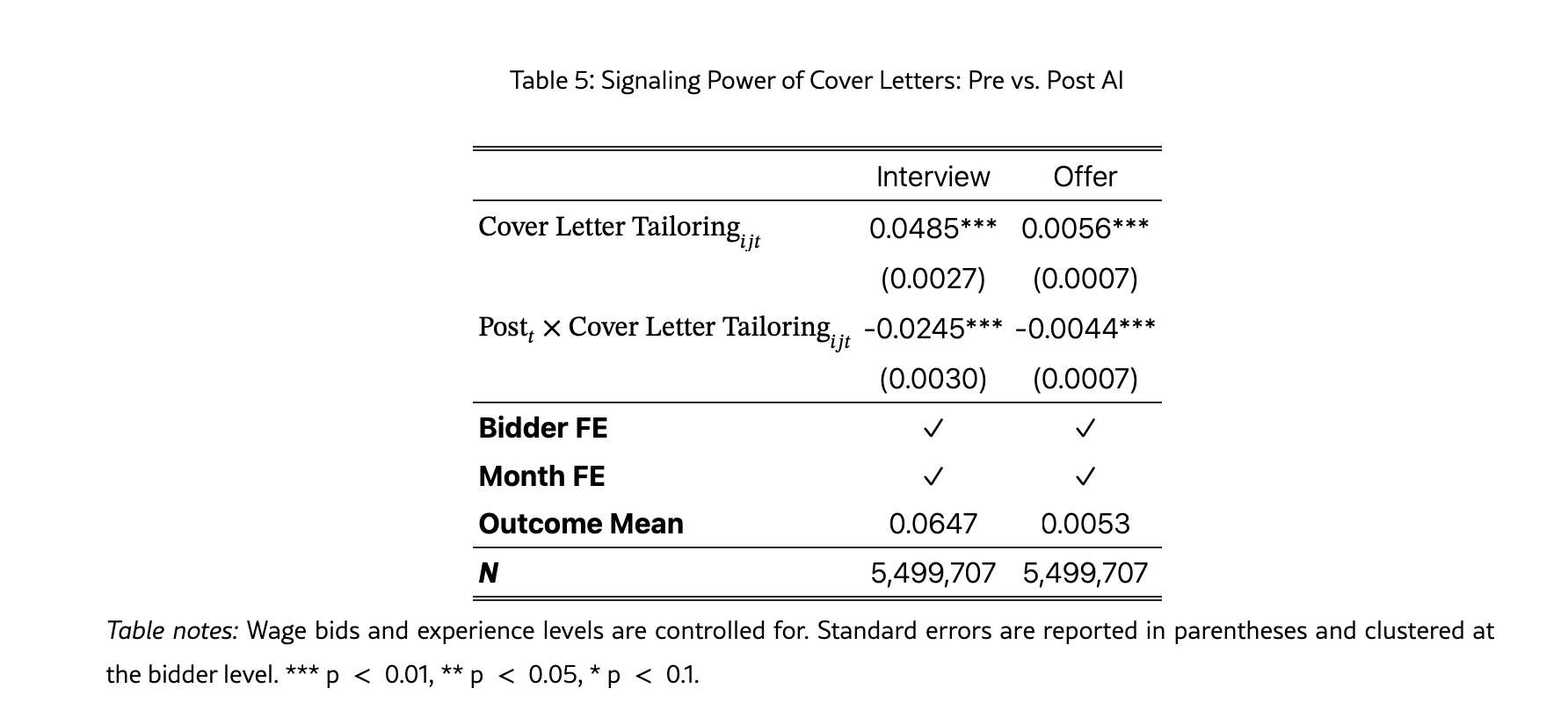
The correlation between a tailored cover letter and getting a callback fell by over 50%. For job offers, it fell by nearly 80%.
In plain English: When everyone can signal, the signal stops working.
How Employers Responded
Employers learned to adjust their behavior to this change. As job seekers, you might want to know what they now look for as signals.
As cover letters became less informative, firms shifted toward signals that AI can’t easily fake:
Past work history
Platform ratings
Prior experience
Networks and portfolios
It advantages workers with established track records and makes it harder for newcomers, exactly the people cover letters were supposed to help. This is why I advise my students to develop a portfolio, or to build in public. The market is looking for signals of productivity and evidence of success.
My advice is that the reliance on networks is even more critical today. Find 5-10 people to connect with. Build relationships, attend networking events.
The Bottom Line
Cover letters stopped mattering because they lost their signal. AI made it harder to observe the applicants’ effort.
My advice today is not to submit a cover letter unless the job requires one.
This is the real lesson of AI in the labor market—not that humans are obsolete, but that old signals break when technology changes their cost.
And if you’re an employer or educator, it’s time to ask a harder question:
What signals still tell us who’s actually ready to do the work?
About the Study
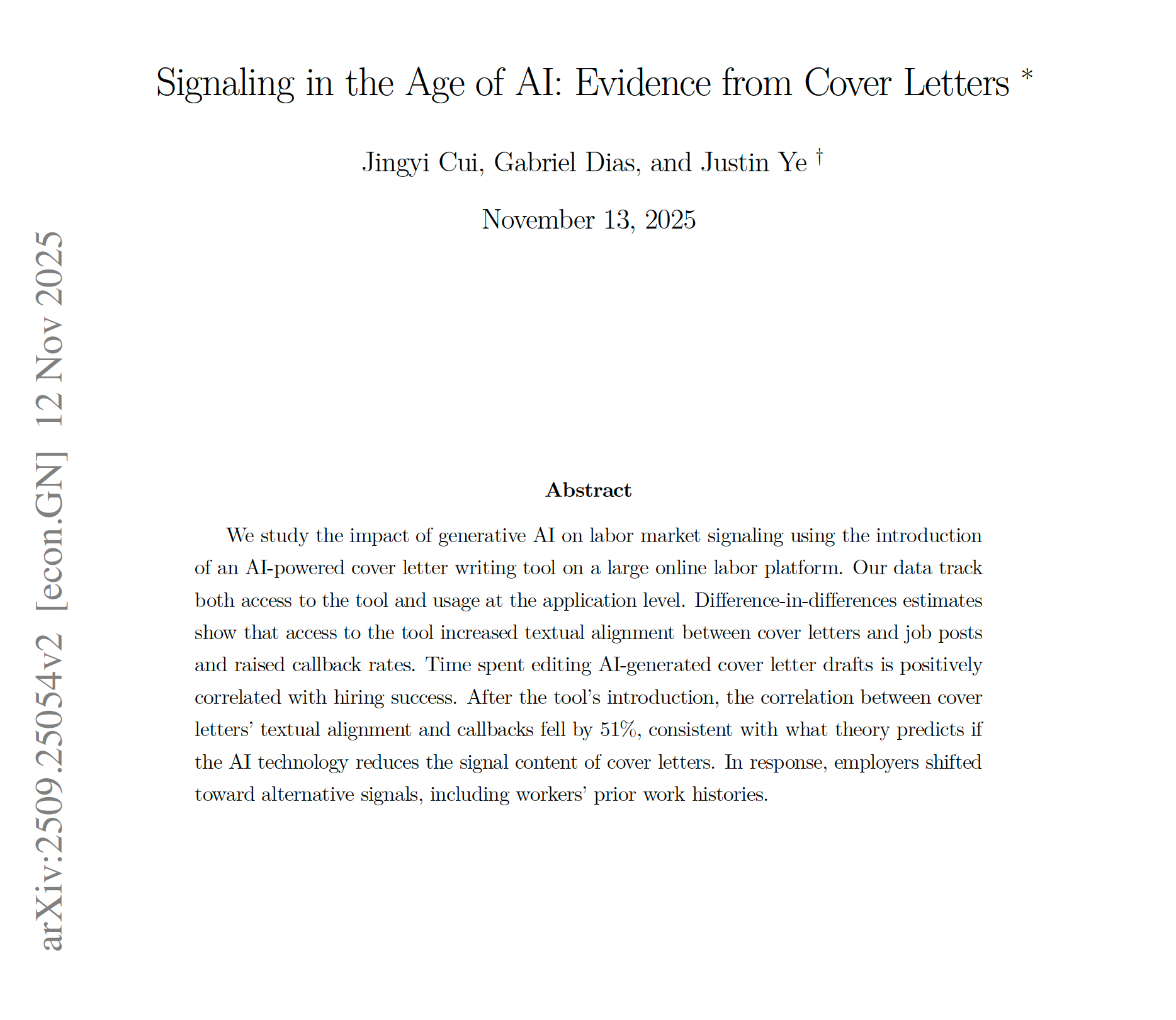
Title: Signaling in the Age of AI: Evidence from Cover Letters
Abstract: We study the impact of generative AI on labor market signaling using the introduction of an AI-powered cover letter writing tool on a large online labor platform. Our data track both access to the tool and usage at the application level. Difference-in-differences estimates show that access to the tool increased textual alignment between cover letters and job posts and raised callback rates. Time spent editing AI-generated cover letter drafts is positively correlated with hiring success. After the tool’s introduction, the correlation between cover letters’ textual alignment and callbacks fell by 51%, consistent with what theory predicts if the AI technology reduces the signal content of cover letters. In response, employers shifted toward alternative signals, including workers’ prior work histories.
Research Question
How does generative AI affect labor market signaling when applicants use AI to write cover letters—and how do employers respond when those signals become easier to manipulate?
Data and Setting
Context: Freelancer.com, a large global online labor market
Intervention: Introduction of an AI-powered cover letter tool (“AI Bid Writer”) on April 19, 2023
Data: ~5 million job applications across PHP and Internet Marketing jobs
Key advantage: Researchers observe who had access, who used the tool, and application outcomes, while employers cannot observe AI use
Methodology
Difference-in-differences comparing workers with and without access before and after rollout
Textual alignment between cover letters and job posts was measured using TF-IDF cosine similarity
Outcomes: cover letter quality, callbacks, job offers
Additional analysis of human–AI interaction using editing time
Main Findings
1. AI Improves Application Quality and Short-Run Outcomes
Access to AI increased cover-letter tailoring by 0.16 SD
Actual AI use increased tailoring by 1.36 SD
AI use increased callback probability by 3.6 percentage points (≈ 51% increase relative to baseline)
Effects on callbacks fade after ~2 months, even though cover letters remain more tailored
2. AI Substitutes for Writing Skill
Workers who previously wrote weaker cover letters benefited the most
Strong writers gained about half as much from AI as weak writers
Result: AI compresses differences in observable application quality across workers
3. Cover Letters Become a Weaker Signal
After AI adoption:
Correlation between cover-letter tailoring and callbacks fell by 51%
Correlation with job offers fell by 79%
Employers increasingly discount cover letters because high quality is no longer as informative
4. Employers Shift to Harder-to-Fake Signals
Employers place more weight on past work history and platform reputation
Correlation between callbacks and prior reviews increases
This shift may disadvantage new entrants who lack work history but previously relied on strong cover letters
5. Human–AI Collaboration Still Matters
Most AI-generated cover letters are submitted with little or no editing
Higher-skill workers spend more time editing AI drafts
More editing is strongly associated with higher offer rates
A 1 SD increase in editing time lead to ~52% increase in offer probability among AI users
Core Contribution
The paper shows that generative AI weakens traditional labor market signals. While AI helps individual applicants—especially weaker writers—it reduces the informational value of cover letters, prompting employers to shift toward alternative signals. This creates distributional consequences, benefiting experienced workers and potentially raising barriers for newcomers.
I noticed the shift to portfolios. I myself am developing one. Cover letters use to be a way employers got to know the candidates before they were hired on now there are likely better methods. The issue is often times workers shift for the employers and many employers dont know what they want. This is how we got skill creep. The role im about to leave asked for a lot of technical stuff when all they needed was an accountant. Im not saying it's only the fault of employers. They just have more market power than the professional labor
Firstly, wonderful piece! Secondly, thank you for your new timely advice...building real networks with real academics by applying for mentorship programs and actively participating in societies is what is keeping my spirits up and inspiring me to really start thinking of building a virtual public signal for myself (think, personal academic economists webpages where they manage their personal identities as researchers - which, I personally think is still very much a strong signal). I'm currently working at an NGO, and I thought that my personality would be better suited for directly influencing policy...but, despite being very appreciative of having employment during a difficult economic time, I don't get to apply my love for economics in my job...so, networking through mentorships and societies is keeping me alive right now and showing me that I'm an academic at heart. Third...thanks for the 'about the study' section...you've just provided me with a great blueprint on how to summarise my literature!