


`
The biggest economic story last week came from the Supreme Court.
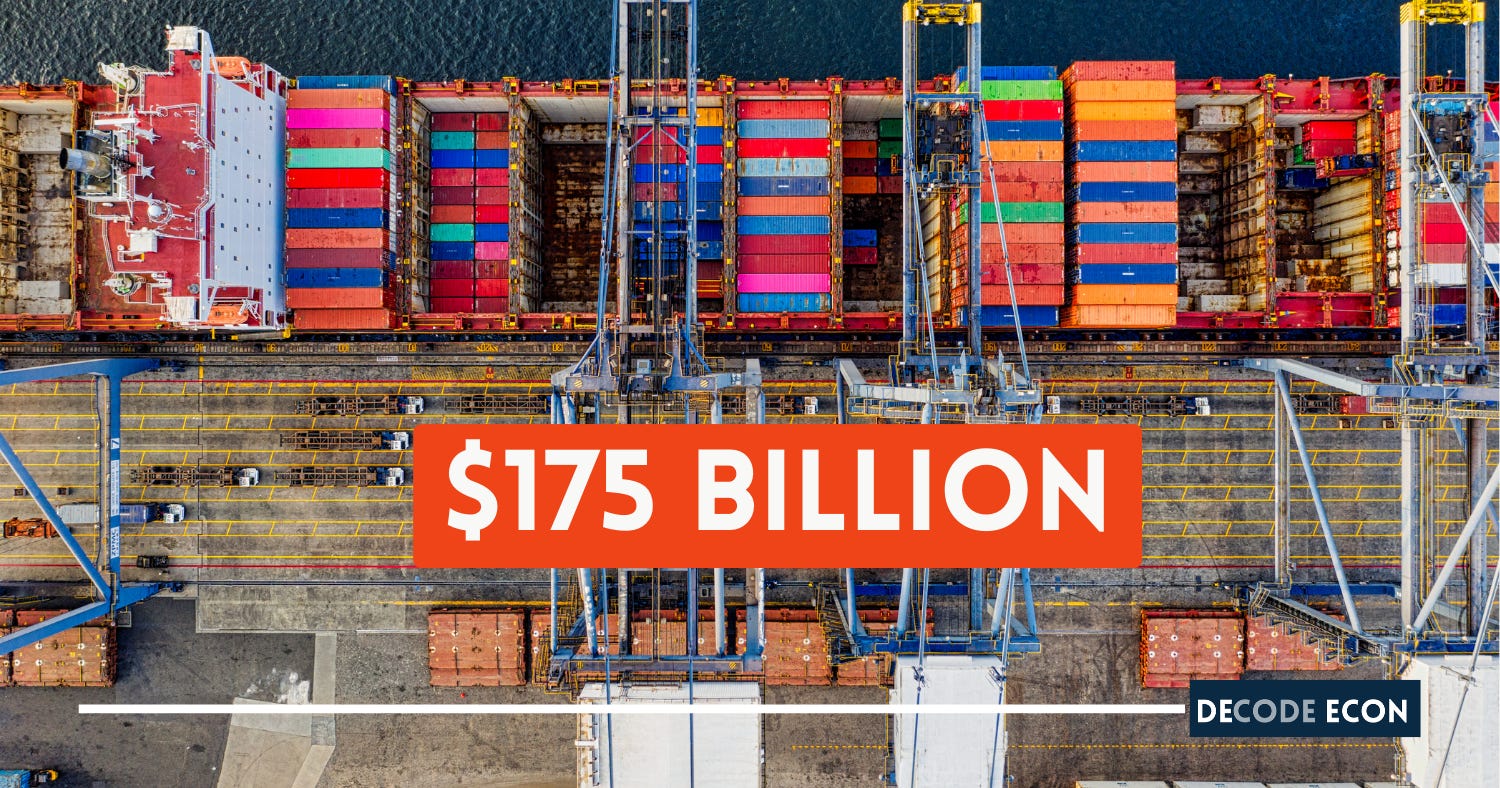
The Court’s ruling that Trump-era tariffs were unconstitutional immediately reshaped the economic conversation. Estimates suggest the U.S. collected roughly $175 billion in tariff revenue. Regardless of the original intent, raising revenue, discouraging imports, or strengthening negotiating leverage, the decision means those funds must now be returned to those who paid them.
That raises an uncomfortable economic question: who actually paid the taxes?
Statutory vs Economic Incidence of Taxes
In economics, we distinguish between statutory incidence and economic incidence, and that distinction is central to understanding the tariff refund debate.
Statutory incidence refers to the party legally responsible for paying the government. In the case of tariffs, U.S. importing firms wrote the checks to the Treasury.
Economic incidence asks a different question: after prices adjust, who actually bears the burden?
Research from Federal Reserve economists suggests that as much as 90 percent of the tariff cost was passed on to consumers through higher prices. If that estimate is correct, then roughly $157 billion of the $175 billion collected was effectively paid by households at the register, not by the firms that remitted the tax. Firms faced the statutory incidence. Consumers faced the economic incidence.
This distinction matters because refunding statutory payers is straightforward; refunding economic payers is not. We can identify the firms that paid the tariffs. We cannot easily identify which consumers faced higher prices or determine how much each person absorbed. That gap between legal payment and economic burden is what makes the refund question far more complicated than it first appears.
Wealth Transfer from Consumers to Corporations
If refunds go to firms while consumers absorbed much of the pain, the redistribution effects become economically and politically complicated. This will serve as a redistribution from consumers to corporations. It also raises a practical question markets will watch closely: will firms lower prices when refunds arrive, or will higher prices simply become the new baseline?
The End of Tariffs?
The Supreme Court's ruling does not signal the end of tariffs as policy. The administration has already indicated it may use Section 122 of the 1974 Trade Act to impose a 10 percent tariff. That number has since increased to 15% globally. The administration's reaction suggests that trade policy uncertainty is far from over. For businesses, that means continued uncertainty around supply chains and pricing. For consumers, it introduces the possibility that trade-related inflation pressures could return even as headline inflation cools.
Tariffs are the administration's main economic policy initiative; they will not concede.
The Bottom Line
The broader economic lesson is that policy uncertainty itself acts like a tax. When firms are unsure what trade rules will look like next quarter, they hesitate to invest. When consumers anticipate price volatility, they delay large purchases. When markets perceive instability, risk premiums increase. Even in the absence of new tariffs, uncertainty alone can slow growth. The Supreme Court may have ended one chapter of tariff policy, but it has not ended the economic consequences.
The Podcast
Did you know that Decode Econ has a podcast? You can listen in and shape the discussion by sending us your questions.
Spotify
Apple
Or here on Substack (With Video)
Help Shape the Podcast
Jonathan Marx and I want to know your questions about the economy so we can discuss them during our podcast this week.
We just started our lessons on taxes in principles, and we'll get to tariffs soon. This was the first time that I've seen students really perk up when a new topic was introduced.
The question I have had on my mind... was this intentional? Secretary of Commerce, Howard Lutnick, is the brain behind the tariff operations. I remember reading a Wired article months ago about the investment firm he used to chair, and now his two sons run it, Canton-Fitzgerald. The firm allowed bets on the tariffs being struck down in court and purchased the tariff refunds from the treasury. So the sons stand to make an ungodly amount of money from this.
https://finance.yahoo.com/news/trump-secretary-silent-sons-poised-213852683.html
https://www.wired.com/story/cantor-fitzgerald-trump-tariff-refunds/