



Markets are beautiful, but they are unforgiving. Industries are continuously transforming. New technologies and innovations disrupt industries and may make some industries obsolete. Consumer preferences are unpredictable and shift with new fads. Business leaders and professionals are expected to react, but most lack the skills to do so.
Success in this economy does not belong to the strongest organizations; it belongs to those that adjust the fastest. Future leaders must become comfortable operating inside this reality. Change is no longer episodic; it is continuous, and you never know where it is coming from.
To survive, and more importantly, to thrive, professionals and organizations need two distinct capabilities: resilience and adaptability.
Resilience is the ability to absorb disruption, recover, and continue moving forward when conditions deteriorate.
Adaptability goes one step further. It is the ability to adjust strategy, behavior, and thinking early enough that recovery may not even be necessary.
If resilience helps you endure the shock, adaptability helps you move before the ground shifts beneath you. Think of resilience as reactive, and adaptability as proactive.
Few companies illustrate this distinction more clearly than Kodak.

When Market Leaders Stop Adapting
Founded in 1888 by George Eastman, Kodak defined the photography business. They were founders and staples.
From the Brownie camera to Kodachrome film, Kodak transformed photography into a mass-market experience. By the 1970s, the company controlled more than 80 percent of U.S. film sales. Its vertically integrated business model, powerful brand, and relentless innovation made it one of the most dominant firms of the twentieth century.
In fact, photography became so synonymous with the company that capturing meaningful life events came to be known simply as “Kodak moments.”
But dominance can create its own form of blindness.
Kodak- The first digital camera!
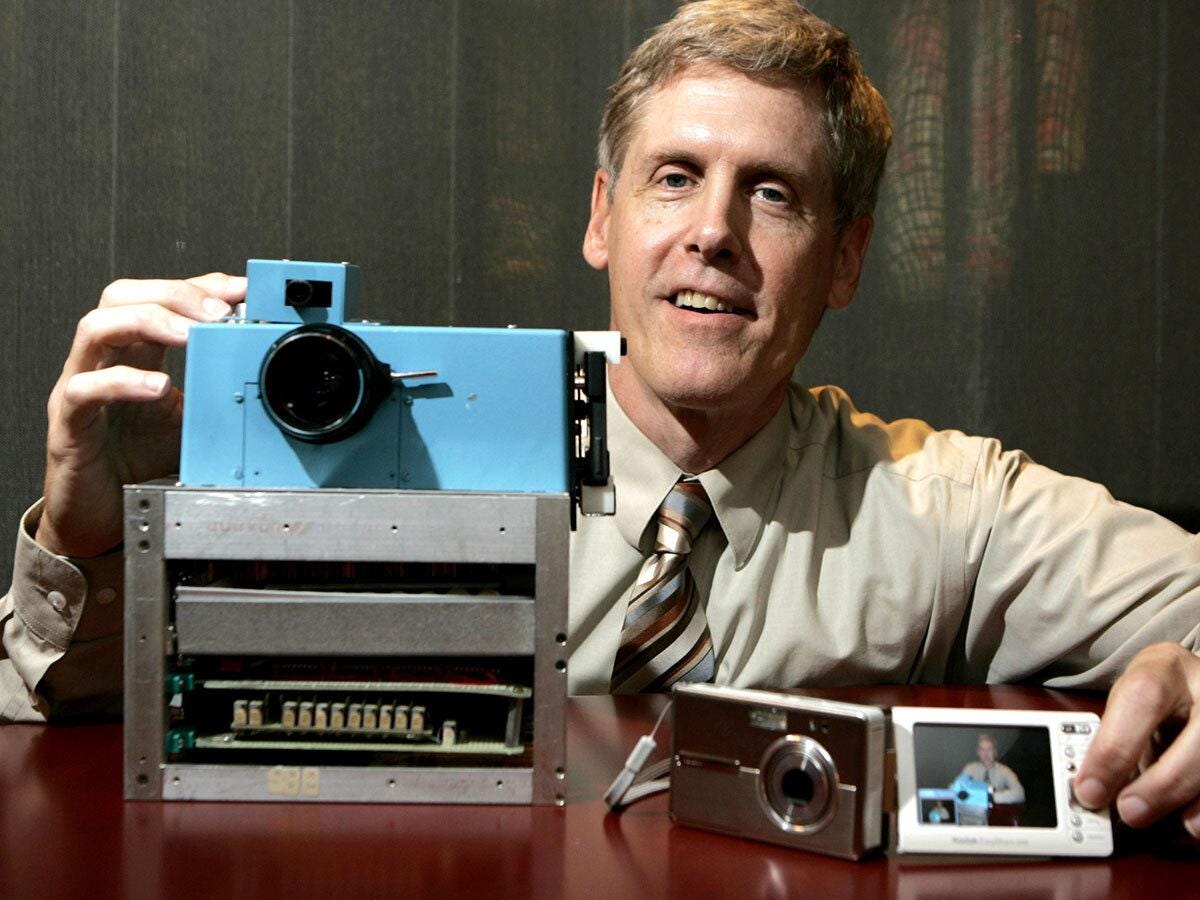
Ironically, Kodak invented the first digital camera in 1975. Engineer Steven Sasson built a prototype that signaled exactly where the future was heading.
Yet the company hesitated.
Why?
Because digital photography threatened Kodak’s most profitable business: film.
This is a classic economic problem. When existing revenue streams are large, organizations often protect them, even when doing so endangers their future. Economists sometimes describe this as a form of organizational inertia, where past success locks firms into outdated strategies.
Kodak was not unaware of digital technology. It was constrained by the incentives created by its own success.
Meanwhile, competitors like Canon, Nikon, and Sony moved aggressively into the digital space, prioritizing long-term positioning over short-term protection.
By the time Kodak attempted a meaningful pivot, the market had already moved on.
The lesson is uncomfortable but clear: Markets punish companies for being slow. Kodak was slow to adapt.
Resilience vs. Adaptability
Kodak was resilient. It had capital, talent, brand recognition, and decades of technical expertise. What it lacked was adaptability.
Resilient organizations can survive temporary shocks. Adaptable organizations reposition before the shock becomes existential. They are willing to adapt to market shifts and respond to economic needs.
In modern economies shaped by rapid technological change, adaptability has become a form of competitive advantage. If you want to succeed in a fast-paced, innovative market, you will need to adapt and have a strategy to react.
Building Adaptability Before You Need It
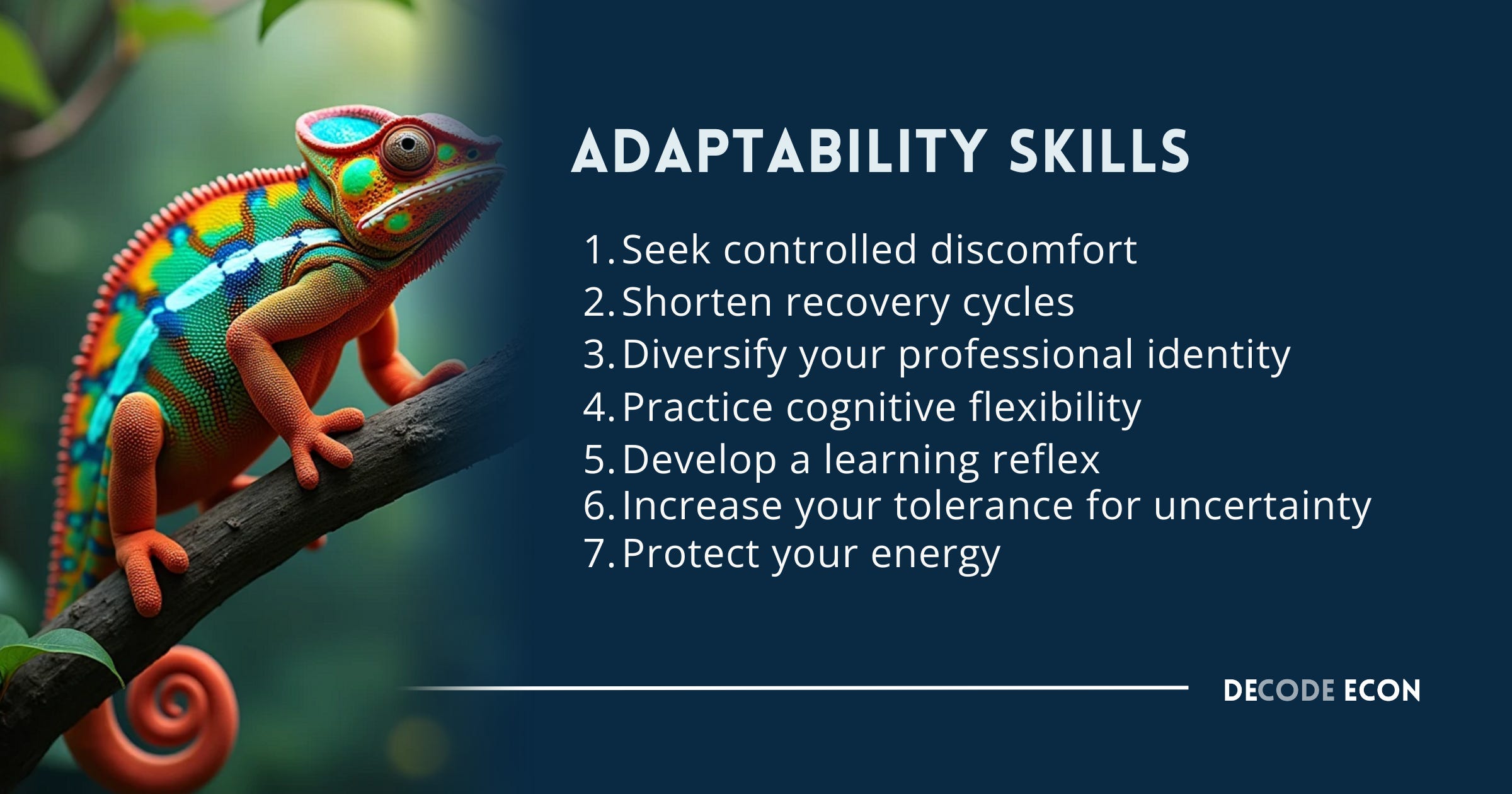
The good news is that adaptability is not an innate trait; it is a developable skill. Great educators teach it, and great leaders work on developing it.
Research on high-performing individuals and organizations points to several consistent behaviors:
Seek controlled discomfort.
Growth rarely occurs in stability. Leaders who intentionally step into unfamiliar territory expand their strategic range and reduce their fragility.Shorten recovery cycles.
Setbacks are inevitable. What separates strong performers is how quickly they convert experience into information and adjust their approach.Diversify your professional identity.
Just as diversified portfolios reduce financial risk, broad skill sets reduce career risk. When your value extends beyond a single role or expertise, change becomes less threatening. I tell my students to focus on problems, not job titles. Job titles change faster than the problems we try to solve. How we solve problems might change, but the problem itself remains; the context might change.Practice cognitive flexibility.
Adaptable thinkers update their beliefs when new evidence emerges. Rigid thinkers defend outdated assumptions, often at great cost. Ask: How can I approach this differently?Develop a learning reflex.
The fastest adapters scan the environment early. They ask a simple yet powerful question: What is changing that others still underestimate? This is why it is so important to be informed about what is happening in the economy.Increase your tolerance for uncertainty.
Meaningful leadership rarely comes with complete information. Waiting for certainty is often the riskiest strategy of all. Be ready to make decisions without all the information and trust yourself. Being in higher education, this is an area I see the industry struggling with. Change is hard to implement because higher education is often afraid to fail. There is a connection between this and the rise of rubric dependency by students and faculty, but that’s a conversation for another day.Protect your energy.
Resilience is not purely psychological; it is physiological. Chronic depletion erodes decision quality and reduces adaptive capacity. Cognitive fatigue will limit your ability to read new information.
A Final Thought
As a professor and Associate Dean for Graduate Programs, I spend a great deal of time thinking about the skills future leaders will need to navigate an economy defined by constant disruption.
One lesson stands above the rest: Markets reward motion.
Comfort, while appealing, is often a quiet signal of stagnation. The organizations and professionals that struggle are rarely lacking in intelligence or capability; more often, they wait too long to adjust.
Many plateaus, whether corporate or personal, are not talent problems. They are adaptation delays. This is why leaders must continuously ask themselves a difficult but necessary question:
Where am I operating from strength — and where might comfort be quietly slowing my next evolution?
In dynamic markets, adaptability is what you need. The willingness to rethink, reposition, and move early, is what keeps you relevant.
Because the future will not belong to those who resist change.
It will belong to those prepared to lead through it.
Take the leap!
Personal Invite
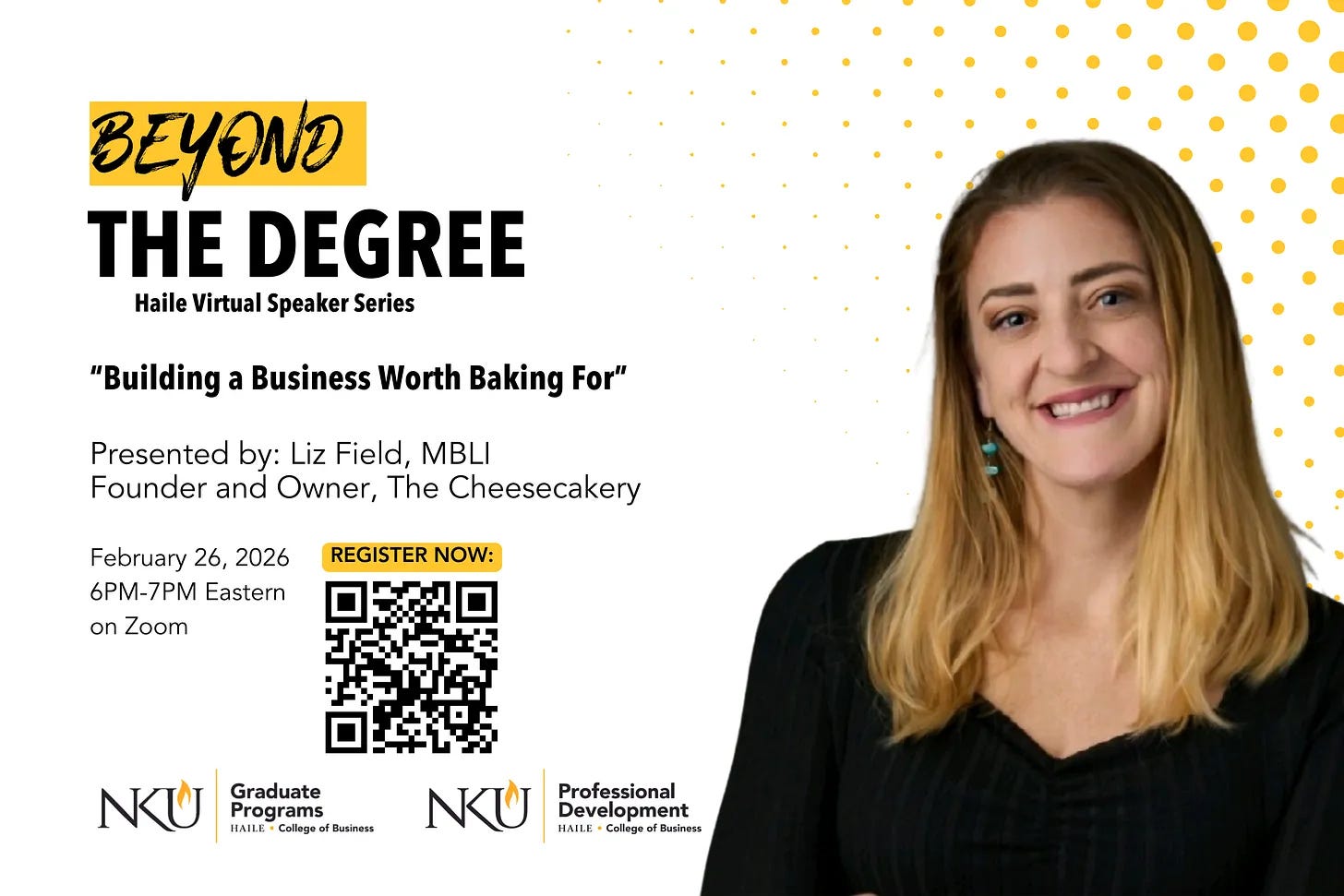
I would like to invite you to this discussion with Haile Graduate Programs, join us and learn more about building a business worth baking for.
This is a live podcast recording. Let’s meet up and learn together. Open to all. Sign up below.
Liz Field (MBLI ‘24) didn’t just dream about entrepreneurship. She built it.
While earning her Master of Business Leadership and Innovation at NKU, Liz was simultaneously growing The Cheesecakery into one of Cincinnati’s most beloved bakeries. Now she’s pulling back the curtain on what it actually takes to turn passion into profit.
Join us on February 26th for our next Beyond the Degree session, where Liz sits down with Dr. Abdullah Al-Barani and Dr. Sandra Spataro for a conversation about building a business in today’s chaos.
Here’s what we’re diving into:
The exact moment she stopped treating The Cheesecakery as a side hustle and went all-in. How she makes tough calls when supply chains explode, costs spike, and the “right answer” isn’t obvious. How graduate-level frameworks hold up when you’re making real decisions with real money on the line.
This is real talk from someone who’s juggling production schedules, team management, and business strategy all at once.
Thursday, February 26, 2026
6:00-7:00 PM Eastern | Virtual on Zoom
Open to everyone: grad students, alumni, aspiring entrepreneurs, anyone hungry to learn and engage. Bring your questions, this will be a live and interactive session and a conversation you don’t want to miss!
This same in-ability to shift towards emerging tech is what killed Border's Books & Music. They suffered from a CEO who hated using email and thought a small company by the name of Amazon would be a good partner to handle online order full-fillment.
That small company not only learned about buying habits but cut better deals with publishers of both books and CDs to handle distribution. (Same lesson that destroyed Suncoast, Wall-to-Wall, Tower, etc.)
Kodak is a sad story since they led the industry in development of product but kept trying to vertically integrate in an effort to prop up stock rather than fund research or production.
Great article but I think number 2 of adaptability is part of the problem. There has been a recovery creep over the years which is contributing to the anxiety people feel in these markets.