



In today’s post, we cover three stories:
The Jobs Report Looks Strong. It Isn’t Simple.
The Arab World Cup
Economics Unpacked- How to Improve Student Reading
New here? Make sure to subscribe and join our community.

The Jobs Report Looks Strong. It Isn't Simple.
The economy added 172,000 jobs in May, and unemployment held at 4.3%, a level strong enough to prompt a sell-off in stocks on the news. The logic: a resilient labor market gives the Fed less reason to cut rates and more reason to focus on inflation, which means rates stay higher for longer. Markets priced that in immediately. But the headline obscures two things worth knowing.
First, 70,000 of those new jobs, nearly half the monthly gain, came from leisure and hospitality, a sector surging ahead of summer travel and the FIFA World Cup, where wages average well below the economy-wide median and women held more than 80% of the new positions.
Second, long-term unemployment, people jobless for 27 weeks or more, jumped by 524,000 workers year-over-year and now stands at 2 million people, or 27.5% of all unemployed Americans. Losing a job today means you will have to wait longer till you find a new one. Be prepared and make sure your emergency savings fund is topped off.
The Economics
Two forces running in opposite directions. The headline job number is a flow statistic; it counts who entered employment this month. Long-term unemployment is a stock statistic; it counts those who have been out of work for half a year or more. Both can rise at the same time, and right now they are.
This is labor market bifurcation: employers are hiring, but the path back in for displaced workers is getting longer, not shorter. Meanwhile, wage growth at 3.4% annually is running below inflation, which means the average worker’s paycheck buys less in real terms even as the top-line numbers look healthy. The stock market and the working household are reading two very different reports.
Decode Econ friend Sean Windle wrote more on his Substack The Personal Economy

The World Cup Is Already Moving the Jobs Numbers
The 2026 FIFA World Cup — which kicks off tomorrow — is the largest in the tournament’s history. The field expanded from 32 to 48 teams, split into 12 groups, with a new Round of 32 added before the traditional knockout stage. That means 104 total matches across 39 days, with the US hosting 78 of them across 11 cities.
The expanded format also produced a historic result for Arab football: eight Arab national teams qualified, including Jordan’s first-ever appearance and Morocco, which reached the semifinals in 2022. That 70,000-job surge in leisure and hospitality from May’s jobs report? This is a significant part of why.
The Economics
Mega-events generate temporary economic activity — a burst of spending concentrated in hospitality, transportation, and retail, followed by a return to baseline. Independent economists have long warned that projections for mega-events routinely outpace reality by 30 to 40 percent. The extra spending is usually spending that would have occurred elsewhere in the economy; it is not necessarily new spending.
Hotel bookings in many host cities are running below expectations, and international tourism to the United States has softened since 2025. Skyrocketing ticket prices and broader economic uncertainty are raising questions about whether the event will deliver the windfall many cities anticipated — and for international travelers, the current immigration environment has become an additional deterrent. The jobs created ahead of and during the tournament are real. Whether they persist past August is a different question.
According to Monday Morning Economist in the post from this week:
But sports economists have heard this refrain before. Drawing on GDP data from every World Cup since 1982, researchers find that hosting produces a marginally positive but statistically insignificant bump in real output. The long-run impact is effectively zero. Heck, twelve of the last fourteen World Cups since 1966 resulted in financial losses for host countries.


The Students Who Got Better at Reading by Doing Puzzles
Economists gave elementary school students in India either math practice or logic puzzles for roughly 20 hours over five months. Both groups improved their reading and language grades by the same amount. The puzzles contained nothing transferable to a language exam, but their grades improved anyway. A separate analysis of international test data found that students from disadvantaged backgrounds fade roughly three times faster during long exams than their wealthier peers, not because they know less at the start, but because they run out of cognitive stamina before the end.
The Economics
This is a human capital story, but one layer deeper than most. Schooling doesn’t just transmit knowledge; it also trains the raw capacity to sustain effortful thinking. Students in lower-income schools spend significantly less time on independent, unassisted cognitive work (roughly 40% less in poor countries and about 10% less in lower-income U.S. households). Less practice means less endurance. The achievement gap that shows up in the second half of a test isn’t a knowledge gap; it’s a stamina gap, and it responds to training the same way a physical muscle does.
Personal Side
I have shared with you that I am seeing a lot of “fading” in higher education. Students start off strong, but cannot maintain their effort throughout the 16-week semester. Persistence and resilience are diminishing. This paper suggests that one reason this might be the case is that our students are not spending enough time on independent, unassisted cognitive work and are therefore unprepared to do so when they arrive in my classes.
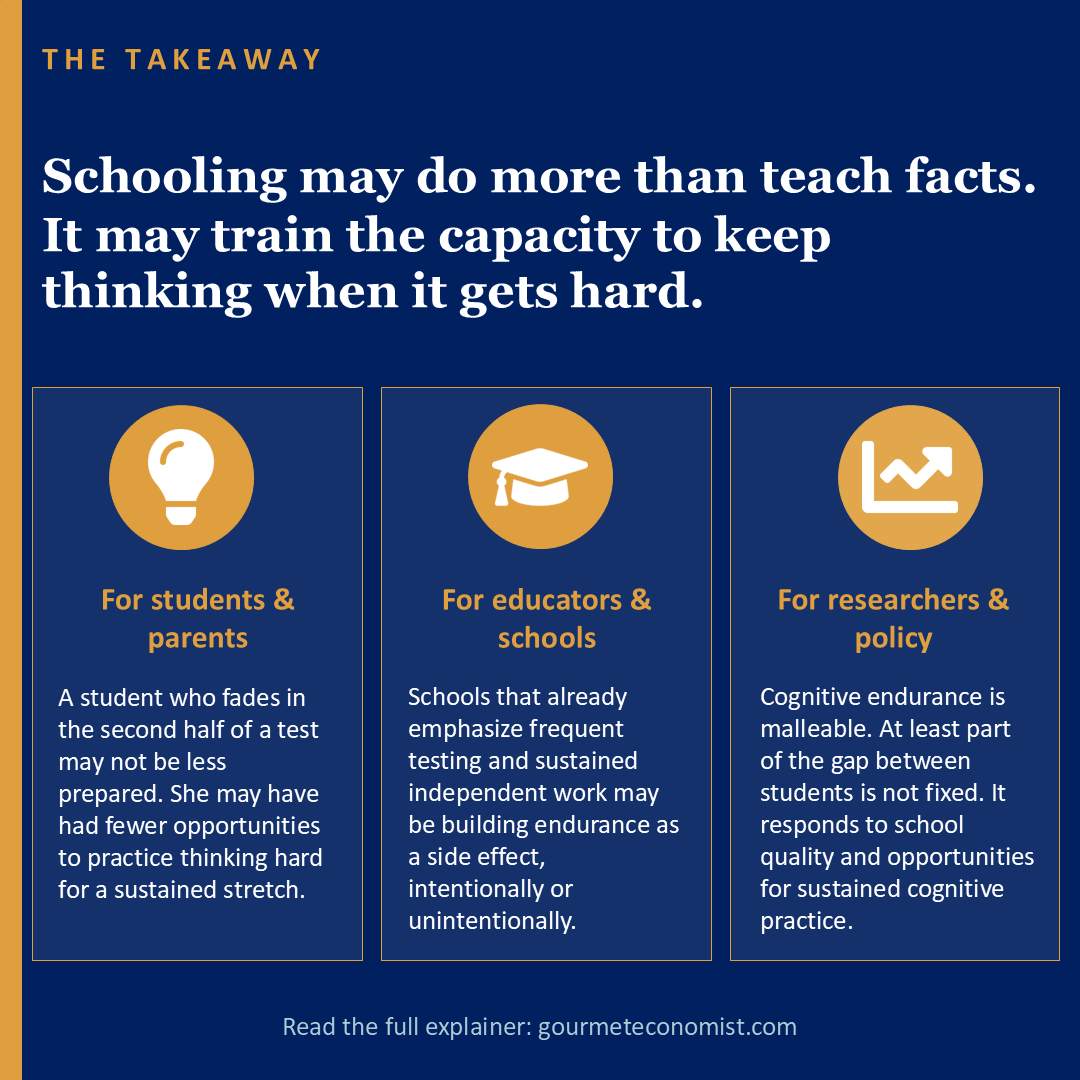
Based on: Christina Brown, Supreet Kaur, Geeta Kingdon, Heather Schofield, Cognitive Endurance as Human Capital, The Quarterly Journal of Economics, Volume 140, Issue 2, May 2025, Pages 943–1002. https://doi.org/10.1093/qje/qjae043
Decode Econ friend, Mallika Pung, covers this in more detail in this ECONOMICS UNPACKED at THE GOURMET ECONOMIST. Check out the image summary too!

Dr. A’s Take
I think we are living through a moment where the headline numbers have become almost useless as a guide to what is actually happening. 172,000 jobs added sounds like a healthy economy, until you see that real wages are still falling and 2 million people have been locked out of work for more than six months.
A 48-team World Cup sounds like an economic windfall, until you remember that twelve of the last fourteen World Cups resulted in financial losses for host countries, and the extra spending is mostly spending that would have happened somewhere else in the economy anyway.
Students improving their reading scores sounds like a school success story, until you realize the improvement came from doing puzzles, which means the real deficit was never about content in the first place.
In all three cases, I believe the conventional read leads people to the wrong conclusion — and the cost of that misread falls hardest on the people least equipped to absorb it: the worker whose paycheck buys less than it did last year, the city that borrowed against a tourism boom that may not materialize, the student who keeps getting told they need to learn more when what they actually need is to practice thinking harder for longer.
What It Means for You
If you are evaluating your own financial position right now, do not let the strong headline numbers talk you out of caution. The job market is bifurcated. Getting in is one thing, but if you lose your footing, getting back takes longer than it used to. Top off your emergency fund, because the gap between jobs lost and jobs found is wider than the unemployment rate suggests. And if you have students in your life who are struggling to persist through hard work, the research says the fix is more independent practice, not more instruction — give them harder problems and step back.
The puzzle story was really interesting and I appreciated the application to the classroom. It's hard to get a sense whether the fading is a lack of routine cognitive work or just burnout from trying to build the perfect college experience from Day 1.
I loved the puzzle story! Thank you for sharing a thought-provoking research with your audience.