



Recently, Nobel Prize-winning economist Claudia Goldin did something unusual for someone of her stature: she went to work for a basketball league. Goldin, who spent her career at Harvard meticulously documenting the gender pay gap, used that research to help WNBA players negotiate a 400% raise.
Critics argued she was injecting “activist economics” into a market that should be left alone. That her intervention distorted wages that were otherwise set by fair, competitive forces. That the market had spoken, and she was overriding it.

Here’s the problem with that argument: it’s built on an Econ 101 model of labor markets that doesn’t describe reality. It describes an idealized version of it, one that assumes you have power you probably don’t have, and information you almost certainly don’t have.
I believe in free markets. But believing in free markets means understanding when they’re working, and when they’re not. Most workers operate within a market that is quietly stacked against them, not because of bad luck or poor negotiating skills, but because of the market's structure itself.
Today I’m breaking down exactly why your labor market requires intervention, what monopsony power and information asymmetry actually mean for your paycheck, and what knowing this changes about how you negotiate. This is the economics your Econ 101 course probably skipped.
What the Free Market Model Assumes
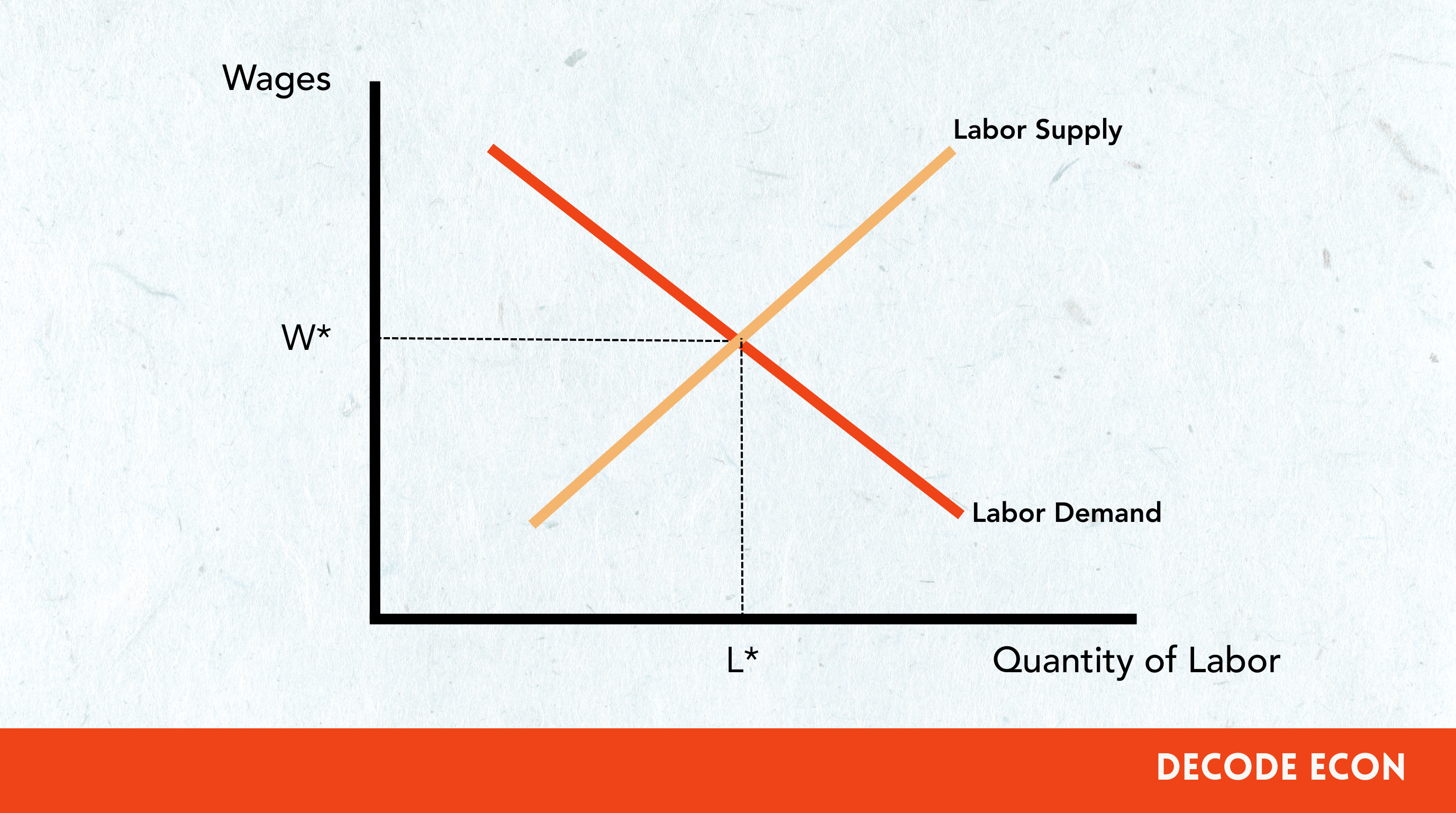
The textbook model of a competitive labor market is elegant. Employers compete for workers. Workers compete for jobs. The wage that emerges reflects the value of the work. No single employer or employee has enough power to move the price. Everyone is a price-taker.
In this world, intervention is harmful by definition. If wages are already at the competitive equilibrium, any attempt to push them higher reduces employment. Simple supply and demand.
This model is useful. It’s also incomplete in many labor markets.
The reason isn’t ideology, although it gets tangled up in ideology more than it should. When wage policy becomes a political identity, the economics get lost. Conservatives defend low wages as market outcomes because intervention feels like government overreach. Progressives push for higher wages as a moral imperative without always engaging the underlying structure. Both sides end up arguing past the actual question: Is this market competitive enough for the model to apply?
That question has a lot to do with market structure. And when you look closely at how most labor markets are actually built, the answer is often no.
