


The U.S. conflict with Iran was supposed to be short. It hasn’t been. And if we apply game theory, it becomes clear why this conflict is likely to persist far longer than expected.
Game theory is a framework economists use to understand strategic behavior, how one decision-maker responds to another. We often apply it to strategic behavior between firms: if one company invests, how does its competitor react?
But the same logic applies to war, and it has been used in previous wars to help end them.
In conflict, each side is making decisions while anticipating the other’s response. That’s what makes war a strategic framework where game theory can be applied. So if game theory is so powerful, shouldn’t it have predicted this outcome?
Because the model only works as well as its assumptions, and in this case, those assumptions are breaking down.
Start Simple: Why Conflict Happens
Let’s begin with a simple model.
Two players:
United States
Iran
Each has two choices:
De-escalate
Escalate
This creates a classic Prisoner’s Dilemma:
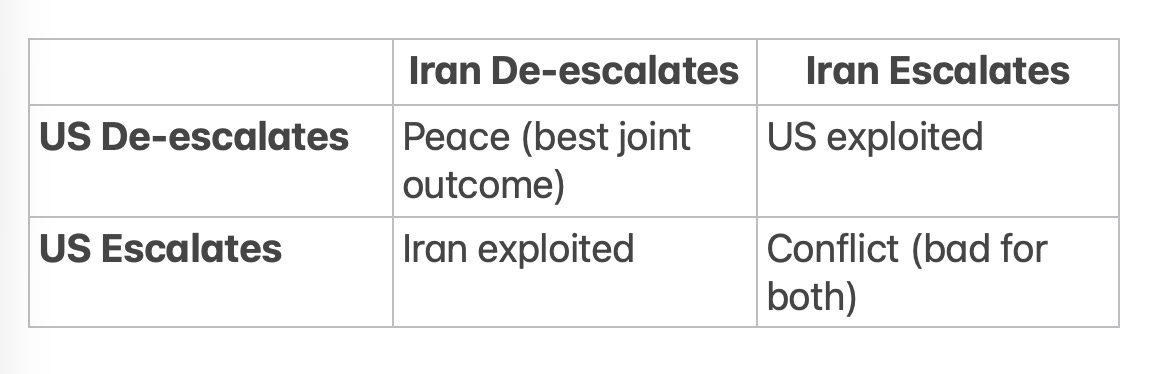
Here’s the problem:
If the U.S. de-escalates, Iran is better off escalating
If the U.S. escalates, Iran is still better off escalating
The same logic applies to the U.S. So even though peace is the best outcome, both sides choose escalation. That is the classic Prisoner’s Dilemma outcome.
But This Isn’t a Static Game
That model assumes both sides move at the same time. That’s not how war actually works. The war against Iran is sequential in nature. One side moves. The other responds. And each move is made with expectations about what comes next. In that case, cooperation is possible.
A Sequential Game with Cooperation
Now consider this structure:
The U.S. moves first
Iran observes and responds
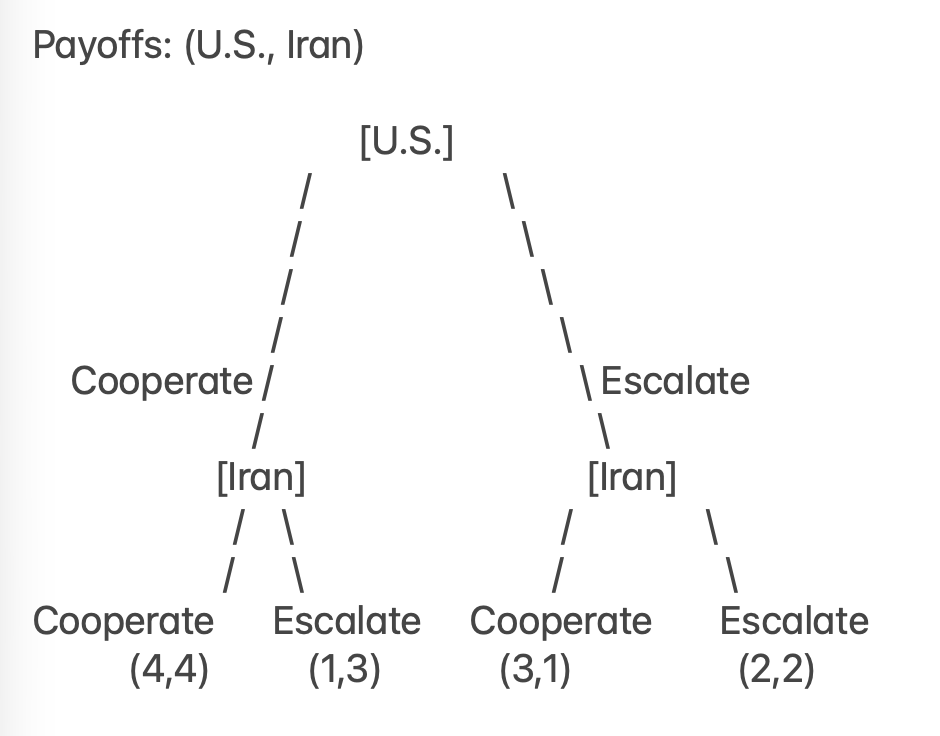
If we assign payoffs carefully, cooperation becomes possible.
If both cooperate → (4,4)
If one exploits the other → (1,3) or (3,1)
If both escalate → (2,2)
When we solve this using backward induction:
If the U.S. cooperates, Iran prefers to cooperate
If the U.S. escalates, Iran prefers to escalate
So the U.S. anticipates the best outcome for them is cooperation, and they choose to cooperate.
Equilibrium: Cooperation (4,4)
When Does This Work in the Real World?
For this cooperative outcome to hold, several conditions must be true:
Credible Guarantees- Inspections, monitoring, and enforcement reduce the incentive to cheat.
Future Matters- If both sides value long-term benefits, trade, stability, and legitimacy, cooperation becomes more attractive.
Clear Communication-Misunderstanding can turn cooperation into perceived weakness.
High Cost of Escalation- If conflict is extremely costly, escalation becomes less appealing. In war, the "madman strategy" is used to keep the other side off guard and to signal that escalation is costly. The premise of the madman theory is that the appearance of irrationality makes otherwise non-credible threats seem credible.
So Why Has This Conflict Persisted?
Game theory explains cooperation and failure. Here are three things that stand out in this conflict:
Mismatched Models- The U.S. initially approached this like a static game. Iran behaved as if it were sequential. That mismatch created early escalation.
Incorrect Beliefs- The U.S. assumed Iran would retreat to minimize losses once attacked. This false belief had a lot to do with the recent success the U.S had in Venezuela. Instead, Iran escalated, leveraging tools like the Strait of Hormuz and targeting U.S. positions.
Strategic Leverage- Iran’s strategy is not to win conventionally. Iran’s military cannot stand against the U.S., but it can impose economic costs. The Strait of Hormuz becomes central as leverage.
The Credibility Problem (The Madman Theory Is Fizzling)
Iran’s willingness to absorb costs and respond to escalation suggests that U.S. threats are no longer as credible as assumed. In game theory terms, a threat that is not believed is not a threat at all. Unfortunately, this raises the probability of aggressive action to restore credibility.
Where Does This Leave Us?
We are in a strategic stalemate. The U.S. is forced to escalate pressure, and Iran’s only response is to escalate economic disruption. The only way for Iran to win is to cause severe economic disruption and cause Americans to put pressure on the administration to back off, and for Americans, the only way forward is to have the Iranians back off. Both countries need an off-ramp, and I do not see one right now. Negotiators have their work cut out for them.
Neither side has a clear incentive to back down.
Isreal... 3rd party movements distort bilateral gameplay. Prisoner's Dilemma requires an isolation of the players.
- Prisoner's Dilemma 𝑢𝑖=𝑓(my action,your action)
- Triadic Strategic System 𝑢𝑖=𝑓(my action,your action,third party’s response)
We still don't know the Transformation Preference, given statements about a lack of cooperation w/ Isreal in terms of certain military moves.
I would call this a Political Game of Influence where the cooperation utility is either manufacturered, enforced or induced by strategic movement. (Russia and Chinese information sharing creates an assymetry of knowledge.)
*Now you can add a 4th party in an endogenous sense with the calls for the Iranian public to enter the "gameplay". (Social movements with their own agenda and influence in outcome.)
it is not easy to reduce the conflict to educational models like prisoners delima or beyond. The final winner is the one who has deep knowledge of the both side's culture, yes CULTURE. and it is clear who the one is.