



In today’s newsletter:
Four issues are shaping your economy right now. Here’s what they mean.
Students aren’t unmotivated. Young people are lonelier than ever. Concert tours are quietly collapsing. And inflation just signaled it might be here to stay.
Let’s decode all of it.
Why Students Stop Trying — and why telling them to try harder makes it worse
The Rise of Loneliness — the lifecycle chart that should change how you think about social skills
Blue Dot Fever — what empty concert seats tell us about the affordability crisis
Sticky Inflation — the number buried in this week’s CPI report that economists are watching

Why Students Stop Trying — and It’s Not What You Think
From Economics Unpacked by Mallika Pung
What Happened
Everyone has noticed that effort in learning seems to be declining; students leave assignments half-finished, checking out before the work is done. In my classes this semester, 22% of my students did not complete their final paper. They participated in the entire course, but just decided not to submit their final project! I have no way of explaining this behavior. Was it a lack of motivation to finish what they started?
A new paper in the Journal of Political Economy tracked over 1,600 fifth- and sixth-graders doing optional math work and found something that runs counter to the obvious explanation. Low-performing students are not less motivated than high-performing ones. On average, they want to succeed just as badly. The gap is in productivity, specifically, how efficiently a student converts time at the desk into correctly solved problems.
The Economics
This is a cost problem, not a willpower problem. When learning is slow, every additional hour of work extracts an increasingly heavy mental toll. The researchers put a number on it: doubling a student’s daily math commitment raises the internal cost of studying by more than 3 times. At some point, stopping before the assignment is done becomes the rational choice, not a character flaw, but a logical response to a cost that has grown too large to bear.

We have been misreading the effort problem for a long time. When we see a student who stopped before finishing, we diagnose motivation and prescribe pep talks, incentives, and information about the returns to education. This paper suggests that for many students, those interventions are targeting the wrong variable entirely. The lever that actually moved productivity was school quality, not who the student was, but what resources surrounded them. That is a much more uncomfortable conclusion because it places responsibility elsewhere than on the student.
What It Means for You
If you work in education, workforce development, or training, the next time someone stops before the finish line, ask whether the environment made the work efficient enough. Effort is not the bottleneck for most people. Access to tools and instruction that make learning faster is.
Visit Mallika’s website for the full write-up about this paper and access to the slides. https://www.gourmeteconomist.com/why-trying-harder-isnt-enough-for-struggling-students/

The Rise of Loneliness
Source: Our World in Data and the U.S. Bureau of Labor Statistics
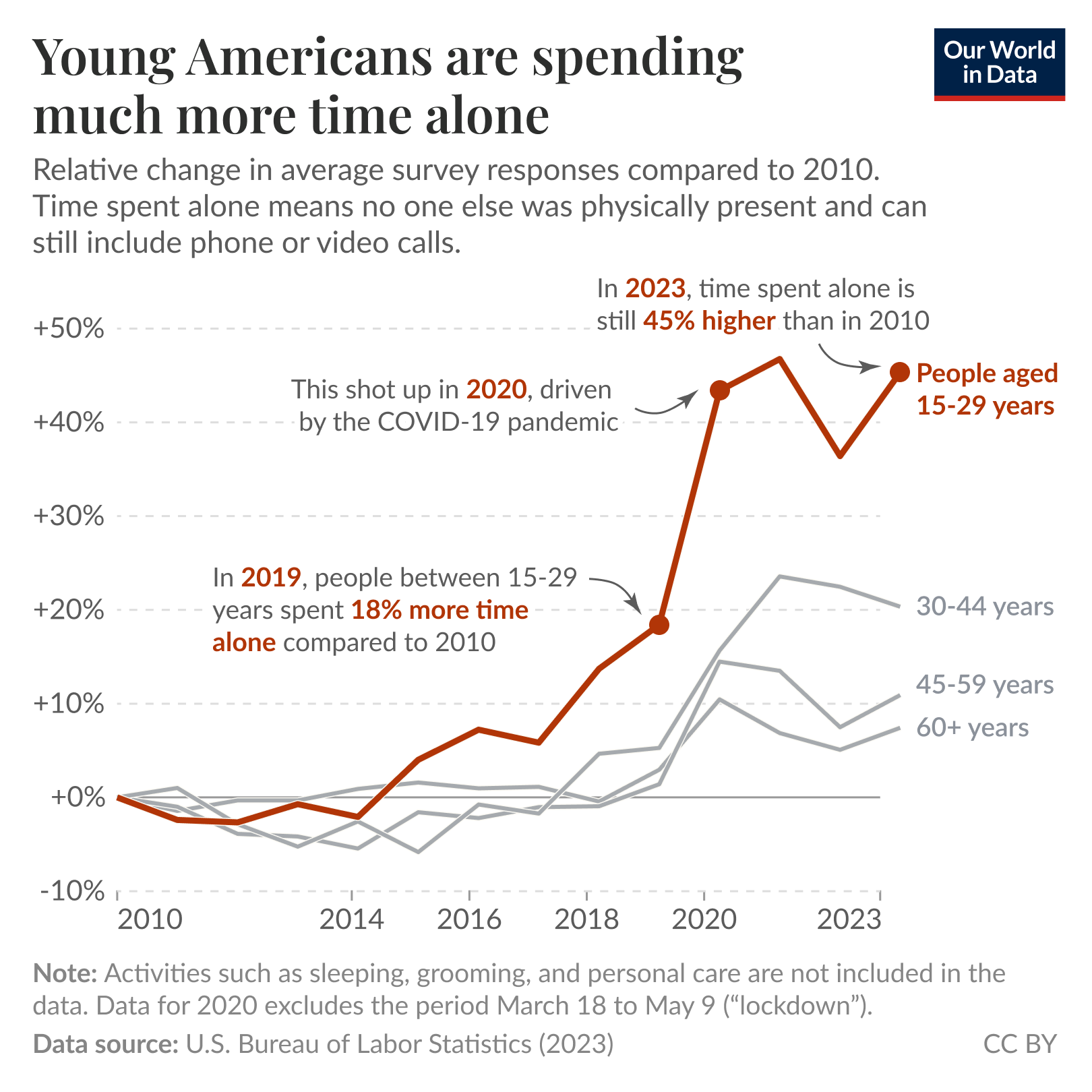
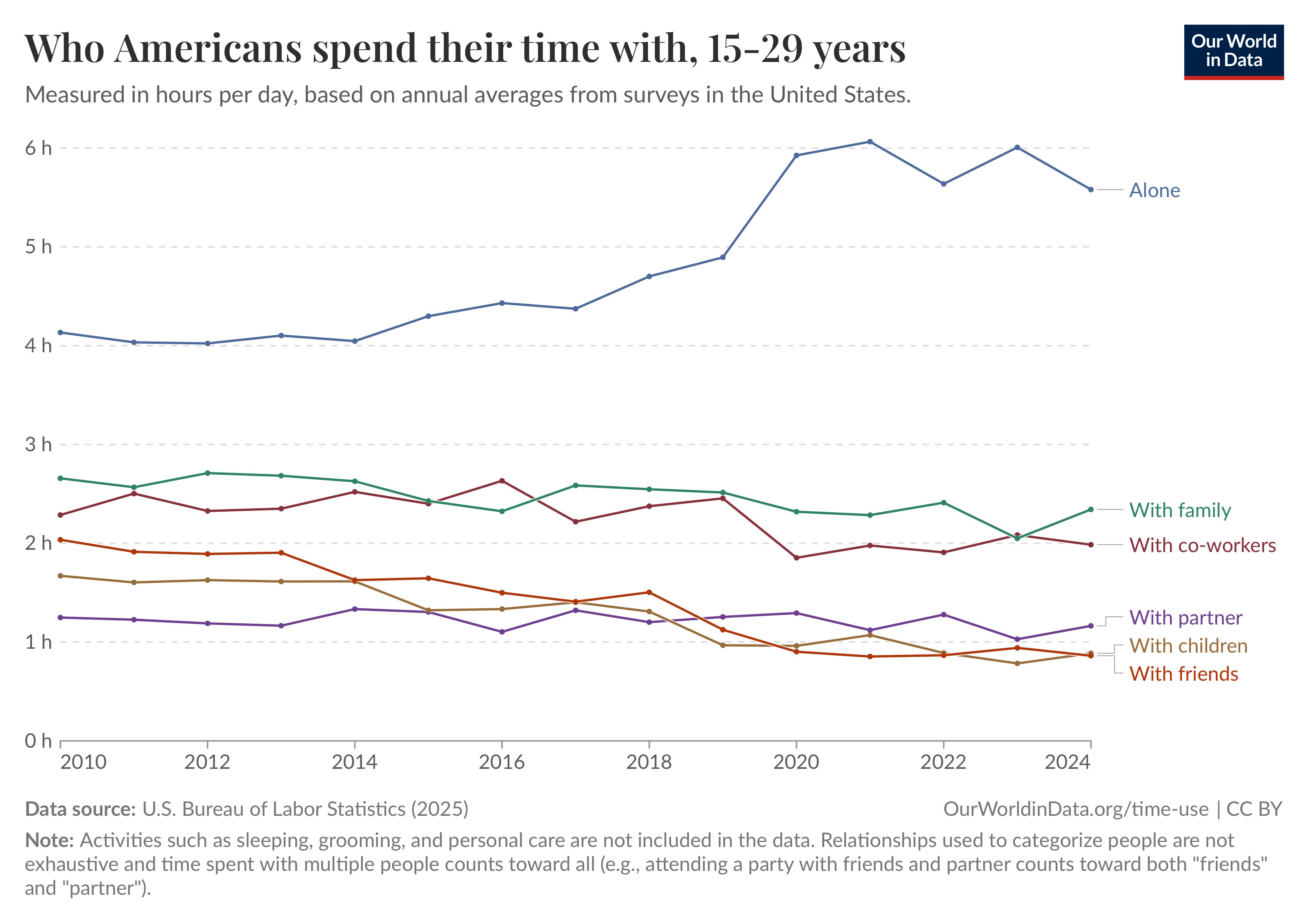
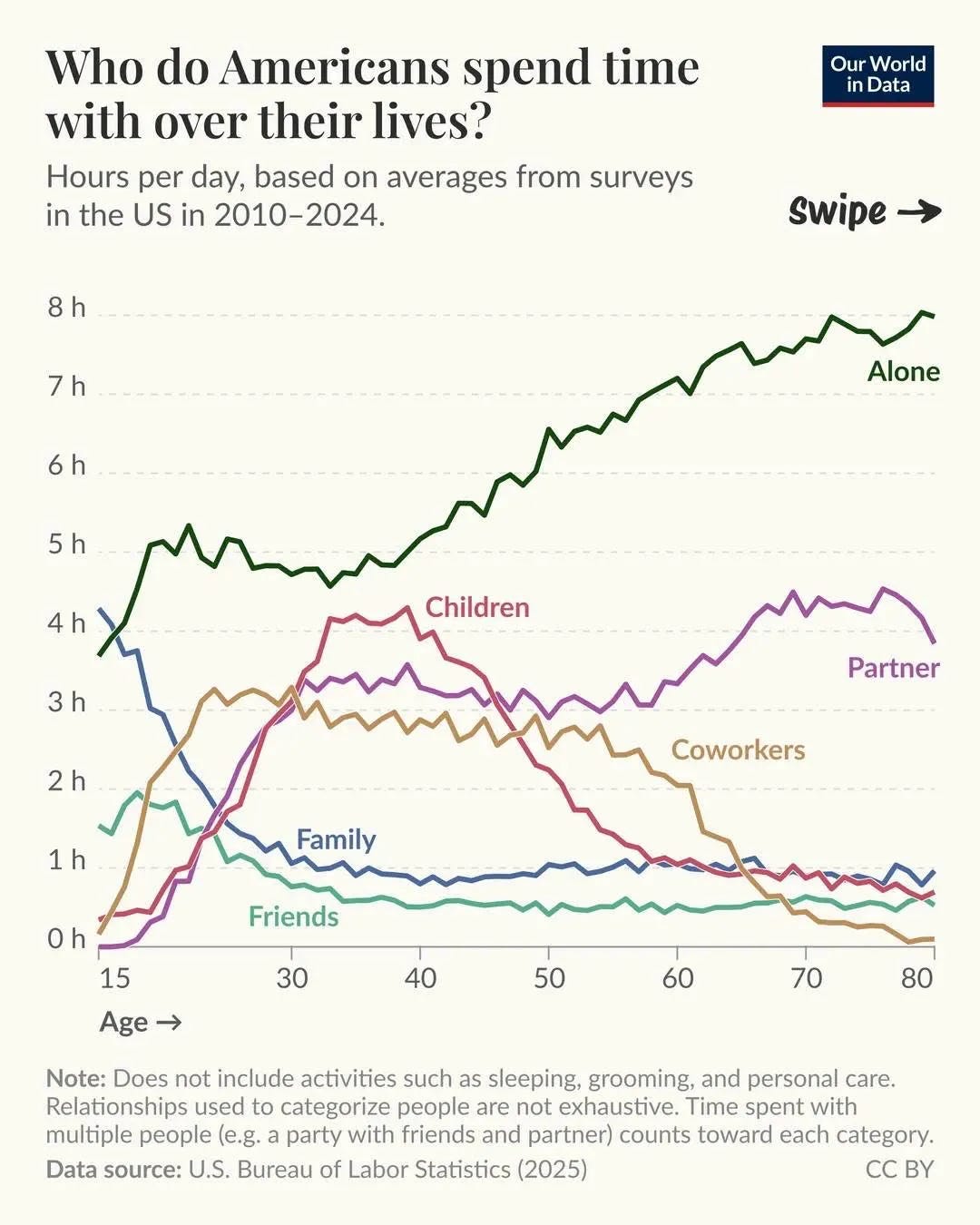
A chart from Our World in Data drawing on BLS time-use surveys from 2010 to 2023, shows that young Americans aged 15–29 now spend about 45% more time alone than they did 13 years ago. That is roughly six hours per day alone, up from four. Time with friends has dropped. Time with family has dropped. But the isolation story doesn’t stop at youth. The same data show that time spent alone rises steadily across the lifespan, reaching nearly 8 hours per day by age 80. Americans don’t just become lonelier as a generation. They also become lonelier as they age.
The Economic Mechanism
Here is what makes the lifecycle pattern so important: the chart also shows why time alone rises with age. Coworker time peaks in the 30s and falls to near zero by retirement. Children fill the middle decades and then leave. Partner time holds through the 60s and then drops sharply, reflecting widowhood and separation. What appears to be a personal or cultural problem is actually a structural one. The social infrastructure that fills adult life, work, children, and partnership is time-limited. When it ends, there is often nothing behind it. For today’s young people, that future loneliness is being pre-loaded: they are entering adulthood already six hours a day alone, before coworkers, partners, and children have even entered the picture.
We are looking at a compounding crisis that economics has not fully priced in. Loneliness and social isolation is associated with health outcomes. According to the CDC, it can increase a person’s risk of heart disease, diabetes, depression and anxiety, and demintia. Solving the loneliness crisis requires effort and targeted interventions.
Social skills are a competency. It is built through repeated exposure, dinners, disagreements, negotiations, awkward silences, and all the informal friction of being around other people. When young people spend six hours a day alone before their careers even begin, they arrive in the labor market with fewer reps than any prior cohort. Social fluency is not fixed; it responds to practice. That’s why my research assistants this summer won’t just be working at their desks. They’ll be off campus, attending events, meeting people, and learning how to be in a room.
As Dr. Dr. Jeni Al Bahrani says, you need to learn to
“Own the room and work the room, to own the room, you need to be able to read the room.”
What It Means for You
If you are early in your career, the most economically valuable thing you can do while optimizing your resume, is spending time with people, in rooms, in uncomfortable conversations, in situations where you have to figure out how to connect. That skill has a return. And like most investments, it compounds. Get out and spend time with people.
If you manage early-career employees, the pipeline arriving at your door has had fewer “social reps” than any prior generation. The communication gaps you are noticing are not an attitude. They lack exposure. Onboarding now has to include what was previously assumed. Talkign and connecting with people is a skill that requires development.

Blue Dot Fever: The Affordability Crisis Comes for Live Music
Source: Nexstar / Pollstar / McKinsey/ Morning Brew

What Happened
A wave of high-profile concert tours from Meghan Trainor, Zayn, Post Malone, and the Pussycat Dolls has been canceled or postponed in recent weeks. Fans on social media noticed the pattern first: seat maps on Ticketmaster showed floods of blue dots, the icons representing unsold tickets. The phrase “blue dot fever” was born. The official explanations for cancellations cited personal reasons. The data tells a different story.
The Economic Mechanism
This is a demand elasticity and affordability problem playing out in public. Concert ticket prices rose 41.3% on average between 2019 and 2024, well above general inflation, during what Pollstar called the “Golden Age of Live Stadium Concerts.” Artists and venues priced for a post-pandemic spending surge that assumed fans would pay almost anything to be back in a room together. Pent-up demand from Covid pushed up prices. That assumption held for a while. It is no longer holding. When tariff-driven inflation, fuel price spikes, and economic pessimism collide with $300 floor seats, consumers make the rational choice to pass on the concert. The blue dots are just what that choice looks like on a map.
The Economics
Here is the part with the most coverage missing: this is not happening evenly. Pollstar’s JR Lind told the The Times that top acts are still selling. The pressure is falling on the tier just below them. For superstars, concerts are closer to inelastic goods; fans pay almost regardless of price. For everyone else, the price elasticity of demand is doing exactly what it should. When your product is discretionary, and your price is high, a deteriorating economy will start to impact your market.
The live music industry made the same mistake many industries did coming out of COVID: it mistook a spending surge for a permanent shift in consumer preferences. It wasn’t. It was pent-up demand with a time limit. Now that the limit has been reached, it’s colliding with an economy where consumers are actively pulling back on non-essentials. The blue dots are not a music industry story. They are an affordability story. And they are showing up in restaurants, travel, and retail, too. It is evident in live music data and will soon show up in other sectors.

Inflation Is Back. This Time, Energy Is Driving It.
Source: U.S. Bureau of Labor Statistics
What Happened
The latest CPI data from the BLS shows headline inflation at 3.8% year-over-year. The increase is being driven by an 18% jump in energy prices from a year ago (40% from last month) and a 54% spike in fuel oil, a direct consequence of the War on Iran and the continued blockage of the Strait of Hormuz.
Why This One Is Different
The initial assumption was that the energy shock would be temporary. That assumption is getting harder to hold. Core inflation, which strips out food and energy and is the number economists watch most closely, is now beginning to rise. It is up .35 percentage points. That matters because it signals that higher energy costs are passing through to the rest of the economy: shipping, manufacturing, services, food production. Once core inflation picks up momentum, it is historically difficult to bring back down. The Fed knows this. So should you.
This is the inflation story I have been watching closely. Energy shocks are manageable when they stay contained, or “transitory”. When they start moving core prices, the calculus changes entirely. If the Strait of Hormuz remains blocked and energy stays elevated, we are not looking at a temporary spike, we are looking at a inflation that embeds itself. That is a different policy problem, a different consumer problem, and a different economic story. Inflation is sticky, and it will hang around much longer than we want it to.
Are you planning on attending concerts this summer? If so, which ones? Drop a comment and tell us who you will be seeing. If you feel comfortable, tell us how much you spent on a ticket!
I've never been to a concert, meaning I'm not too concerned with the rising ticket prices.
However, I am concerned with rising prices overall. Core inflation still isn't spiking just yet, but the prolonging of these blockades in the Strait of Hormuz might change that very soon. American's have been battling inflation for too long and our leaders seem to be slightly out of touch with its real impact. Just for clarification, I'm speaking about leaders from both sides of the isle when I say this.
As for the rising loneliness, I wonder if they have any measure for online social interaction. Are hours spent alone in a room but online speaking and conversing with friends still considered hours alone? I still think human interaction in the real world is better for people, but I'm curious if that was taken into account.
I think the loneliness crisis is interesting because I feel like I don't get enough time to myself. I think there is a argument for finding better quality friends and associates as well and then of course technology and responsibilities are major sinks for younger folks.