


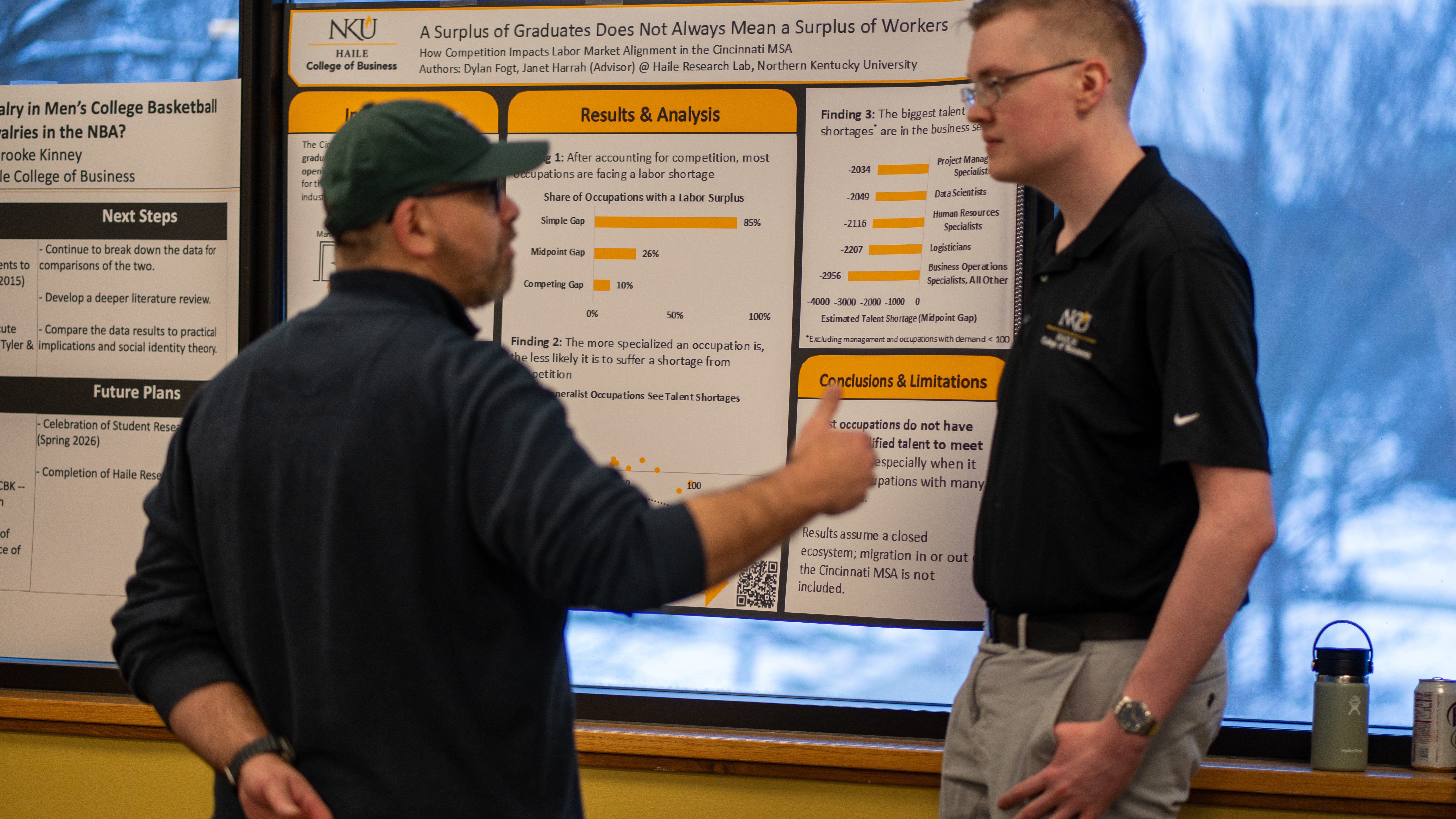
Last week, I wrote about storytelling as a skill—and why it’s worth investing in. I’ll admit, I was surprised by how strongly it resonated. That post performed better than any post so far in 2026.
That makes me happy. Not only because these topics matter to me, but because they are economics, just not the headline-driven kind. They’re about how people actually navigate the labor market and life!
Today, I want to talk about another skill that matters deeply in the economy—and in life more broadly—but one I worry is quietly eroding at the very moment we need it most.
That skill is critical thinking.
Everyone Says It. Few Explain It.
In academia, “critical thinking” gets said constantly. Professors list it as a core learning objective. Universities emphasize it when talking to legislators and donors. We proudly claim we are producing “critical thinkers.” Employers tell us that they need critical thinkers.
But here’s the problem: Critical thinking sounds vague, fluffy, and hard to define. And for some, politically loaded.
A couple of weeks ago, a student stopped by my office, frustrated. An assignment in another course instructed students to “critically think and evaluate” a document. He looked at me and asked:
“What the heck is critical thinking? How do I critically think?”
That question is revealing and uncomfortable.
Because if students don’t know what it means, that’s on us. We’ve failed to define it clearly, and as a result, we’ve failed to get real buy-in.
The Skill We Think We’re Teaching (But Aren’t)
Critical thinking isn’t about being negative or contrarian. It’s not “just asking questions,” and it’s definitely not about having strong opinions.
At its core, critical thinking is the ability to slow down, question what you’re being told, and reason your way to a better conclusion—using evidence, logic, and context instead of instinct, ideology, or vibes.
Academia often says, “We teach critical thinking.”
What students hear is: “Figure it out.”
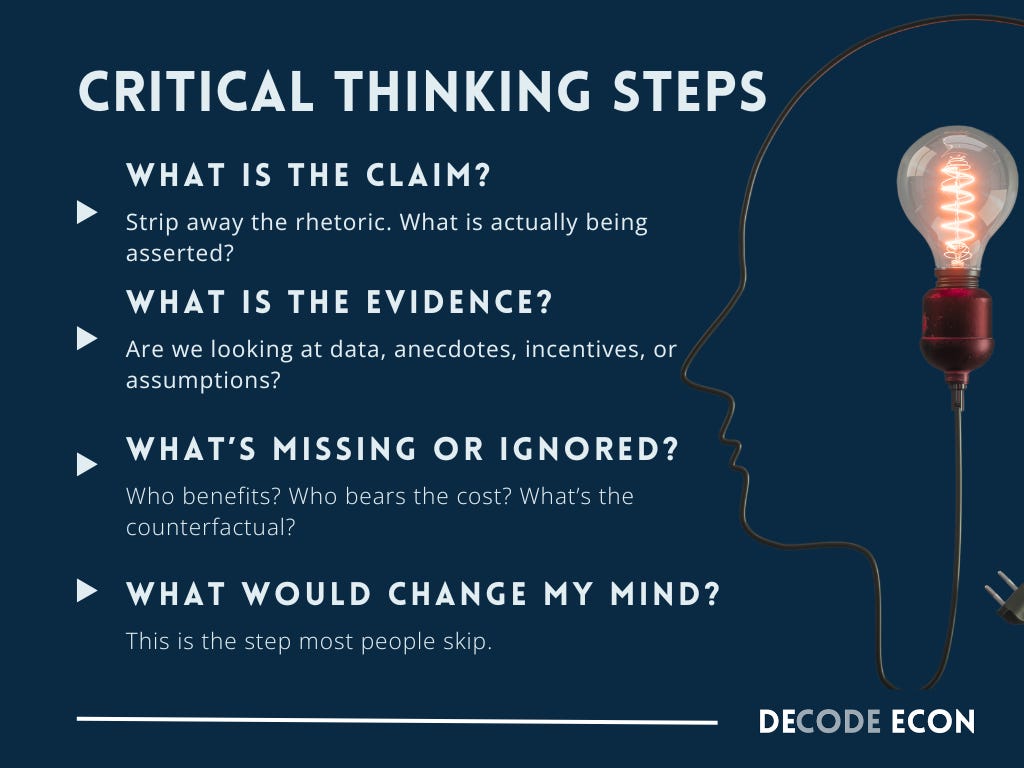
That’s the failure. Critical thinking isn’t abstract. It’s a process:
What is the claim?
Strip away the rhetoric. What is actually being asserted?What is the evidence?
Are we looking at data, anecdotes, incentives, or assumptions?What’s missing or ignored?
Who benefits? Who bears the cost? What’s the counterfactual?What would change my mind?
This is the step most people skip.
If you can’t answer step four, you’re not thinking critically; you’re defending a position.
Why This Matters for the Economy
Labor markets reward people who can adapt. AI, automation, and rapid change are constantly reshaping which skills matter. Technical skills age quickly. Job titles disappear.
Critical thinking is different.
It’s the skill that allows you to:
Spot bad arguments
Evaluate claims made with confidence but little evidence
Make better decisions under uncertainty
Adjust when the world changes—because it always does
That’s why this is an economic issue, not just an academic one.
A Simple Example
One of the best explanations of critical thinking—and what happens when we don’t apply it—comes from the short video below. It highlights an innovative approach used by a high school AP U.S. History teacher and shows how powerful critical thinking can be when it’s taught explicitly.
Watch it. I’d love to hear what you think.
The Bottom Line
Critical thinking isn’t about knowing the answer. It’s about knowing how to get there and being willing to change course along the way. It is about evaluating information and incentives, and when the data provides new insights, you must adjust your conclusions.
In an economy flooded with information, confidence, and AI-generated certainty, that may be the most valuable skill of all.
Our society is failing at critical thinking. We need to do a better job of developing our critical thinking skills.
This post is brought to you by Haile College of Business’s Master of Business, Leadership & Innovation (MBLI). This program is designed to help future business leaders develop the skills to navigate the complexities of leading people and change. Applications are open. Reach out if you want to learn more.
Effective Leadership in Business
If you’re looking for a master’s degree that helps you leverage your critical thinking skills, consider this:
Most graduate programs teach you what to think. The Master of Business, Leadership & Innovation (MBLI) teaches you how to think differently and how to turn that thinking into innovation that drives real change.
Through human-centered leadership development, you’ll build the skills companies desperately need but can’t teach: critical thinking, strategic communication, empathy, creativity, and the ability to innovate in complex environments. You’ll apply it immediately in your organization. Learn it today, use it tomorrow.
Here’s what makes MBLI different:
Experience-based admission. No GMAT required. We value your track record over test scores.
Small cohorts. Designed for working professionals. One online course plus one in-person Saturday per month.
A 10-day global leadership experience where you’ll study innovation in action across two countries.
Real-world impact from day one through hands-on projects that drive organizational change.
This is your opportunity. Not just to earn a degree, but to transform how you lead and innovate.
Applications for Fall 2026 are open and all application fees are waived through April 30th!
Subscribe to Haile Graduate Programs to stay up to date.
What's a critical thinking? Just kidding, loved this post. Critical thinking is referred to heavily nowadays but most don't actually know what it means to think critically. Great post to understand what it means to critically think.
Excellent post, Dr. A.