


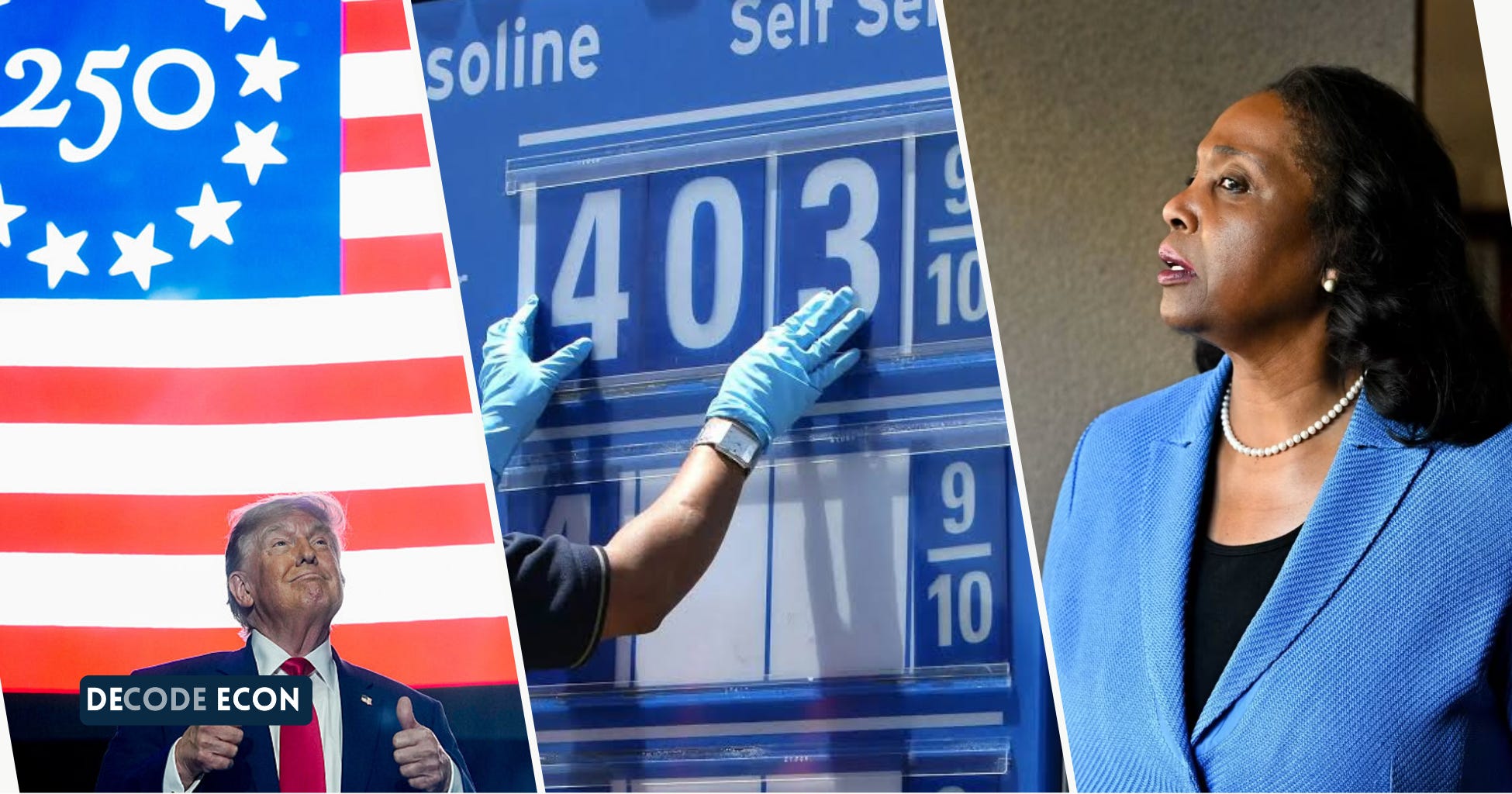
This week, two very different stories are making the same point.
PCE inflation increases as oil prices re-spike on Iran-US tensions
The Supreme Court protects one federal agency’s independence and strips another’s
Both are stories about risk.
Here’s what’s actually going on.

Inflation Expectations as Oil Prices Increase Again
What Happened
PCE inflation came in at 4.1% year-over-year in May, with core at 3.4%. The bump was mostly airfares and fuel — not a broad-based reacceleration. Inflationary pressure seemed to ease when the Strait of Hormuz reopened. Then, days after the report, oil prices started climbing again amid fears that a breakdown in Iran-US talks could disrupt supply from the Middle East. As of Wednesday morning, Brent futures rose 33 cents, or 0.45 percent, to $73.28 a barrel at 06:39 a.m. Saudi time, while US West Texas Intermediate crude climbed 34 cents, or 0.49 percent, to $69.84 a barrel.
The Economics
As we have said, the Federal Reserve can’t fix this inflationary problem. This is a risk premium, not a demand story. Oil traders aren’t pricing in more barrels getting used; they’re pricing in fewer barrels being available. That distinction matters because a demand-driven price increase tells you the economy is heating up. An increase in the risk premium signals that geopolitics is acting like a tax on all of us, increasing our costs without any associated growth.

The Supreme Court Just Ruled Two Different Ways on the Same Question — and Nobody’s Talking About It
What Happened
In the same term, the Supreme Court handed down three rulings that all touch the same underlying question — how much power does a president have to override an institution’s independence — and answered it three different ways.
First, in a 6-3 decision, the Court struck down Trump’s executive order attempting to limit birthright citizenship, upholding 150 years of precedent. The Constitution won in this fight.
Then, on Monday, the Court split its logic. In a 5-4 ruling, it sided with Federal Reserve Governor Lisa Cook, whom Trump had tried to fire in August 2025. Fed governors serve 14-year terms and can only be removed for cause, and the Court preserved that protection, for now. Cook’s term runs through 2038. Financial experts called it a win for consumers and the broader economy, since a Fed that can be fired at will is a Fed that can be pressured at will.
But in a companion ruling the same day, the Court went the other direction. It gave the president the power to fire members of other independent federal commissions — the FTC and, by extension, bodies like the SEC and the CFTC. These are agencies that have functioned for decades as independent, bipartisan regulators with consumer protection mandates, deliberately insulated from being an extension of whoever happens to be in the White House.
The Economics
Here’s the mechanism most coverage is missing: markets and businesses don’t price in what a rule says. They price in how confident they are that the rule will hold. Economists call this regime uncertainty. It’s the cost of not knowing which version of the rules you’re operating under. Here at Decode Econ, we strongly believe in the rule of law and its importance to a functioning economy.
The Fed ruling reduces that uncertainty. Businesses, investors, and foreign governments can still treat U.S. monetary policy as insulated from short-term political pressure; that’s what allows a 10-year bond to be priced without a political risk premium baked in.
The FTC ruling does the opposite. If the agency enforcing antitrust law, or the SEC deciding what counts as securities fraud, or the CFTC regulating derivatives can now flip its priorities every time the White House changes hands, every business operating under those rules has to build “regulatory whiplash” into its planning. Not because they know the rules will change but because they can no longer assume they won’t.
The Court didn’t rule against independence. It ruled against independence selectively — protecting it for the institution most closely tied to interest rates and inflation, and removing it for the institutions most closely tied to enforcement and competition. Two branches of the same tree.

Dr. A’s Take
Most coverage of this frames it as “Trump wins one, loses one.” That framing misses the actual economic consequence, which isn’t about who won. It’s that the predictability of independent agencies just became conditional. A rule that can be selectively applied isn’t really a rule in the economic sense; it’s a signal that the next fight over the next agency is still live. Businesses don’t get to relax just because the Fed held. They now have to ask, agency by agency, whether this one is protected or exposed.
A more important consequence of the current Supreme Court is that it has become a partisan body, voting along party lines most of the time. This, in itself, has consequences for the long-run stability of the U.S. economy. Remember, if rules can change frequently, you don’t have rules.
The throughline between these two stories is that risk premiums exist; most countries face them because of a lack of institutional stability. The U.S., through self-induced actions, is introducing more risk. Higher risk means higher interest rates in the long run.
A Note From the Team
Our latest podcast has found traction in Oman — thanks to all our newest listeners; welcome to Decode Econ! If you haven’t listened to the latest episode yet, here’s the link:
We’re taking a couple of weeks off to prepare for the new academic year. Abdullah Al Bahrani is working on new course prep and AACSB accreditation reports; Claire Maddox and Frannie Staley are developing a new Instagram strategy; Jonathan Marx is building our podcast guest list; and Ben is developing our LinkedIn communication strategy. To keep up with the behind-the-scenes, make sure to follow Decode Econ on Instagram and Dr. A’s personal account, @EconwithDrA. We will continue to post there because the economy never stops!
The Supreme Court ruled the Lisa Cook hadn't been given "due process" and that a Truth Social post doesn't meet the "required notice" statute. In essence they only said Trump didn't follow the required steps and if he could meet his burden of proof, they could procede. (The argument about her mortgage is still unanswered as a point of law. Add in that the Senate confirmed her to the position "knowing" her financial disclosures, there's a question of whether or not Trump has the ability to overide Congress in their appointment for actions taken prior to her confirmation.) Sending it back to the lower court only means the process gets dragged out w/o a permanent solution. (Expect Powell to stay his full term as a result, he's not going to make it easy to replace him.)
Every time we have a Presidential "switch" to the other party, we have regulatory uncertainty. Lena Khan is a good recent example of someone not fond of mergers that harm consumers. Currently we only have 2 out of the statutory 5 Commissioners at the FTC... Paramount+ actions would have faced larger blowback two years ago. Absolute wild swing in approach. (mapping out SpaceX and it's need to raise funds and acquire would have been completely different under a Democrat Admin.)
Haiti and Syria and their removal of TPS protections is the next challenge. Both are designated "Do Not Travel" Level 4 by the State Department, yet somehow they are "safe" for immigrants to return to? North Korea, Afghanistan, Russia all hold the same threat level (and some of the same reasoning - crime, disease, political instability.)
The Supreme Court offered one common thread this week, Congress needs to do better in constructing laws and offering protections that current voids in protections have exposed.