


Students are anxious, and it is for good reason.
The labor market keeps shifting. Job titles appear and disappear faster than degree programs can keep up. Headlines tell them that AI is taking their jobs and that education is becoming obsolete. Many students feel pressure to choose a major that leads to a specific job, even if they’re not sure that the job will exist or will still look the same in five years.
That anxiety is exactly why I recorded a short video a few years ago on the single most important reason to study economics. I didn’t expect it to reach over 230,000 views, but the comments all echo the same concern students still have today:
“I want options—but I’m afraid of choosing something too broad.”
Here’s the economic way to think about your degree and the skills you need to develop to succeed in today’s labor market.
The Economics
This is my 20th year teaching economics. Other than feeling older, I am more convinced that economics is often misunderstood. Students arrive at class thinking it is “the study of money.”
It’s not.
Economics is the study of decision-making under scarcity. It teaches you how to evaluate tradeoffs, interpret information, and reason through uncertainty. Those skills show up everywhere and underlie every decision made. Economics helps you develop skills that you will use every day and in every industry. More importantly, it teaches you to tackle today’s most pressing social and business issues. You can apply it to poverty, healthcare, international trade, wages, affordability, and many other topics.
Why Study Economics?
That brings us to the real reason to study economics: flexibility. However, this is a double-edged sword.
The upside: Economics graduates aren’t trained for one narrow role. They’re trained to think. That’s why economics majors appear in policy, business, data analytics, law, consulting, healthcare, tech, and entrepreneurship. You will find them in every industry and job title.
The downside: There’s no single job title called “economist” waiting for you at graduation. That uncertainty can feel uncomfortable, especially in a world that keeps asking 18-year-olds to predict their entire future.
But flexibility is not the absence of skills. It’s the presence of transferable ones.
That’s also why economics pairs so well with other fields:
Policy & government → Political Science, History, International Relations
Data & analytics → Math, Statistics, Computer Science
Business & strategy → Finance, Marketing, Management
You’re not diluting your degree. You’re customizing your human capital.
My undergraduate degree from the University of Louisville is in Economics with a minor in Finance. That combination helped me when I worked in the financial industry and continues to help me today in higher education administration and as the founder of Decode Econ.

Show Me the Money
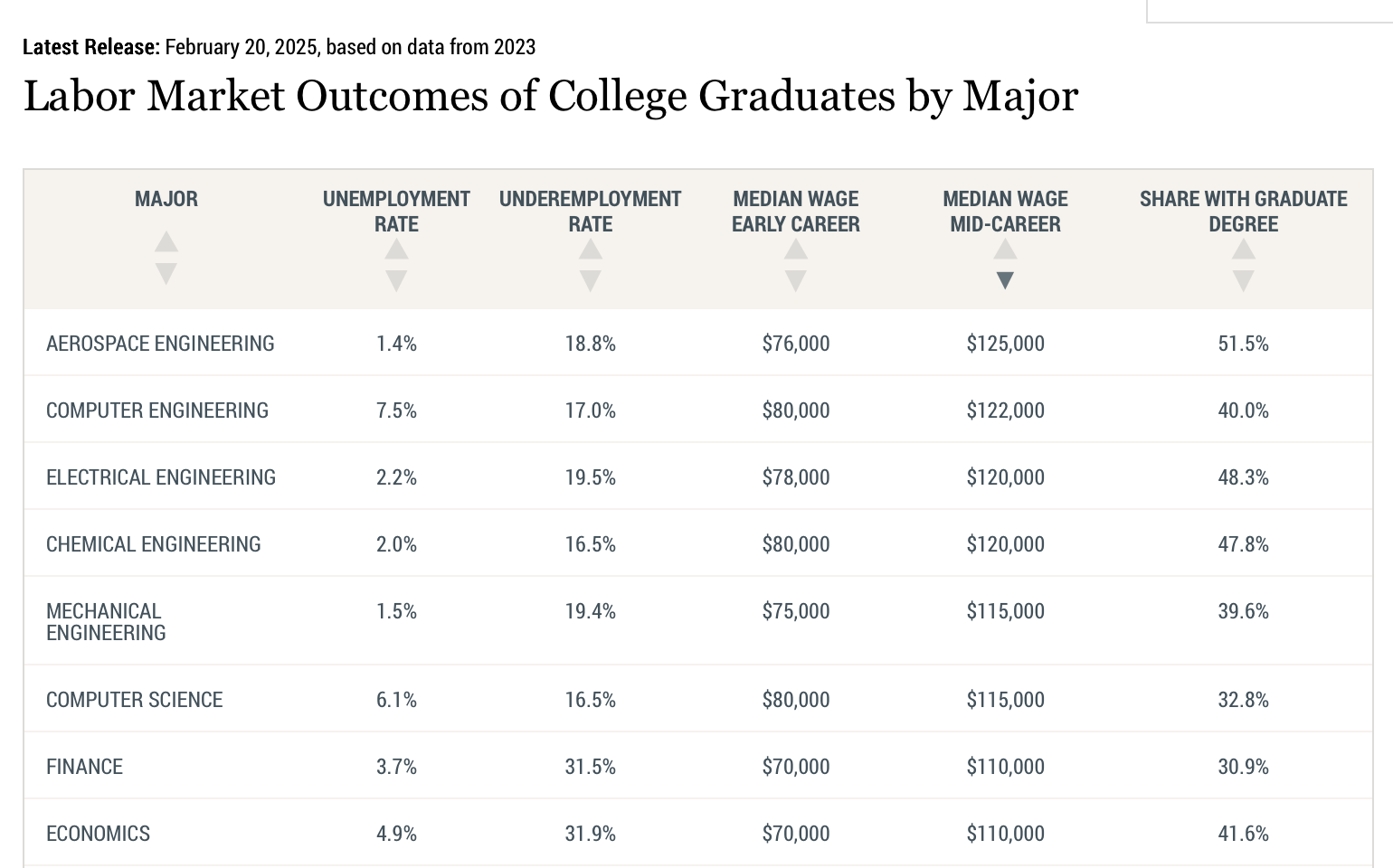
Most students evaluate success by how much money they will make. If you are motivated by money, Economics is also a strong choice, likely because of the transferable skills it provides. When choosing a major based on income, don’t just look at starting salaries; examine midcareer income, which better reflects growth and long-term stability.
According the the Federal Reserve Bank of New York, Economics ranks 7th highest median wages. Tied with Finance, with a median mid-career wage of $110,000. The unemployment rate for Econ majors is 4.9%. For early career wages, Economics and Finance rank 11th, with a median salary of $70,000.
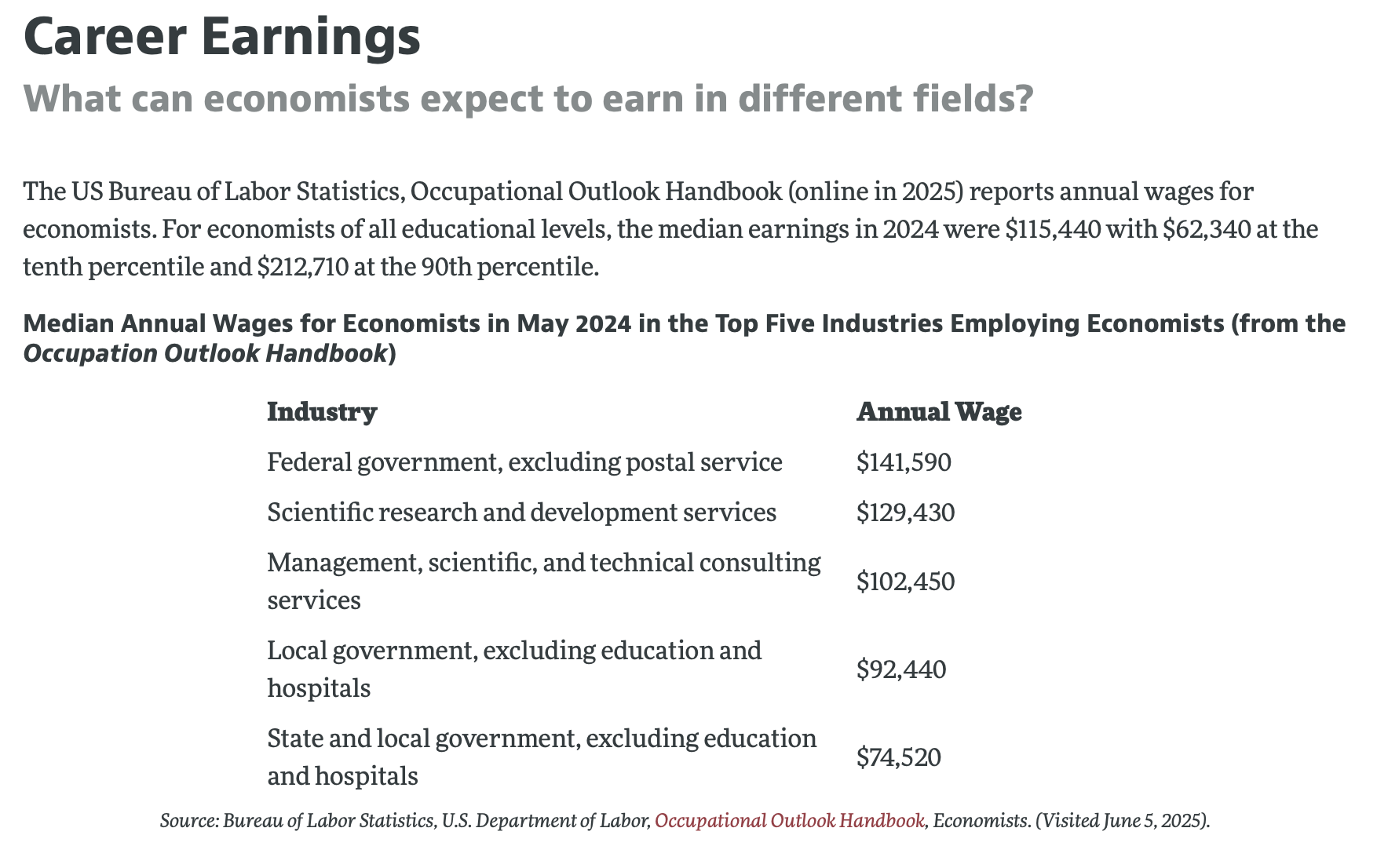
According to the American Economic Association website, the US Bureau of Labor Statistics, Occupational Outlook Handbook (online in 2025) reports annual wages for economists. The median earnings in 2024 were $115,440, with $62,340 at the tenth percentile and $212,710 at the 90th percentile.
The Bottom Line
If you want certainty, economics may frustrate you.
If you want adaptability, it’s one of the best investments you can make.
But, and this part matters, the degree alone isn’t enough. In today’s labor market, the degree is great, but you also need to show what you can do with it and learn how to communicate the skills you are developing.
To succeed in today’s labor market, economics students should actively develop:
Data literacy (working with real data)
Analytical storytelling (explaining what the data means)
Excel and technical tools
Clear written and verbal communication
The economy doesn’t reward people who know the answer. It rewards people who know how to figure it out. Build your skills to be a problem solver, a great communicator, and a researcher. Learn how to critically think about data and turn it into information to help make better decisions.
That’s what economics trains you to do.
I want to hear from you
If you’re an economics major (or thinking about it), I’d love to hear this:
Why did you choose economics?
And if this helped you think differently about your major, share it with a student who’s still deciding.
Professors, I also want to hear from you; join the comments.
Why study economics? Because econ is life.
Studying Econ has opened so many doors for me already and I haven’t even graduated yet. Recommending this newsletter to everyone.