


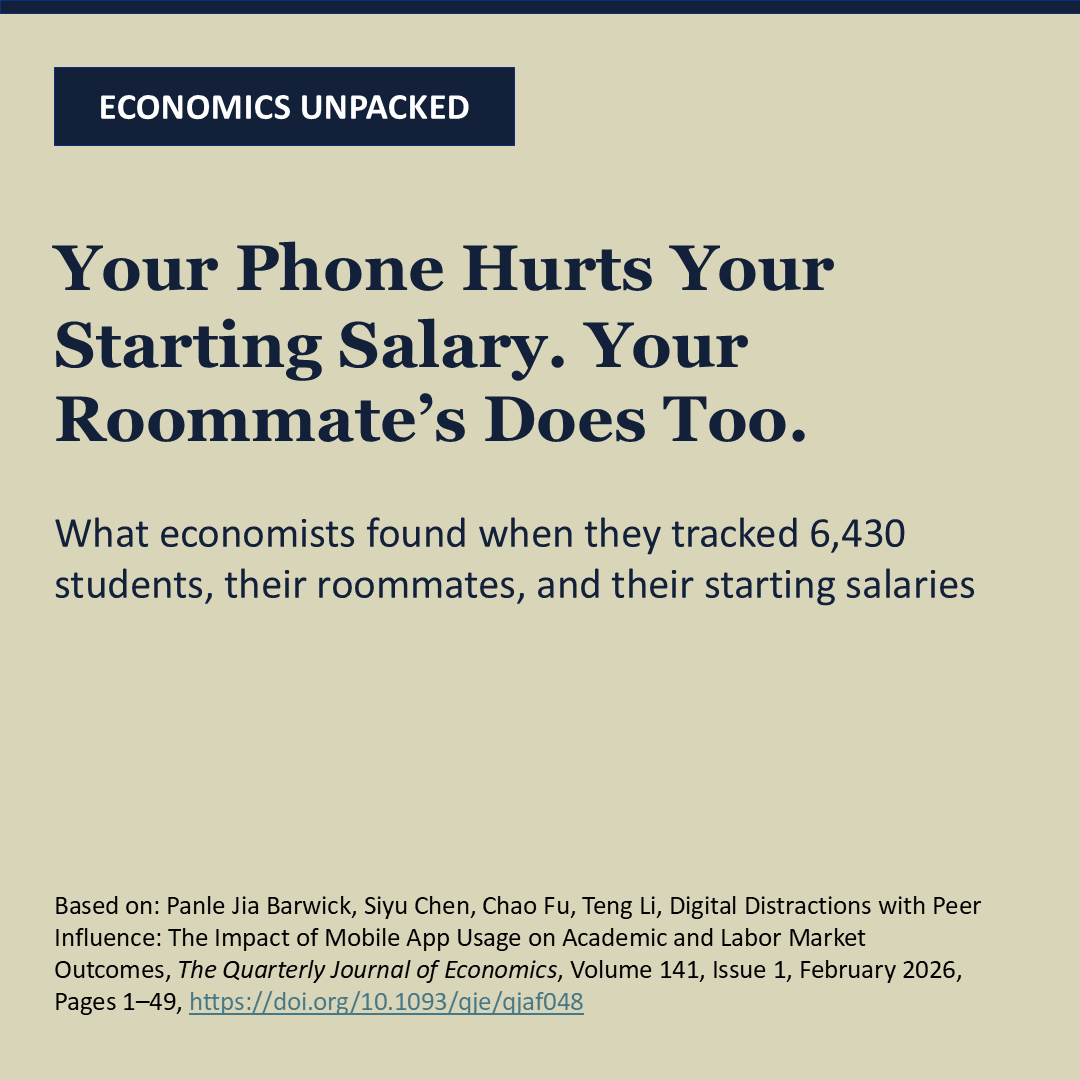
We already know your own phone habits affect your outcomes. But new research shows your roommate’s behavior creates a negative spillover (an externality) that affects you too.
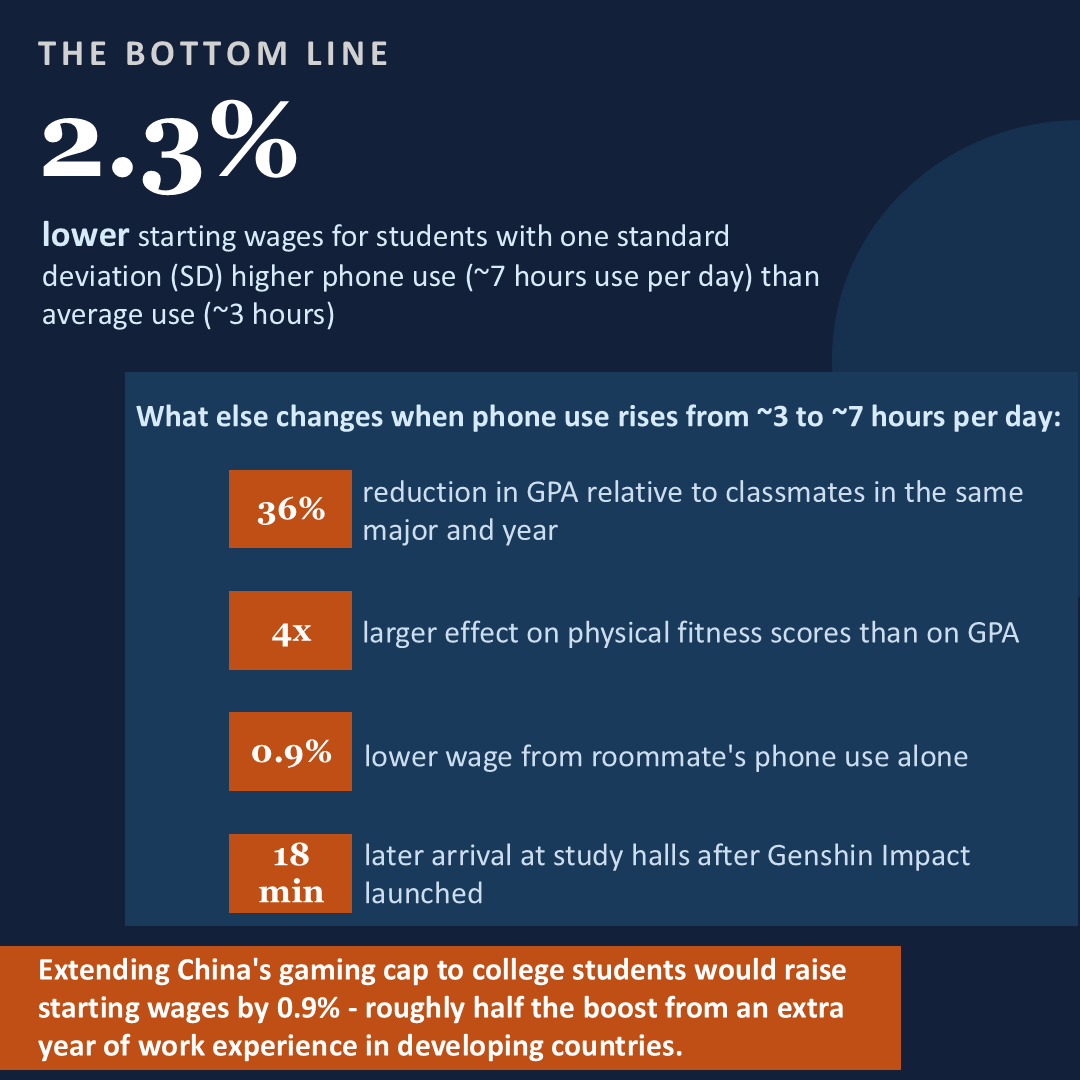
Your roommate’s phone use can lower your GPA and reduce your income by about 1%. The impact of your roommate’s behavior is substantial; it is roughly 60% as large as the effect of your own phone use.
In the recent installment of Economics Unpacked, Dr. Mallika Pung covers a new research paper by
Citation:
Barwick, P. J., Chen, S., Fu, C., & Li, T. (2026). Digital distractions with peer influence: The impact of mobile app usage on academic and labor market outcomes. The Quarterly Journal of Economics, 141(1), 1–49. https://doi.org/10.1093/qje/qjaf048
You can find the slides and a more detailed summary here.
Why does your roommate’s behavior impact you?
The roommate effect operates through two distinct channels.
The first is direct disruption. A roommate gaming or scrolling in a shared dorm room, where four to eight students live, sleep, and study within a few feet of each other, creates noise and distraction that impairs your ability to focus and sleep, regardless of what you are doing on your own phone.
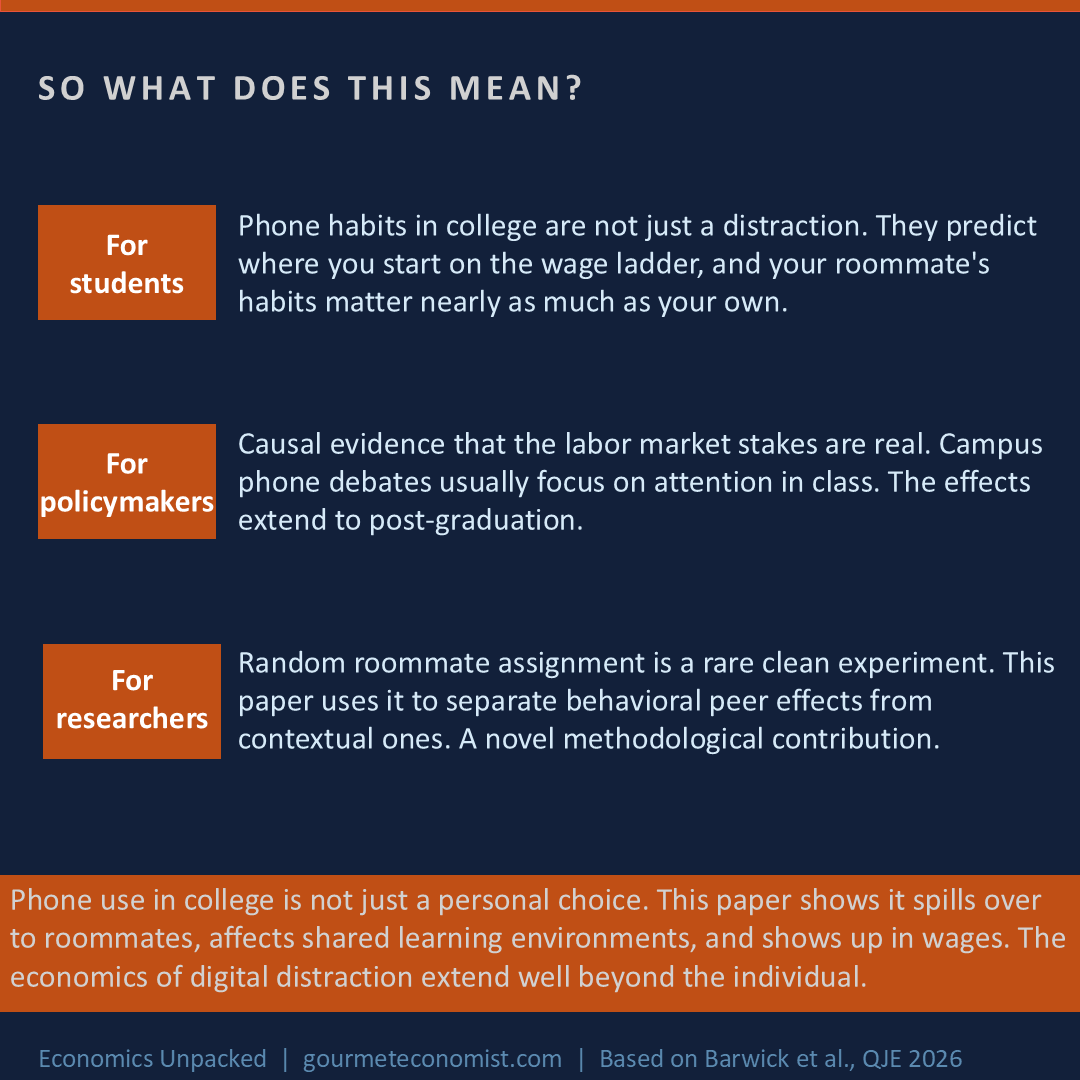
The second is behavioral contagion. Phone use is genuinely infectious. When a roommate increases their usage significantly, it pulls your own usage up by roughly 5.8%. The researchers were careful to establish that this contagion is driven by what your roommate does around you (behavioral peer effects), not simply by the type of person they are (contextual peer effects). If phone use spreads primarily because of who your roommate is, there may not be very many policy tools to address the adverse effects of phone use. If it spreads because of what they do around you, changing the shared environment can actually work. According to this study, the behavioral channel dominates here. It is not who your roommate was before college that matters most — it is what they do in the room with you.
This is even more reason to pick your roommates more carefully.
Some Slides from the Gourmet Economist
More slides can be found on the website.
Very insightful. It makes sense when you think about it. It is a added distraction . Phone use already disrupt people sleep patterns. Im glad i never needed a room mate since i was a commuter. Great work!
A few notes...
This study excludes Winter/Summer breaks and that pattern of behavior is essential in understanding the rural students. The "control" data for pre-college may be indicitive of previous norms but it also may be reflective of externalities that do not exist at college (farming being #1).
Wage growth in China fell 3% between 2018-2020... relative to 2024 the growth was 2%. The population has outpaced the available number of jobs leaving employers in control. Plenty of data on young people leaving for "work" in the morning, only to sit in cafe until it's time to go home. (And most are still living with parents due to apartment scarcity, which plays a role in the $810K home valuations used in study. Lots of ghost apartments where the builder went to prison by overpromising and vastly under-delivering. Entire cities of concrete shells!)
https://www.sciencedirect.com/science/article/pii/S2405844024083580
The above is inclusive of 2013-22 data from 42 different studies (yes, a study of other's studies!) While it is of no surprise to anyone, increased depression/anxiety and the overlapping effects of COVID play large roles in the outcomes.
*Not to dismiss the original study, but you could substitute PC Gaming in college age students and acheive similar results. 45% of the Chinese population, 675M, play video games on various platforms, not just mobile.
Negativity Bias in Chinese population is a huge challenge and the Social Credit System the government employs only makes it more difficult to get help. Imagine if in the US you were turned down for a job just for having asked for some help.