
The Leaky Cup with Meena Beri and Brian Lynch
"Relevance and rigor are not enemies." That's Meena Beri's tagline, and she and Brian Lynch prove it every week.
Three takeaways
- Build the foundation, then build up. Brian teaches inflation with leaky cups of water and supply and demand with pool noodles. Meena's online students build graphs out of crochet hooks. The object is what sticks.
- Sometimes procrastination is anxiety. When Meena's students named their procrastination type, she learned they weren't putting off work to have fun. Starting was the hard part, and once they could name it, they fixed it fast.
- Two-year faculty shouldn't have to teach alone. Their newsletter, TRECC, reaches about 3,000 economics instructors, including the one person teaching econ at a small college hundreds of miles from another economist.
When most people say "higher education," they picture a campus with dorms, a football stadium and a four-year sticker price. That picture leaves out a lot of students. It leaves out the 40-year-old taking five classes while working full time. It leaves out the parent juggling two part-time jobs and three kids. It leaves out the 18-year-old who is the first in their family to try college at all.
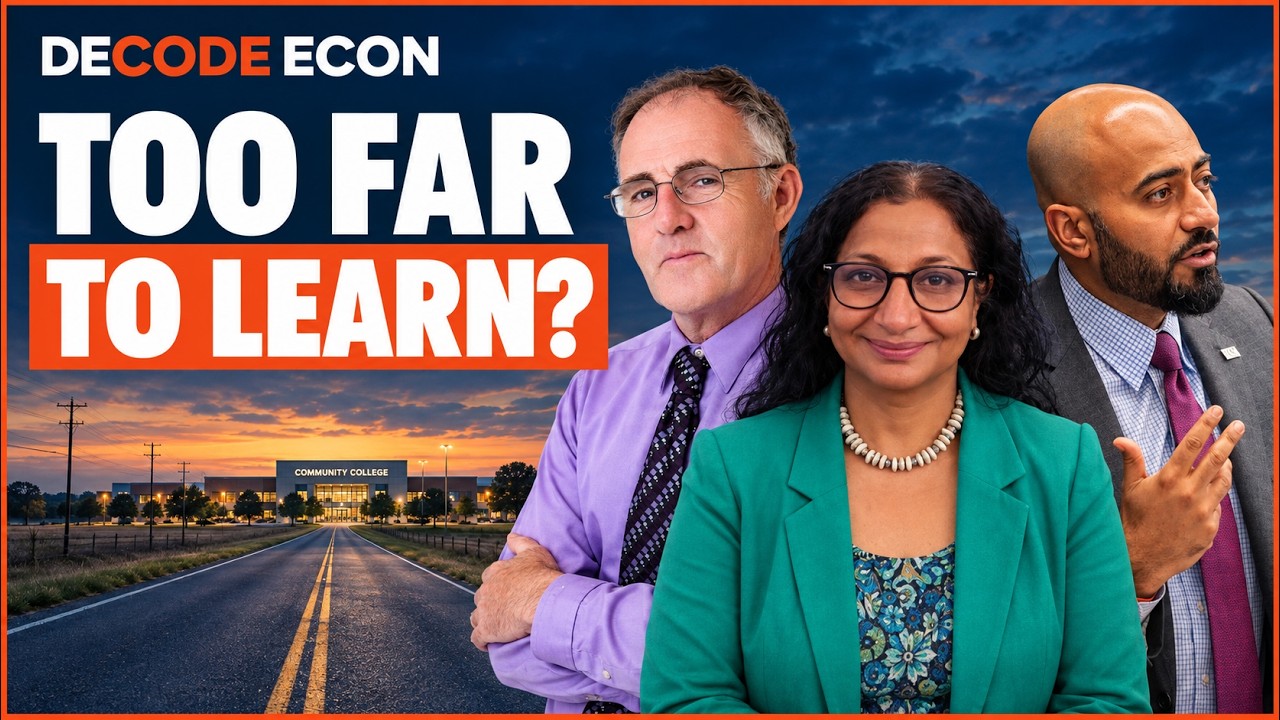
Those are Meena Beri's and Brian Lynch's students. Meena teaches at a community college in the Dallas–Fort Worth area, mostly online. Brian teaches in Southeast Texas near Beaumont, in an area with the fourth-highest unemployment rate in the state. Both teach dual-credit classes for high school students too. And together they run TRECC (Teaching Resources for Economics at Community Colleges), a newsletter that shares teaching resources and connects community college economics instructors across the country.
Why I wanted Meena and Brian on the show
I'm a big believer in community colleges and what they do for local economies. I also think our profession has a hierarchy problem. We treat the research university as the top rung and community colleges as somewhere below it, and that's backwards for a huge share of the students who actually take economics.
I have some personal stake in this. I failed my first principles of microeconomics class. The F is still on my transcript. I retook it with an instructor who slowed down and built the foundation with us, and I credit that person for where I am today. That's the kind of teaching community college faculty do every day, with students who bring a lot more than coursework into the room.
A cup of water, a pool noodle, a crochet hook
Both of them teach economics with things you can hold. Brian's point to students is simple: you're building a model, and that's what economists do.
Leaky cups of water
Students hold cups with holes while he pours. What comes in is income. What leaks out is purchasing power. Taping up your cup over and over is shoe-leather costs. When every cup leaks, you throw them all out: hyperinflation.
Pool noodles and tape
Painter's tape for the axes, a pool noodle for each curve, string for equilibrium. Then he asks which curve shifts. Sometimes the whole class draws it in sidewalk chalk outside.
Whatever's at home
Meena teaches online, so she flips it. Her students build their graphs from household objects: crochet hooks, knitting needles, pipe cleaners.
Not every prop works, and Brian is honest about it. A tricycle with training wheels (he calls them stabilizers, which may be the problem) got a lot of blank looks. Karaoke was fun, but students still missed the test question on the law of supply. Meena's take: the fun gets them interested, and the debrief is where the learning happens.
"Start with the fun, get students interested, and then use the debrief as your reflection." Meena Beri
Students who need more than coursework
Meena told a story I keep thinking about. Her online students kept starting assignments at 10 p.m. the night they were due. She assumed they were putting it off to have fun first. When she had them take a procrastination quiz and reflect on it, she found out it was anxiety. Starting the assignment was the hard part. Once they could name it, they fixed it faster than she expected. She keeps handwritten notes that she holds up to the camera in Zoom office hours: "The more I try, the more my brain grows."
Brian has been reading about trauma-informed teaching. His students include single parents, people running a business while paying the bills, and parents whose kids are enlisting. He doesn't drop the rigor. He tells them up front to let him know what's going on, and he'll work with them. He's been there. He was the first in his family to go to college, and when his self-employed dad's back gave out, there was no paycheck, and no Christmas presents.
$90. That's the textbook a first-year advisor told me students are dropping out of college over. Meena's students don't buy one. She builds her course from free resources, including ours.
Why distance matters
There's research behind why this work matters. A team of economists followed more than 1.5 million Texas high school graduates and found that when there's no community college within a 30-minute drive, White and higher-income students mostly switch to a university. Hispanic and low-income students mostly don't enroll at all (Acton et al., 2026). Distance works like a price, and the students with the fewest substitutes feel it most.
Community colleges are also changing what they offer. Twenty-four states now let them award bachelor's degrees. In nursing and criminal justice, those graduates earn about the same in their first year as traditional bachelor's graduates, for roughly half the tuition (Acton et al., 2026b).
TRECC and the instructor in Wyoming
Brian started working on TRECC in 2016, after telling Mark Maier at the AEA meetings in Denver that two-year economists didn't have a newsletter. Mark, whom Brian calls the godfather of two-year economic education, started this work decades ago, and James Peyton and Susan McMaster built on it. Meena joined a few years ago. Their reader is the adjunct who may never get to a conference, or the one economist at a small college in Wyoming who's teaching the course because no one else could. That instructor isn't alone, and TRECC wants to make sure they have the resources to prove it. Next up: how AI is changing econ careers, so students can see the value in the major.
"We may be the only economics course they ever take, but guess what? We may be the most memorable course they've ever taken." Brian Lynch
Our guests
Meena Beri teaches economics at a community college in the Dallas–Fort Worth area, online and in dual-credit classrooms, and co-leads the TRECC newsletter. Connect with Meena on LinkedIn
Brian Lynch teaches economics in Southeast Texas near Beaumont, including dual-credit courses, and has worked on the TRECC newsletter since 2016. Connect with Brian on LinkedIn
What we cover
- 04:45The headline students bring to class: "My paycheck isn't keeping up"
- 07:35Teaching inflation with leaky cups of water
- 11:00Pool noodles, painter's tape, sidewalk chalk and crochet hooks
- 15:30Why the foundations matter more than the fancy math
- 18:15The F on my transcript
- 20:00When an activity flops: training wheels and karaoke
- 24:45"The Anxious Generation," growth mindset and resilience
- 28:00The procrastination quiz that turned out to be about anxiety
- 31:25Trauma-informed teaching without giving up rigor
- 35:10Students dropping out over a $90 textbook
- 38:55Community colleges and the hierarchy in higher ed
- 41:10"Relevance and rigor are not enemies"
- 44:10Why I took institutions off conference name tags
- 46:50The TRECC newsletter and what's next
Research and resources from this episode
Acton, R. K., Cortes, K., Miller, L., & Morales, C. (2026). Distance to degrees: How college proximity shapes students’ enrollment choices and attainment across race-ethnicity and socioeconomic status. Economics of Education Review. Read it
Acton, R. K., Morales, C., Cortes, K., Turner, J. A., & Miller, L. (2026b). Community college bachelor’s degrees: How CCB graduates’ earnings compare to AAs and BAs (NBER Working Paper No. 34684). National Bureau of Economic Research. Read it
Haidt, J. (2024). The anxious generation: How the great rewiring of childhood is causing an epidemic of mental illness. Penguin Press. Get the book (affiliate link)
Logan, J. L., & Clayton, M. (2017). Noodlenomics: Using pool noodles to teach supply and demand. The Councilor: A National Journal of the Social Studies, 78(1), Article 3. Read it
McMurtrie, B. (n.d.). Scholarly groups open up slowly. The Chronicle of Higher Education. (Subscription required.) Read it
They’re not lazy: Why trauma-informed teaching matters in higher education. (n.d.). Faculty Focus. Read it
Mueller, P. A., & Oppenheimer, D. M. (2014). The pen is mightier than the keyboard: Advantages of longhand over laptop note taking. Psychological Science, 25(6), 1159–1168. Read it
Wammes, J. D., Meade, M. E., & Fernandes, M. A. (2016). The drawing effect: Evidence for reliable and robust memory benefits in free recall. Quarterly Journal of Experimental Psychology, 69(9), 1752–1776. Read it
Teaching resources mentioned
TRECC: Teaching Resources for Economics at Community Colleges. The newsletter Meena and Brian run, focused on teaching economics at the community college level. It shares resources for building dynamic, meaningful courses and connects instructors across the country. Read and subscribe
Economics at Community Colleges (SERC, Carleton College). Teaching materials for two-year faculty. Visit
Procrastination Test (Psychology Today). The quiz Meena uses with her online students. Take it
Platypus Economics newsletter. Visit
The Monday Morning Economist. Visit
More from Decode Econ
For the classroom and your conversations
- Open a map. How long would it take you to drive to the nearest community college? The nearest public university? Who in your town doesn't have a car?
- Draw Brian's cup. What flows into it for you (paycheck, side job, financial aid)? What leaks out? Which leak is inflation, and which ones could you actually patch?
- Why would a 30-minute drive stop one student from going to college and barely affect another? What does "having a substitute" have to do with it?
- A first-year advisor told me students are dropping out of college over a single $90 textbook. Compare $90 to the lifetime cost of not finishing. Why might a student still make that choice?
Did a community college shape your path, or someone you know? Tell me about it.