


Yesterday’s ADP report was a surprise. Economists expected private firms to add about 40,000 jobs in November. Instead, ADP reported a decline of 32,000 jobs. That’s a 72,000-job swing in the wrong direction.
And with the Federal Reserve meeting on December 9–10, this is the last private-sector jobs snapshot policymakers will see before deciding what comes next.
Let’s dig into what actually happened.
A Sudden Drop Before a Big Fed Meeting
The ADP data shows a labor market losing momentum, led by one group in particular: small businesses. Small firms (under 50 employees) lost 120,000 jobs, the sharpest one-month decline since March 2023. In positive news, Medium and large firms grew by 90,000 combined.
ADP revised its October numbers up from 42,000 to 47,000, so we went from modest growth to an outright contraction in just one month.
This matters because there’s no government jobs report this week due to the shutdown. The BLS nonfarm payrolls report won’t arrive until December 16. Yet, another complication for the Federal Reserve as it decides what is best for the U.S. economy.
Where’s the Slowdown Coming From?
The job losses weren’t random; they were concentrated in the sectors most sensitive to business spending and macroeconomic uncertainty.
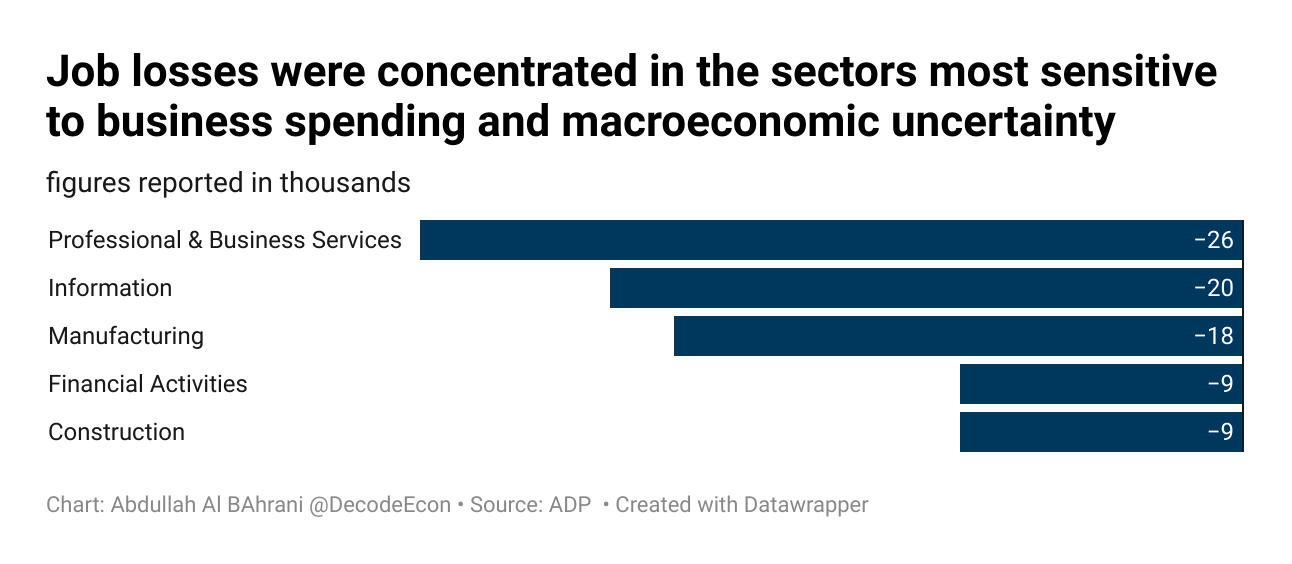
These industries tend to pull back early when firms become cautious.
Meanwhile, the bright spots were education/health (+33,000) and leisure/hospitality (+13,000), signaling that consumer-facing and care-economy sectors remain resilient.
Small Business Fragility Is the Story
The most important takeaway is the collapse of small firms. Micro firms (1–19 workers) lost 46,000, and Small firms (20–49 workers) declined by 74,000. These firms are more sensitive to higher interest rates, tighter credit, slower consumer spending, and rising labor costs. Their weakness often shows up months before a broader labor slowdown.
What About Pay?
On a positive note, even with weak hiring, wages continue to grow:
Job stayers: +4.4% annual pay
Job changers: +6.3% annual pay
The gap between job changers and stayers remains wide. Workers still get their biggest raises by switching firms.
The Bottom Line
This report gives the Fed new data but more to worry about. Are market uncertainty and tariffs starting to hit small businesses hard enough to weaken the labor market?
Small firms employ nearly half of private-sector workers. We already know that consumer confidence is slipping. That is a concern, since retail spending has propped up the economy to this point. A weakening labor market might signal to consumers that it is time to tighten their grip on spending.
The market had predicted that the Federal Reserve would keep its target interest rate unchanged. I expect that this data and recent reports of weakening manufacturing will complicate the discussion and the final decision.
Your article the other day on Small Business Saturday is still fresh in my mind. I understand that these job losses predated Saturday, but do you think the jobs shed by small businesses indicate that the largest firms are disproportionately driving the “resilient consumer” narrative?
The "Hospitality" catagory is seeing an uptick based on economic uncertainty related to individual income and inflation. (We're also seeing some reclassification due to immigration since "some" of the jobs are being filled by citizens where the tax records are a bit more exacting.) The number of individuals taking on second jobs is also a hedge about job situations.
Small scale retailers are unable to absorb tariff increases and have to chose cutting staff hours and owners being more present.
RTO is just a constructive firing technique.
It's going to take time for good data to be available regarding immigration effects on employment. Overall employment numbers may be negative for some time and still have an overall healthy employment situation.