


This is a guest post by Dallin Gariety.
Dallin Gariety is an Economics student and Research Fellow at BYU–Idaho whose research focuses on labor market outcomes, educational decision-making, and the ways economic information shapes student choices.
Skepticism toward higher education is growing rapidly. A recent NBC News poll found that 63% of voters believe a four-year degree is no longer worth it, with many believing students graduate with “a large amount of debt” but without “specific job skills.”
That is a brutal number. But I think the conclusion many people draw from it is too broad. College as a whole is not the scam. The bigger problem is that students are often pushed through college without seeing the labor-market risks attached to the specific major they choose.
That distinction matters. A college degree is not one product. It is a bundle of very different pathways that happen to share the same campus, tuition bill, and graduation ceremony.
The Decode
The economic mechanism here is human capital investment under imperfect information. That sounds technical, but the idea is simple: students spend years of time, tuition, and foregone wages preparing for a career before they fully know what their chosen field is likely to return. When that information is missing, students may sort into majors based on identity, family expectations, social pressure, or vague career impressions rather than on a clear picture of earnings, unemployment, and the risk of underemployment.
This is why the “college is worth it” debate often feels stuck. Broad averages can be true yet unhelpful. A student does not graduate into the average college degree. They graduate into a specific field, with a specific wage profile, a specific unemployment risk, and a specific chance of working in a job that does not fully use the degree.
To make those differences more visible, I grouped college majors using labor market data from the Federal Reserve Bank of New York’s Labor Market for Recent College Graduates. Instead of ranking majors by a single number, I used four outcomes: early-career wages, mid-career wages, unemployment, and underemployment. I then used k-means clustering, a method that groups similar observations together, to identify majors with similar labor-market profiles.
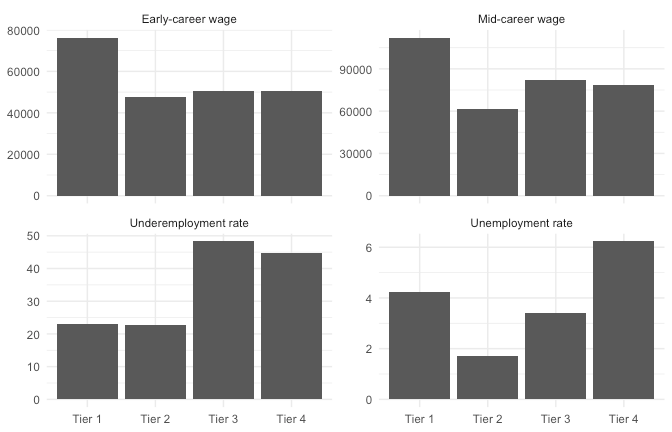
The tiers are not moral categories. They do not measure whether a major is meaningful, intellectually serious, or personally fulfilling. They describe labor-market profiles. In my updated analysis,
Tier 1 majors combine relatively high earnings with relatively low unemployment and underemployment. Across 73 majors in the NY Fed data, this group has an average early-career wage of $76,211, an average mid-career wage of $112,053, a 4.2% unemployment rate, and a 22.9% underemployment rate. Examples include Aerospace Engineering, Construction Services, Civil Engineering, Electrical Engineering, and Chemical Engineering.
Tier 2 majors look different. They may not dominate the wage rankings, but they tend to have more stable employment outcomes. Their average early-career wage is $47,471, with unemployment around 1.7% and underemployment around 22.7%. Examples include Special Education, Miscellaneous Physical Sciences, Elementary Education, Miscellaneous Education, and Secondary Education.
Tier 3 is the group that complicates the usual “high-paying versus low-paying” story. These majors often show mixed profiles: some earnings strength, but also more labor-market mismatch or employment risk. The average mid-career wage is $82,161, but underemployment is 48.3%. Examples include Engineering Technologies, Geography, Biochemistry, Journalism, and Public Policy and Law.
Tier 4 majors have the weakest labor market profile on average: lower earnings, higher unemployment, and higher underemployment. The average early-career wage is $50,312, while unemployment and underemployment rates are 6.2% and 44.7%, respectively. Examples include Architecture, Advertising and Public Relations, Pharmacy, Commercial Art & Graphic Design, and International Affairs.
The point is not that every student should chase Tier 1. Students should know which kind of risk they are accepting.
Why This Feels Personal
Imagine two students choosing majors during their freshman year. One chooses a field because it sounds practical. Another chooses a field because it feels personally meaningful. Both may be making reasonable decisions. But neither choice is fully informed unless the student understands the labor market environment associated with that field.
This matters because students do not choose majors solely for the money. Interest, identity, values, mentors, family expectations, and the feeling that “this is the kind of person I am” all matter. That is not irrational. But it does mean labor-market data should not be treated as a replacement for personal fit. It should be treated as the missing piece of the decision.
A good advising conversation should not ask, “What are you passionate about?” or say, “Pick the highest-paying major.” It should ask, “Do you understand the tradeoffs this path carries, and are you choosing it on purpose?”
My Take
Higher education increasingly asks students to make six-figure investment decisions while withholding some of the most important labor-market information needed to evaluate risk. I believe colleges should make those tradeoffs far more visible before students are deep into their degree plans. Not because earnings should dominate every academic decision, but because hiding the numbers does not protect students. It simply makes the decision less informed.
In many ways, the market for college majors behaves like any other market. When large numbers of students concentrate in a field faster than labor-market demand grows, wages tend to fall, and underemployment tends to rise. That does not mean the major lacks value. It means students are entering a more crowded market with different risks and rewards.
I think one of the biggest mistakes in higher education is treating all majors as economically interchangeable, even though the data clearly show they are not. Students deserve honest information about earnings, unemployment risk, dependence on graduate school, and career volatility before committing years of their time and tens of thousands of dollars. The goal should not be to push students away from certain fields. The goal should be to help them make decisions with clearer expectations about the trade-offs associated with different paths.
What This Means for You
If you are a student, do not ask only, “What can I do with this major?” Ask, “What usually happens to graduates from this major, and what would I need to do to beat the average?” The second half of that question matters. Internships, location, networking, graduate school, technical skills, and work experience can all change the outcome.
If you are a parent, advisor, or professor, the goal should not be to scare students away from certain fields. The goal should be to make the trade-offs visible early enough for students to respond.
The main thing I want readers to carry with them is this:
major choice is not just about passion versus pay. It is about choosing a path with a particular mix of opportunity, uncertainty, and risk.
What labor-market information do you wish someone had shown you before you chose your major or career path?
Sources and Notes
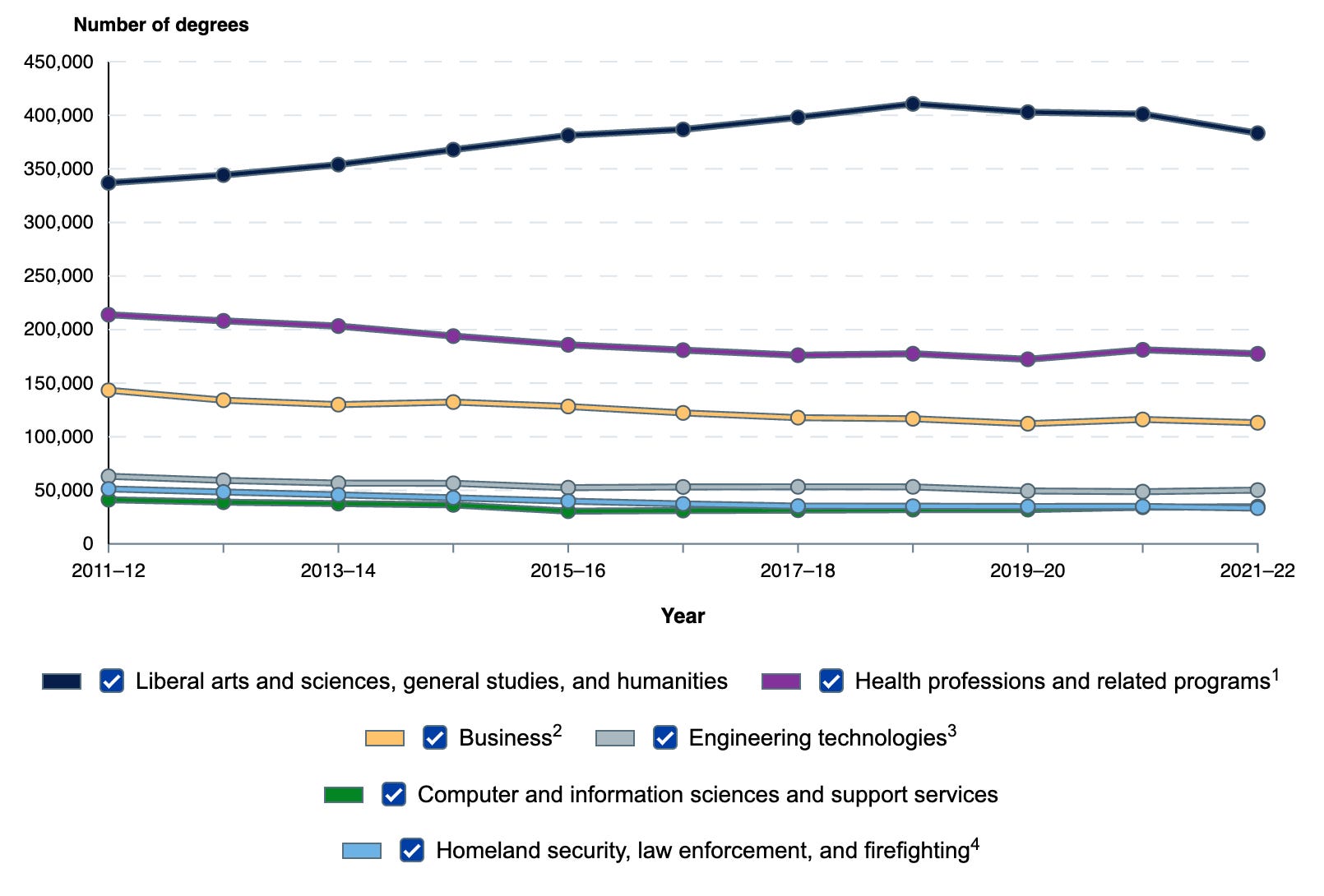
National Center for Education Statistics (NCES). Number of associate’s degrees conferred by degree-granting postsecondary institutions in selected fields of study: Academic years 2011–12 through 2021–22. Condition of Education, U.S. Department of Education.
https://nces.ed.gov/programs/coe/indicator/ctaFederal Reserve Bank of New York. Labor Market Outcomes of College Graduates by Major. Data derived from the U.S. Census Bureau American Community Survey (IPUMS), 2024.
https://www.newyorkfed.org/research/college-labor-marketPost Editorial Board. Americans are rightly waking up — much of higher education is now a scam. New York Post, November 30, 2025.
https://nypost.com/2025/11/30/opinion/americans-are-rightly-waking-up-much-of-higher-education-is-now-a-scam/
Methodological Note
Majors are grouped using k-means clustering on standardized early-career wages, mid-career wages, unemployment rates, and underemployment rates. The resulting clusters are ordered into tiers using a composite labor-market score. These tiers describe average labor-market profiles and should not be interpreted as deterministic predictions for individual students.

Asking a HS student to understand how Hindsight Bias of the questioner distorts their ability to predict a future outcome is irrational. Imperfect recall distorts memory and the resulting distortion of prediction nets poor outcomes.
College degrees used to be a measure of completion as much as skill based. Plenty of people were employed in fields outside their major. Some employment was in tangent fields, say a Physics major opting to teach HS rather than work in technical field.
They tracked how weather effected applications... rained that day? less likely someone applies.
https://www.nber.org/papers/w34944
Even with the best information available, most people will make a choice based on "feels", or Kyla's "Vibes". My nephew is entering his Senior year in HS and will make a decision that I'll not understand or potentially agree with due to factors neither of us will factor in. (He's actively avoiding schools attended by one side of the family to not upset the other side that didn't attend college... hugely irrational decsion tree!)
Maybe I am a bit of an outlier. But I absolutely chose my undergraduate degree by the extent to which it was meaningful, intellectually serious, and personally fulfilling. I studied Islam in the Department of the Study of Religion, which included courses on pilgrimage, Gnosticism, Zoroastrianism, as well as ancient and modern political philosophy, History of Art, Islamic Art, and on and on -- a wish list of the courses on the most important topics in the world. This was deliberate -- I always expected to go to graduate school. In grad school I studied the Arab World and Economics. Now I teach Economics in a VERY multi-cultural institution, and I think I have the best, most meaningful job in the world. I never really was in it for the money alone...