


A post by Antowan Batts
What does it mean to actually learn something in the world of AI?
That question matters more today than ever. Because artificial intelligence is now sitting in our classrooms, our dorm rooms, and our browsers. And while it promises efficiency, it may be quietly weakening the very thing education is supposed to build: your ability to think.
I love learning. Not because it makes money possible (though that’s real). I love it because of the moment when confusion turns into clarity. When something finally clicks.
AI shortcuts threaten that click.
Hear me out. LLMs and the more recent iteration of AI are still new, and we still have a lot to learn about our relationship with these systems. On the other hand, the early results are not promising. Early studies show that overreliance on AI can lead to declines in skills and retention. This is to be expected of relying too much on any tool, but it doesn’t stop there.
The Cognitive Debt Problem
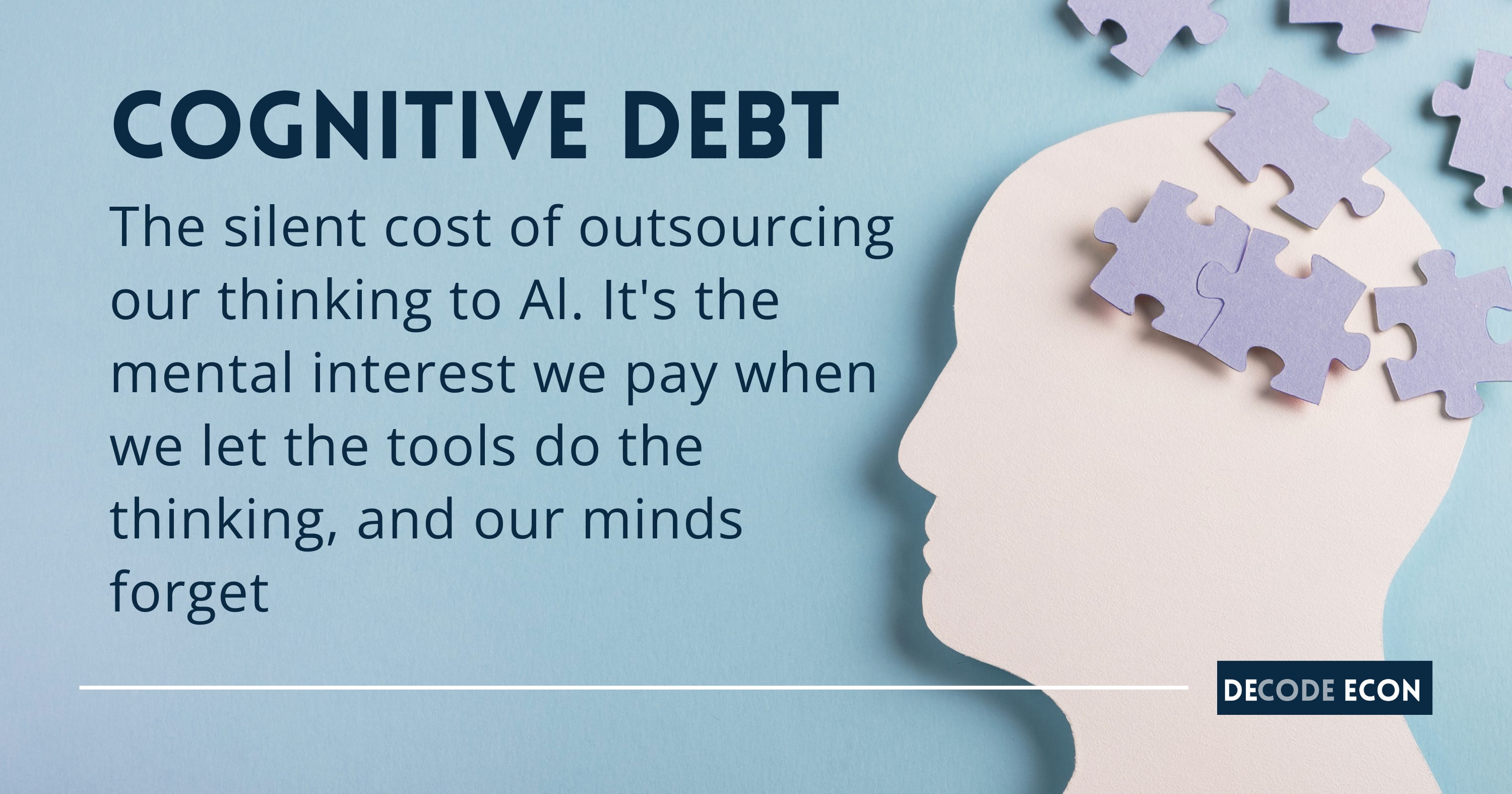
Researchers at MIT’s Media Lab have identified what they call “cognitive debt” - the accumulation of gaps in understanding that occurs when students use AI assistants for tasks like essay writing. Think of it like taking out a loan for your learning. You get the immediate result (the essay, the answer, the solution), but you’re borrowing against future understanding you never actually acquired. And unlike financial debt, you can’t just pay this back later with interest. Those neural pathways that would have formed through struggle and resiliency. They simply never develop.
This isn’t just about essays. When a student asks ChatGPT to solve a calculus problem, they get the answer, but they miss the struggle with the concepts that build mathematical intuition. The same occurs when AI summarizes a complex reading; it bypasses the cognitive work of identifying main arguments, evaluating evidence, and forming its own synthesis. The tool thinks, and the student’s brain remains a spectator.
The Great Retreat to Tradition
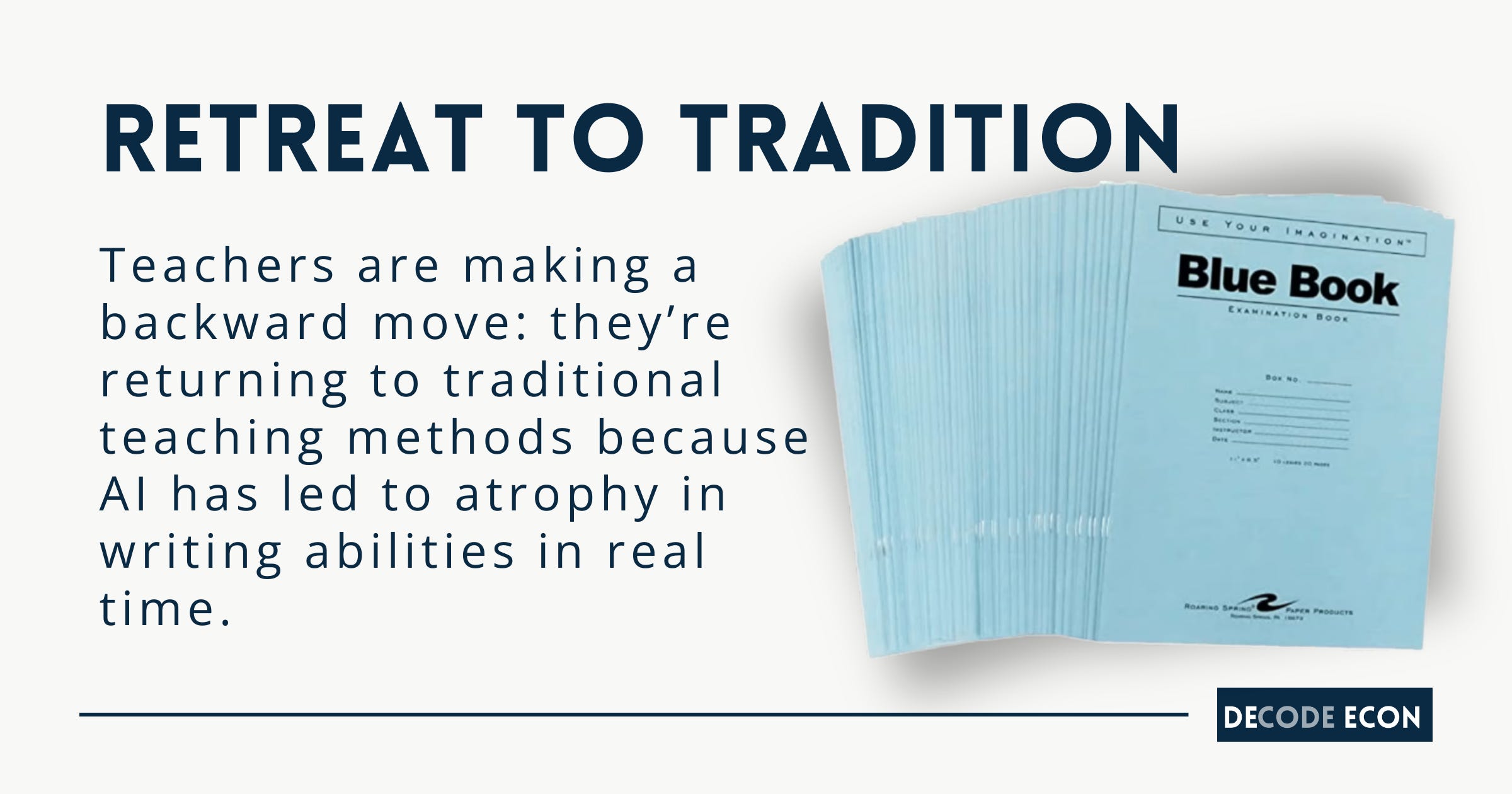
And educators are noticing. Teachers are making what might seem like a backward move: they’re returning to traditional teaching methods that many had abandoned years ago. One high school English teacher profiled by NPR has banned AI from her classroom entirely. Not because she’s a Luddite, but because she watched her students’ writing abilities atrophy in real-time.
The shift is real: More in-class essays written by hand. Oral presentations replacing written reports. Process-focused grading where students must show their work at every stage. Teachers sit with students during brainstorming sessions to ensure the ideas are their own. Some are even returning to blue book exams - remember those?
This isn’t nostalgia. It’s triage. These teachers aren’t rejecting technology wholesale - most still use educational software, online resources, and digital tools. But they’re drawing a hard line against tools that do the student’s cognitive work. Educators realized that you can’t teach critical thinking if a machine is thinking.
The Cheating Paradox
Here’s the messy part. Harvard researchers found that the reality of AI cheating is far more complicated than the wholesale academic dishonesty educators initially feared. Some students use AI as a brainstorming partner - ethical enough. Others have it written in entire sections - clearly cheating. But most fall somewhere in the murky middle: editing AI output, using it to “improve” their own work, or leaning on it when they’re stuck. The question becomes: at what point does assistance become replacement?
The problem is that students themselves often don’t know where that line is. When NPR asked college students about their use of AI, the responses revealed a troubling ambiguity. Many students view AI much as previous generations viewed calculators or spell-checkers: just another tool in the toolkit. They don’t see themselves as cheating; they see themselves as being efficient. But there’s a critical difference: a calculator doesn’t understand math for you. AI does understand - or at least appears to - and that’s precisely the problem.
The Skills We’re Losing
Beyond academic integrity, there’s a more fundamental concern: what happens to a generation that never develops certain cognitive muscles? Harvard researchers examining whether AI is dulling our minds found evidence suggesting that constant AI assistance may be weakening our ability to engage in deep, sustained thinking.
Consider what happens when you always have a shortcut available. You’re writing an essay and get stuck on how to articulate a complex idea - do you struggle through it, building your ability to communicate nuanced thoughts? Or do you ask ChatGPT to phrase it for you? The latter is faster, often better, and requires zero cognitive strain. Do that enough time, and you never develop the skill at all.
This extends beyond writing. Problem-solving, research skills, argumentation, and the synthesis of complex information are all “use it or lose it” capabilities. And we’re increasingly choosing not to use them. The Brookings Institution frames this as a need to help students “prosper, prepare, and protect” in an AI world, but prosperity built on skills you never actually acquired is a house of cards.
The Sad Truth
So yes, AI is making education worse - but the “sort of” matters. Technology isn’t inherently destructive. Used appropriately, AI could be a powerful learning aid. The problem is that appropriate use requires discipline, metacognition, and a clear understanding of learning goals. Qualities that most students don’t yet possess and that we’re not systematically teaching them.
The teachers’ retreat to traditional methods isn’t wrong. They’re protecting something precious: the irreplaceable experience of genuine learning. Of struggling with an idea until it clicks. Of building knowledge through effort rather than acquisition through prompts.
We have arrived at a fork in the road. We can continue to outsource our cognitive abilities, producing students who generate impressive-looking work without developing impressive-thinking minds. Or we can get intentional about preserving the struggle that makes learning real. The question isn’t whether AI belongs in education - it’s already there. The question is whether we’ll let it replace the very thing education is supposed to build: our ability to think.
Back in community college, I took a microeconomics class. The class was amazing, I loved learning about budget constraints, supply and demand, and markets. I received a C in that class. I was terrible at it, and I loved it. Now, 10 years later, I have a bachelor’s and a master’s in economics, the master’s of which I earned with a 3.84 GPA. I struggled with economics at every stage of my journey, and I love the field more now than ever. That joy could only happen because I struggled with the topic. That struggle is what has allowed me to become a college professor today. The most rewarding job I have ever had came after the longest fight of my life, and that is something that you cannot get from AI. The best things in life are the ones we fight for. So, please join me in the fight for our education.
Resources
NPR - “The risks of AI in schools outweigh the benefi.ts”
https://www.npr.org/2026/01/14/nx-s1-5674741/ai-schools-education
Brookings - “A new direction for students in an AI world: Prosper, prepare, protect.”
https://www.brookings.edu/articles/do-ais-risks-outweigh-the-benefits-for-students-and-schools/
Harvard Gazette - “The fear: Wholesale cheating with AI. The reality: It’s complicated.”
https://news.harvard.edu/gazette/story/2025/10/the-fear-wholesale-cheating-with-ai-at-work-school-the-reality-its-complicated/
NPR - “To AI or not to AI? Do college students appreciate the question?”
https://www.npr.org/2025/12/02/nx-s1-5626843/to-ai-or-not-to-ai-do-college-students-appreciate-the-question
NPR - “How a high school English teacher banned AI from her classroom”
https://www.npr.org/2026/01/28/nx-s1-5631779/ai-schools-teachers-students
Harvard Gazette - “Is AI dulling our minds?”
https://news.harvard.edu/gazette/story/2025/11/is-ai-dulling-our-minds/
MIT Media Lab - “Your Brain on ChatGPT: Accumulation of Cognitive Debt when Using an AI Assistant for Essay Writing Task”
https://www.media.mit.edu/publications/your-brain-on-chatgpt/
(Also on arXiv: https://arxiv.org/abs/2506.08872)
Additional citations
“AI Cheating Is Getting Worse” - The Atlantic (Aug 2024)
https://www.theatlantic.com/technology/archive/2024/08/ai-cheating-getting-worse/679548/
“Is AI Enhancing Education or Replacing It?” - The Chronicle of Higher Education
https://www.chronicle.com/article/is-ai-enhancing-education-or-replacing-it
“How Are Students Really Using AI?” - The Chronicle of Higher Education
https://www.chronicle.com/article/how-are-students-really-using-ai
“To avoid accusations of AI cheating, college students are turning to AI” - NBC News
https://www.nbcnews.com/tech/internet/college-students-ai-cheating-detectors-humanizers-rcna253878
“The Hidden Costs of Academic-Integrity Tech” - The Chronicle of Higher Education
https://www.chronicle.com/article/the-hidden-costs-of-academic-integrity-tech
“Should College Graduates Be AI Literate?” - The Chronicle of Higher Education
https://www.chronicle.com/article/should-college-graduates-be-ai-literate

Great post Antowan. In a recent discussion with the Decode Econ Faculty Network, this post was requested.
This post hits home in an emotional way for me. I’m a huge advocate in trying to convince people that an over reliance on AI is a huge detriment to the brain development of younger generations . I personally limit how much I use it, but I know plenty of people who don’t think it’s something to worry about and it hurts to see. Awesome post, really appreciate the effort and insight.