


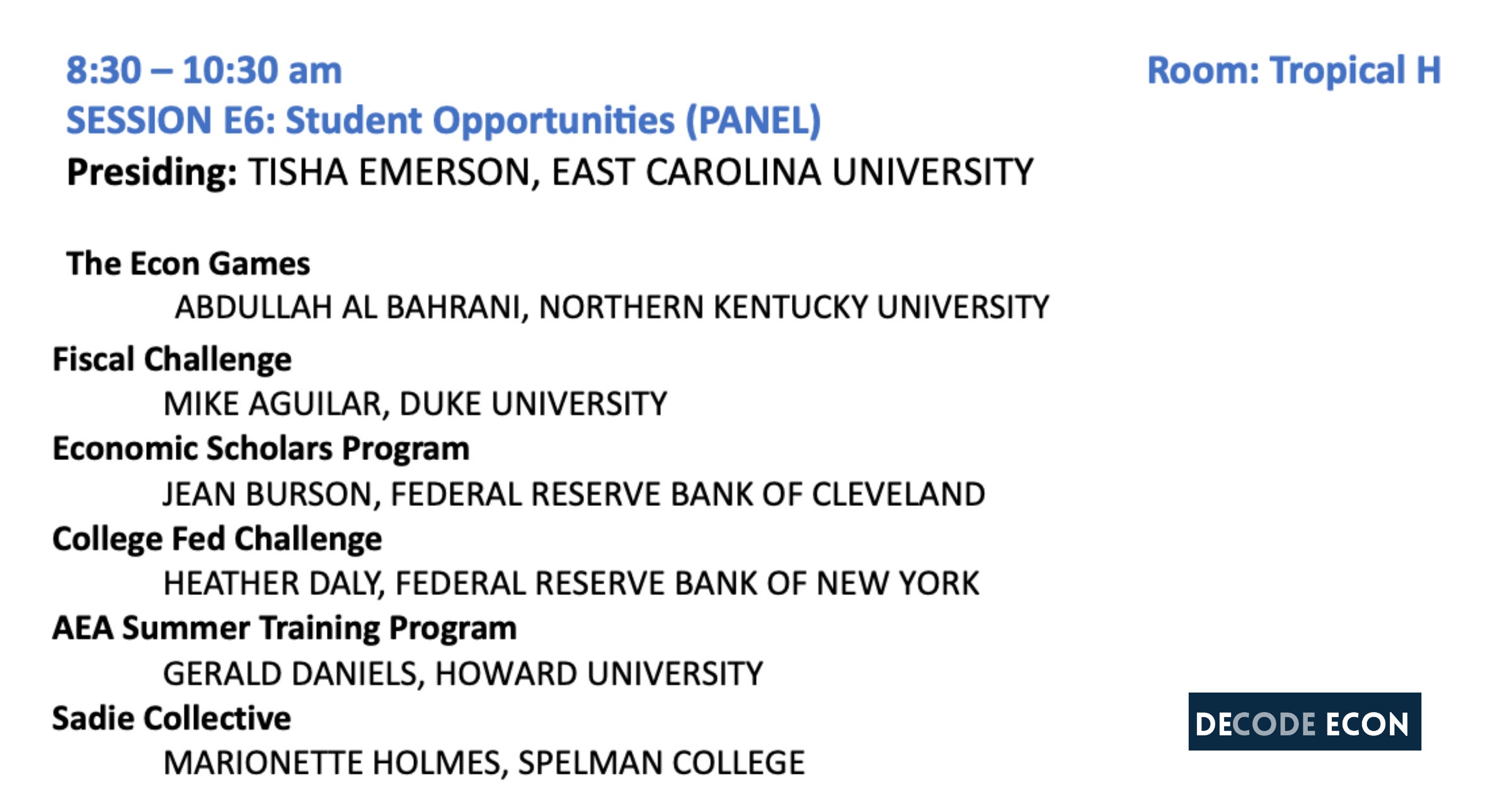
I’m in Las Vegas this week at the Conference on Teaching and Research in Economic Education (CTREE). In a couple of hours, I will present on a panel on student opportunities in economics. I’m on the panel with colleagues from Duke, the Federal Reserve Bank of Cleveland, the Federal Reserve Bank of New York, Howard, and Spellman. Each of us is talking about a program we believe gives students something they can’t get in a classroom.
I’m talking about The Econ Games.
You can access the slides here and read my notes below.


I wanted to write up my notes here for two reasons. First, many of you have been following the Econ Games since the beginning and deserve to hear the latest update. Second, we have some new data worth sharing.
It started with a horse racing company
Equibase Technology came to us with a problem. Equibase is the official data provider for North American thoroughbred horse racing. They collect GPS data, race performance data, and historical records. They have so much data. Their question was simple on the surface: horse racing is an aging sport. Attendance is declining. Younger audiences aren’t engaging. The sport is struggling to stay relevant in a world of instant data and digital entertainment. Can economics help?
The economic problem.
That’s actually a classic demand-side economics problem. Shrinking consumer base. Shifting preferences. The threat of a market in long-run decline. It’s also an information economics problem. Equibase has rich GPS data that could generate new value, but that value isn’t being captured or communicated effectively.
This is the kind of problem economics is built to solve. Consumer behavior, market structure, data-driven product design, it’s all there. But students almost never see it in economics classrooms. Not in this form. Not messy, open-ended, with real data and a real company waiting for an answer.
That gap is what the Econ Games were built to address.
What are The Econ Games?
The Econ Games is an applied economics competition in which student teams tackle a real-world business or economic challenge posed by an industry partner. They get real data. They work under time constraints. They collaborate in teams, get feedback from mentors, and present their analysis to a panel of industry judges.
This year’s competition had:
29 universities participating
225+ students competing
30+ faculty mentors supporting teams
The event was held in Lexington, Kentucky, co-hosted with the University of Kentucky’s Gatton College of Business and Economics
The Equibase prompt asked students to use GPS race data to develop a data-driven product or tool that delivers meaningful insights beyond traditional racing metrics. Something that could attract and retain new and younger audiences. Students had to analyze both traditional and GPS variables, demonstrate the added value of the data, and apply their solution to an actual upcoming race.
That’s applied microeconomics. In the real world. With real stakes.
The economics education problem underneath all of this
One of the slides is titled “The Econ Ed Problem.” I put it there on purpose, right after the Equibase story, because the two problems are connected.
Students ask:
What can I do with an economics degree?
Employers ask:
Why don’t economics graduates know how to communicate their analysis?
Both questions point to the same gap. We train students to think like economists. Specifically, academically focused economists. We don’t always train them to act like economists in an industry setting. How to take a real problem, work with imperfect data, collaborate across teams, and explain what they found to someone who isn’t an economist.
The Econ Games is a direct attempt to fill that gap.
Darshak Patel and I started this program to bridge exactly that distance between the economics classroom and the business world, where most of our students will eventually go. The program has grown since, but that original problem, the one that made us think something like this was worth building, hasn’t changed.
The data — who participates, and what we measured
Our research team, Darshak, Haley Wilder, and I, collected pre- and post-competition surveys from participants and used a matched sample approach to evaluate the program’s impact. Here’s what the sample looked like:
Full sample: 184 students
Matched sample: 137 students
Average age: 20.7 years
45% female, 55% male
71% White, 20% Asian, 12% Hispanic, 6% Black
76% declared economics majors
49% had taken 5 or more economics courses
17% had no declared economics major or minor at all
That last number matters. The Econ Games isn’t just for econ majors. It draws students from adjacent disciplines who want real-world problem-solving experience, and the program is intentionally designed to welcome them. It can serve as a path into the major or minor.
What we found.
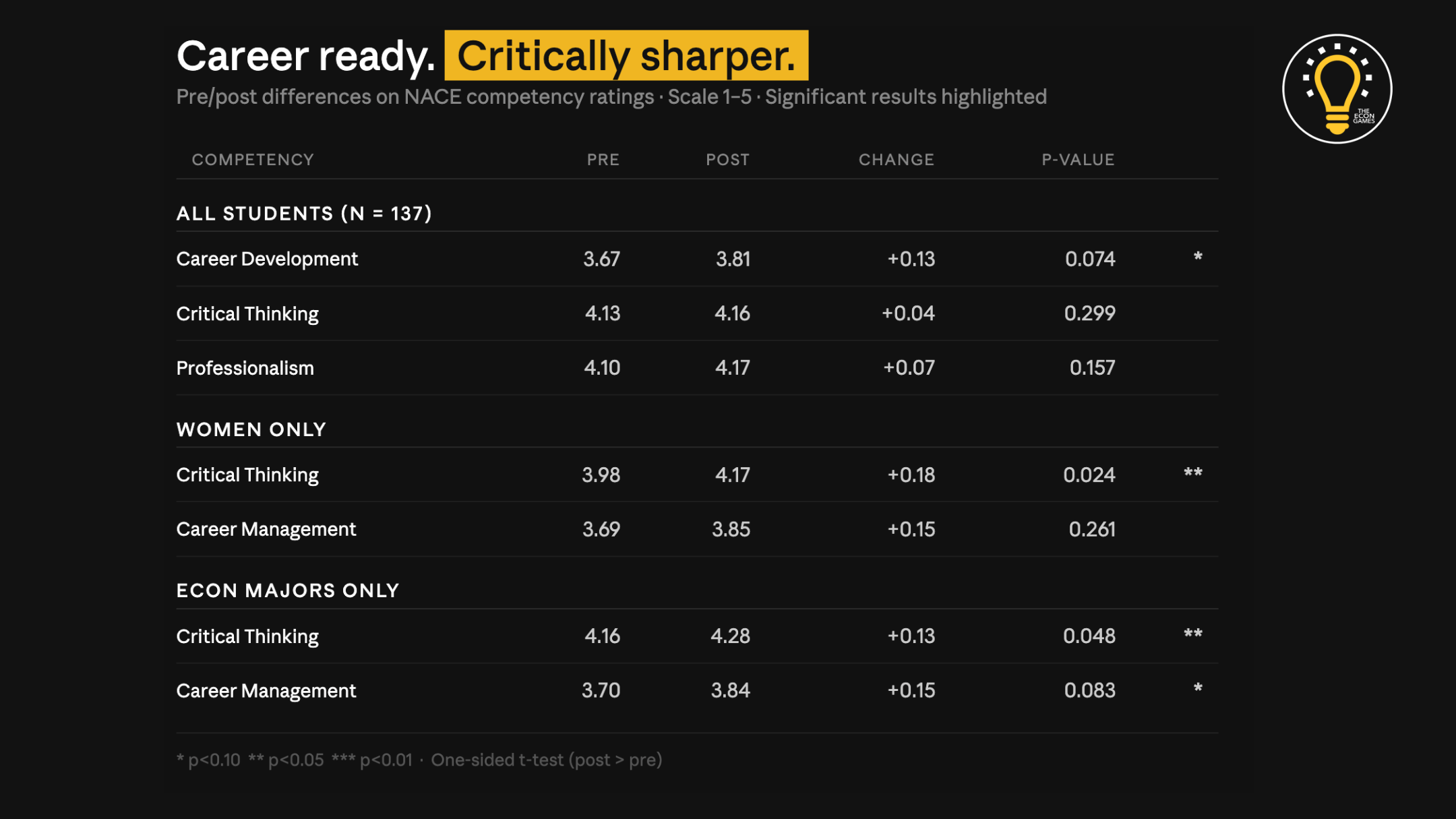
We measured students across three domains: NACE workplace competencies, what we call RBG (Relevance, Belonging, and Growth Mindset), and research and data skills.
Here are our early findings worth reporting.
Career development got better for everyone.
Across all participants, career development readiness improved significantly after the competition (p = 0.074). For economics majors specifically, career management also showed a meaningful gain (p = 0.083). These are students who came in already committed to economics, and the competition still moved the needle on how prepared they felt for the workforce.
Women showed the biggest gain in critical thinking.
This one stood out. Female participants showed a statistically significant improvement in critical thinking (p = 0.024), the sharpest gain of any group on that measure. The applied, team-based format of the Econ Games may be creating conditions where women are more likely to demonstrate and recognize their analytical capabilities. That’s not a small finding.
Men shifted on belonging and mindset.
Male participants showed significant gains across multiple dimensions of economic identity: comfort participating in economics discussions, sense of belonging in the field, and growth mindset. For men in the matched sample, the fixed-ability mindset item — “my abilities in economics are fixed and cannot improve with effort and practice” — shifted significantly toward a growth orientation (p = 0.006).
The strongest finding of all: communication.
Across every group we analyzed — all students, women, men, and economics majors — the ability to communicate economic ideas and findings to others improved significantly. The full-sample result was significant at the 0.1% level (p = 0.001). This held for women (p = 0.012), men (p = 0.006), and economics majors (p = 0.001).
Communication is the number-one skill employers say economics graduates are missing.
The finding that surprised me most
After the competition, students rated applying economic theory to real-world problems as harder, not easier.
At first glance, that sounds like a failure, but it isn’t.
What it reflects is a more honest self-awareness about the theory-practice gap. Students who participate in the Econ Games encounter a difficult problem. They struggle with imperfect data. They get professional feedback on their analysis. And on the other side of that experience, they have a clearer picture of what they don’t yet know.
That’s what learning looks like. It’s not confidence that everything is easier; it’s an honest realization of the gap between textbook economics and real-world economics. The result was significant across all students (p = 0.021), men (p = 0.003), and economics majors (p = 0.009).
We’re calling it productive struggle, and I think it’s one of the most important things the Econ Games produces.

What this means if you’re an economics educator
The Econ Games is not a substitute for rigorous coursework. The sharpest gains in the data are often among students who are already deeply committed to economics; they reinforce and extend academic preparation, not replace it.
What it does is function as a bridge. It converts theoretical knowledge into applied confidence. It gives students a professional context in which to demonstrate what they know. And it connects them, through industry partners, faculty mentors, and cross-university competition, to a broader community of practice in economics.
If you’re an economist at a university and you’ve ever had a student ask you what they can do with an economics degree, the Econ Games is one answer worth knowing about.
What’s next?
Darshak and I continue to ask how we can increase value to participants and the economics community.
Three areas we are investing in for 2026-2027 are:
Regional Econ Games: We have an interest in the Carolinas, Texas, and Utah
Graduate School and Program Bridge: We have 200+ students annually seeking their next opportunities. We would love to help them connect to their next offering, whether it is a job, graduate school, or a new program.
Faculty Opportunities: We are connected with student-focused educators committed to making economics accessible. We would like to identify new opportunities for them.
Subscribe if you haven’t. Share this if someone you know needs to see it.
And if you’re reading this while at CTREE, stop by session E6.
— Abdullah
Stuff like this is why I love the games and am a big supporter
Great presentation last week. I'm excited to see how this paper turns out.