


The war against Iran is now in its seventh week, already lasting much longer than the administration expected or wanted. The interaction between Iran and the U.S. has become a strategic game, one that has challenged both sides’ assumptions and their willingness to escalate. The question now is simple: how far is each side willing to go?
Iran’s strongest position and most powerful tool is oil. By leveraging its geographic control over the Strait of Hormuz, it can inflict real economic pain on the U.S. through higher energy prices. Americans have shown a willingness to tolerate a lot from this administration, but that patience fades quickly when it hits their pocketbooks. Iran understands that.
I don’t want to minimize the human cost; the death and terror being experienced in Iran and other war zones are real. But the economic front of this conflict is increasingly centered on the oil market. Iran is trying to push prices up. The U.S. is trying to bring them down.
Let’s Look at Oil Prices
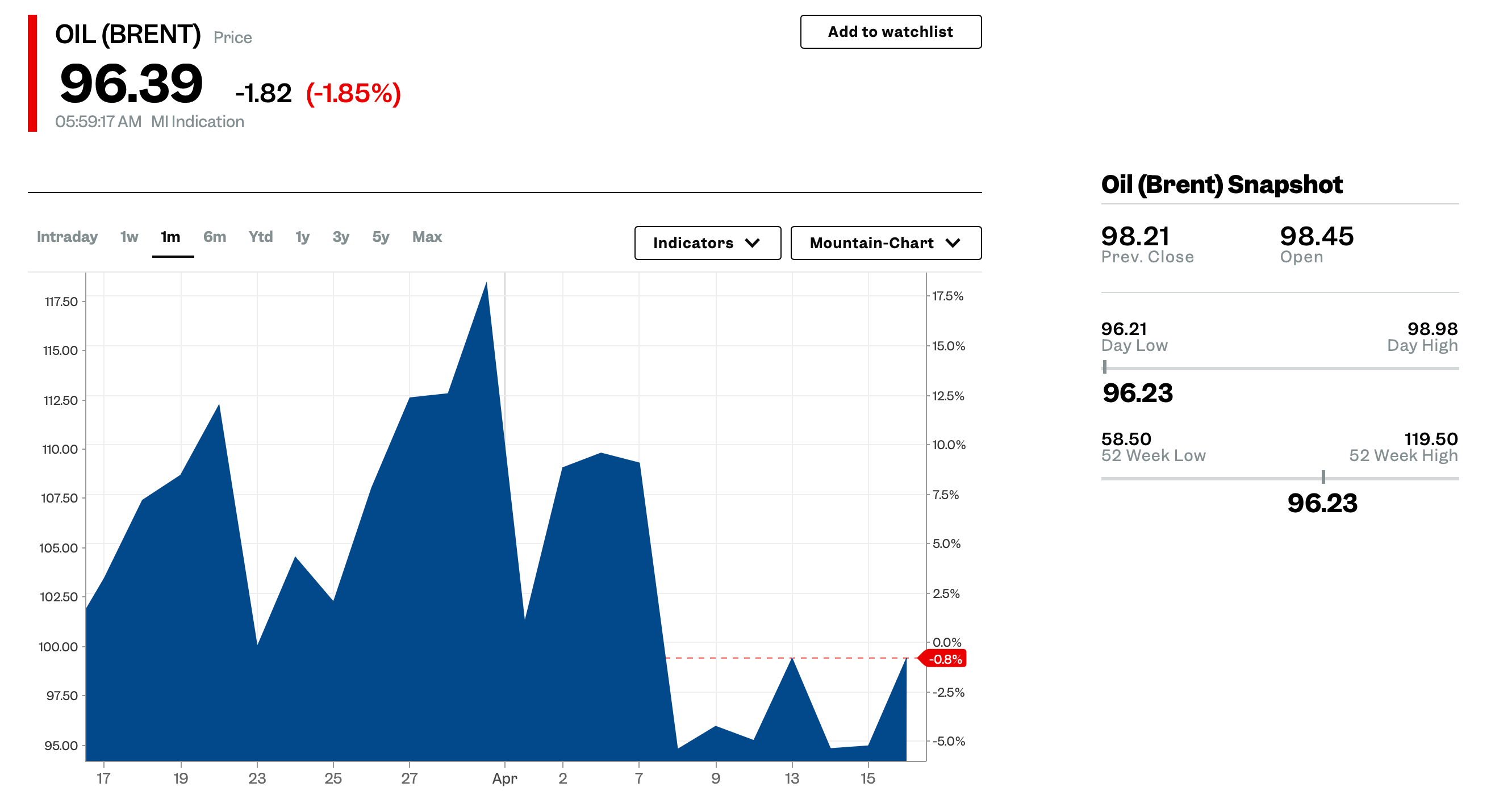
Brent crude hit a high of $110 on April 6. Prices have been volatile and are currently around $97. The recent decline reflects diplomatic signals from Washington suggesting a potential easing of tensions with Tehran. Trump has indicated that Iran may be willing to accept terms it previously resisted, including reopening the strategically critical Strait of Hormuz.
But the reality is this: the tension is far from over. Oil prices will continue to swing with each new headline, press conference, and signal. Whether it is real or perceived.
“America Has Enough Oil”—So Why Are Prices Rising?
It’s true, the U.S. is now a net exporter of oil. But oil is a global commodity, and the U.S. does not directly control its price. Prices are set in global markets.
And right now, the global market has access to less oil than it did seven weeks ago.
This is shaping up to be one of the largest oil supply disruptions in history. Bank of America estimates that in March alone, the global economy lost between 14 and 15 million barrels per day.
Let’s Talk About What Comes Next
This week marks an important turning point: the last oil tanker that left the Middle East before the war began has now arrived.
According to Sea Rates:
An oil tanker typically takes 35 to 50 days to travel from the Middle East to the U.S. Gulf Coast—a roughly 12,000-mile journey. Many vessels reroute around the Cape of Good Hope, adding time. Speed (averaging about 13 knots), route choice (Suez Canal vs. longer routes), and port congestion all influence delivery timelines.
That lag matters. What we are experiencing now reflects decisions and disruptions from over a month ago. What happens next will reflect today’s conditions. It also means that if the conflict ends today, we will still experience oil disruptions based on the transportation lag.
Oil and Your Pocketbook
Inflation data released last week showed year-over-year inflation at 3.3%, with core inflation (excluding food and energy) at 2.6%. The gap tells the story: energy is driving the increase.
Fuel oil is up 44%. Gasoline is up 19%.
For now, markets expect these spikes to be temporary. But there is a real risk that higher energy costs begin to filter into broader consumer prices. If that happens, the next CPI report will show more widespread inflation across categories.
So far, many firms are avoiding permanent price increases. Instead, they are introducing temporary energy surcharges. This gives them flexibility; prices can come back down if oil does.
But if oil stays elevated, those “temporary” adjustments may not stay temporary for long, and that is the real threat.
The Path to $200 Oil
Whether oil reaches $200 a barrel will not be determined by fundamentals alone; it will be determined by signaling and market expectations.
Right now, the oil market is not just reacting to supply and demand. It is reacting to expectations. And those expectations are being shaped by the strategic signals coming from Iran and the United States.
Iran understands its leverage. It knows that sustained high oil prices can create economic pain inside the U.S., eroding domestic support for the administration. It also knows that if a conflict, one widely perceived as initiated by the U.S., leads to global economic hardship, it can weaken American standing with European allies already sensitive to energy shocks.
The U.S. administration understands the stakes just as clearly. One of its most central political promises, affordability, is directly threatened by rising energy prices. As the midterm elections approach, higher gasoline and energy costs are not just an economic issue; they are a political liability. The administration needs oil prices to move down, not up.
This is what makes the current moment fragile.
Every statement, every diplomatic signal, every perceived concession or escalation is being priced into the market in real time. If Iran can convince markets that supply disruptions will persist or worsen, prices will climb. If the U.S. can convince markets that a resolution is near and supply will stabilize, prices will fall.
The path to $200 oil is not inevitable. But it is possible.
And it will depend on one thing: which side can send the more credible signal about where this conflict is headed next.
Thank you for an excellent post. One slightly tangential issue I would like to inquire about: the price of fertilizer just as the planting season occurs in the Northern hemisphere -- this will raise food prices by Fall. Do you have a good estimate by how much?
I believe we are seeing the divergence in Commodity Pricing vs the Physical Pricing for oil when $200 a barrel comes into play. The market for oil reacts to the signals from various news outlets while the physical pricing includes the insurance, transport, labor related expenses.
"Rises like a rocket, falls like a feather" is the most common phrase to describe oil pricing and the distillate refinery products like petrol, plastics, diesel, etc.
I'm finding that I agree with something Ray Dalio wrote this week about the globe being in a world war (note lower case). We're seeing kinetic actions in the Middle East and Soft Power tug-of-war with the addition of other global economic forces engaging in gamesmanship via material supplies to continue that kinetic action.
The US responds by tariffs, China floods markets and uses Belt and Road Initiative related goals, Russia sits on a nuclear arsenal and meddles in Africa and Ukraine (They've left Cuba long term).
Classic Triadic Game where the defection is economic ties even when there is military threats consistantly being used.
*In a nod to Jack, ordering Celcius by the case from Amazon ran $19 for 12. Yesterday that same case cost $29. Aluminum and bottler fuel fees are hitting the marketplace since the Gulf region supplies 10% of global supply, and the US is a customer of that supply.