


Pakistan is one of the most beautiful places in the world. It has a rich culture, incredible food, and some of the warmest people you’ll ever meet. That’s why the emerging demographic crisis worries me so much.
And no, this isn’t a Malthusian “too many people, not enough food” argument. The problem isn’t population size. It’s that Pakistan’s economy and institutions aren’t keeping pace with its fast-growing population.
The Problem
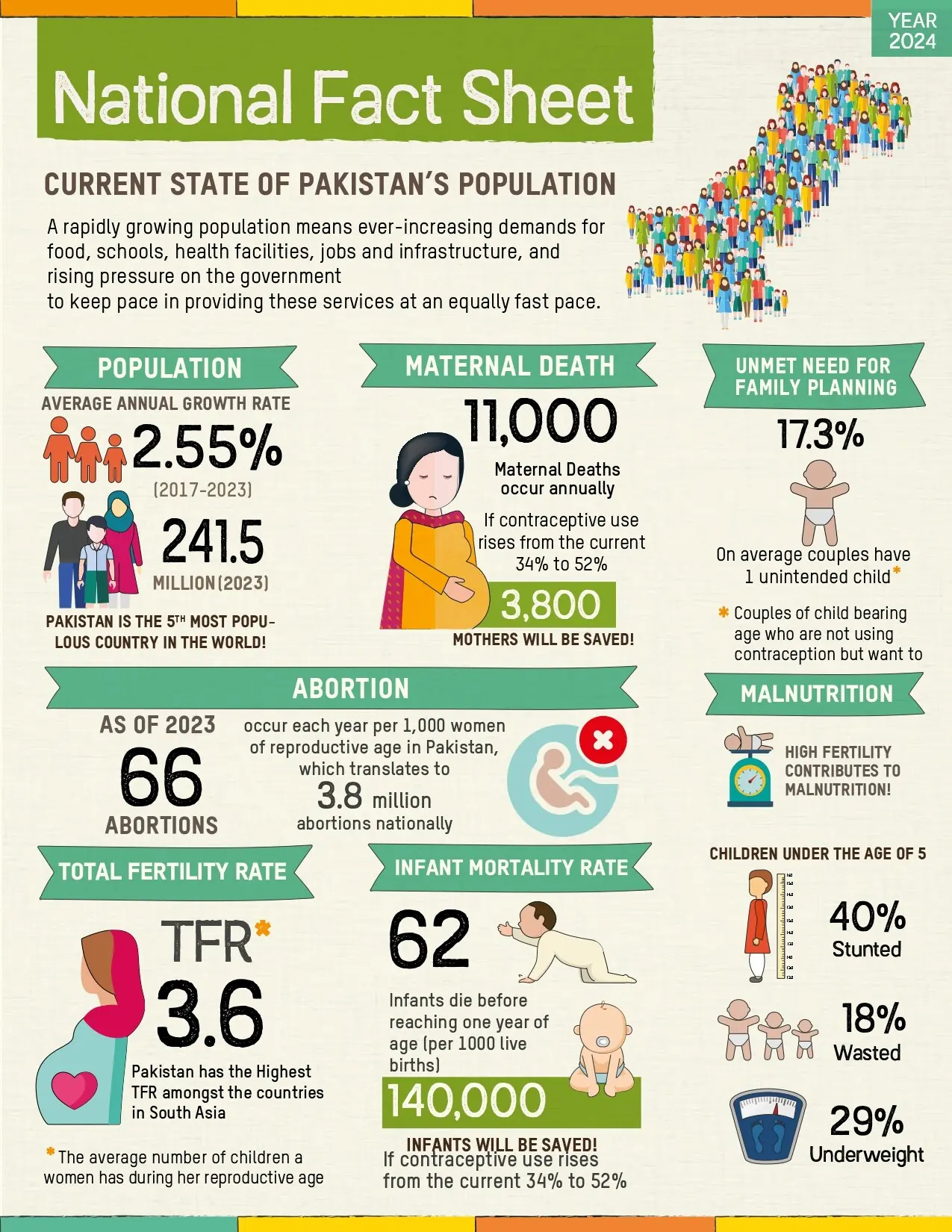
Pakistan’s population has reached 241.5 million and is expected to hit 300 million by 2030, and could exceed 400 million by 2050. At current growth rates, the country simply isn’t expanding its resources fast enough to support that trajectory. Pressure on food systems, hospitals, infrastructure, and job creation is mounting.
This gap creates real risks: strained public services, rising unemployment, climate-driven food insecurity, and even large-scale migration.
But there’s good news: none of this is inevitable. And there are smart people, inside and outside Pakistan, working on solutions.
The Economics: Population Pressure vs. Population Dividend
The population itself isn’t the enemy. Large populations have powered economic miracles in places like the U.S., China, and South Korea. The key difference? Their population growth was paired with rising productivity and strong institutions.
For Pakistan, the challenge is that several foundational systems are not growing at the same pace as its people. Pakistan's fertility rate is 3.6, the highest in South Asia. For comparison, the U.S. has a fertility rate of 1.6, which is too low.
When the population grows faster than economic opportunity, you get demographic pressure.
The Path Forward: Turning Pressure Into Potential
Experts consistently point to six strategies that can change Pakistan’s trajectory.
1. Invest in Education—Especially for Girls
Education is the strongest driver of long-run growth. Improving literacy and school access would. Education increases productivity and income. Bangladesh, Vietnam, and South Korea all followed this playbook.
2. Expand Healthcare and Family Planning
When families have reliable access to maternal care, vaccinations, and contraception, fertility rates fall naturally, and outcomes improve across generations.
3. Build Climate-Resilient Infrastructure
Pakistan is urbanizing quickly and is among the most climate-vulnerable countries in the world. Population growth magnifies climate risk unless infrastructure evolves.
4. Strengthen Labor Markets and Entrepreneurship
With more than 60% of Pakistanis under 30, this is either a demographic dividend or a time bomb. What does Pakistan need?
Easier business formation
Vocational training linked to tech and modern industries
Support for SMEs
Better digital infrastructure
Incentives for foreign investment
Young, skilled workers can attract global industries, but only if an ecosystem supports them.
5. Improve Governance and Reduce Political Instability
No demographic strategy works without stable institutions. Investors—domestic and foreign—need predictable rules. Pakistan must prioritize:
Stronger democratic institutions
Judicial independence
Fiscal stability
Better tax collection and public spending
Anti-corruption efforts
Governance is the multiplier that makes everything else work.
6. Use Better Data for Better Planning
Demographic success relies on anticipating problems before they appear. Pakistan needs:
High-quality population data
Urban planning models
Resource early-warning systems
Coordinated federal–provincial planning
Benchmark-based sustainability targets
Good data turns guesswork into policy.
Bottom Line
Population growth isn’t Pakistan’s downfall; it’s that the population is growing faster than the infrastructure can keep up. Population growth has been a theme we have covered here lately. In the U.S., the problem is the opposite; the population isn’t growing fast enough. This is why economists spend so much time examining population pyramids.
Countries have overcome similar challenges before. Pakistan can absolutely do the same, if it aligns its policies with its people: their health, their education, and their economic opportunities.
What Pakistan faces is a planning problem, an investment problem, and ultimately a governance problem. And it is solvable.
Would you like to help us?
Before you go, we have a quick favor. As we start planning for 2026, we want Decode Econ to grow with its readers, not away from them. We put together a short, 3-minute survey to learn more about you, the content you value most, and how this newsletter can improve and expand. Your responses will directly shape future topics, formats, and new features, and we are also collecting brief testimonials to help spread the word. The survey is completely anonymous unless you choose to self-identify in the testimonial. If Decode Econ has helped you better understand the economy, we’d truly appreciate your input.
Take the survey here:

Excellent, this is an ideal case study for geography teachers, teaching about population and development. I will share with my geography teacher groups.
Hi, Antowan- Excellent article! A couple of comments:
- Yes, you hit the nail on the head. For China, a large youth population was a tremendous boon, enabling the fastest economic growth in history. For Pakistan and other countries that have much higher population growth than growth in jobs, high fertility leads to disaster. What enabled China to harness the human capital that resided in their youth? Job creation and investment in human capital (education). What enabled them to manage this? Strong governance, oriented strongly toward national economic growth. There is reason to say that good governance needs to come first, as the prerequisite for all the rest -- this is what Pakistan lacks. And it is hard for it to achieve that, because of national disunity -- largely as a result of Islamism. I would argue that Islamism, in a way parallel to Christian nationalism in the US, is a kind of populist rebellion against a long history of unwillingness on the part of elites to improve the situation of the lower classes. People hope/believe that Islam will make them better off culturally, but also more prosperous, as with US Christian nationalism. Unfortunately it is not true. In China Communism provided a revolutionary fervor that was eventually under Deng Xiaoping applied to making the nation more prosperous for its citizens. People believed the government was working for them. In South Korea national prosperity began as a rightwing dictatorship that nevertheless demonstrated that it was dedicated to the project of rebuilding the nation for the sake of the Korean people, so they worked hard to make it a reality. In Pakistan, and to a worrisome extent in the US, the population does not trust the government to be on the side of the people -- and largely for good reason.
- Also, the idea that a US fertility rate of 1.6 is "too low" is debatable. Humans and their livestock and domestic animals make up 95% of all mammalian biomass on Earth. This is a railroad train running directly at human (and many other species) survival on this planet. We really do have to give up on increasing the human population of this planet. https://ourworldindata.org/wild-mammals-birds-biomass?utm_source=OWID+Newsletter&utm_campaign=700cc5fbd2-owid-brief-2025-12-12&utm_medium=email&utm_term=0_-0c7f305164-515551285