


Summer is a great time to rest and evaluate what we do. We’re doing that at Decode Econ, and I’m doing the same thing in my career and teaching.
I just got back from the Conference on Teaching and Research in Economics Education (CTREE). It helped facilitate a lot of reflection. One thing I left with is the power of trust and community in education. This is always an important question but especially in the era of AI, where content is easy to find, but someone still needs to bring it to life. My view is that the role of the educator is more important than ever, not less, as some might argue. But the work we do has to be reshaped.
Here is what I want you to keep in mind:
The content is not the job. The content is the vehicle. The job is helping the person sitting across from you grow.
WHAT’S ACTUALLY HAPPENING IN EDUCATION
AI has dramatically reduced the cost of accessing information. A student can ask an AI to explain comparative advantage, get a worked example, and move on. That part of the traditional educator’s job, content delivery, is being commodified fast. What is missing is the teaching. AI is not a good teacher, at least not in its current form.
There’s a difference between access to information and teaching, and we’ve started to confuse them. Information tells you what. Teaching shows you how to think, how to sit with a hard problem, how to know when your answer is wrong, how to build the confidence to try again when it is. A language model can give you the answer. It cannot give you the moment of genuine struggle that makes the answer stick. What I have called productive struggle and what I believe makes up good learning.
The education system spent two decades chasing scale. Bigger classes. More online courses. MOOCs that promised to democratize learning for millions. Completion rates on those courses are still sitting below 10%. The content was fine, most of the time excellent.
But most people didn’t finish because finishing requires more than access to information. It requires someone who notices when you’re stuck. Someone who adjusts. Someone who pushes back when you’re wrong and encourages you when you’re close. That is teaching. And it does not scale the way a video lecture does.
The answer is not more technology. It is a return to quality teaching. Those two things are in tension, and we need to stop pretending they’re not. Do not get me wrong, good teaching can happen in large courses, but it requires a whole lot more work. The institutions that figure out how to provide quality teaching will be the ones still standing when the enrollment cliff hits. The ones that don’t will find that no amount of AI integration saves a model built on the wrong premise.
WHAT EMPLOYERS ARE ACTUALLY ASKING FOR — THE BLS DATA
Here’s where the data gets interesting, and where a lot of educational institutions are looking in the wrong direction.
The Bureau of Labor Statistics published its 2024–34 employment projections alongside a new dataset: the top skills required across every major occupation group. I went through all of it. Not one of the top skills is content-focused.
Across all 170 million workers in the U.S. economy, the top three skills employers need are Adaptability, Detail-Oriented, and Interpersonal. Not coding. Not subject-matter expertise. Not technical credentials. The skill that ranks #1 across 22 of 22 major occupation groups- management, healthcare, construction, education, sales, you name it- is Adaptability.
Think about what that means for a moment. The fastest-growing occupations- nurse practitioners, wind turbine technicians, solar installers- all list adaptability and interpersonal skills ahead of technical knowledge. Even computer and mathematical occupations, where you’d expect hard skills to dominate, rank adaptability second, right behind technical computing skills.
The labor market is not asking for more content delivery. It is asking for humans who can navigate uncertainty, read a room, and work with other humans. Those are teachable skills. But they are not taught in a lecture. They are not learned from an AI. They are developed through relationships, through feedback, through being pushed by someone who actually knows you and cares.
The skill employers need most across every sector of the economy — from management to healthcare to construction — is adaptability. You don’t learn that from a textbook. You learn it from someone who challenges you and cares.
This is the argument I wish more deans and provosts were having: if the labor market is pricing human skills above content knowledge, and AI is eating content delivery, what exactly is the justification for large lecture halls, 200-student courses, and transactional faculty relationships? The data doesn’t support that model. The economy doesn’t support it. And increasingly, students aren’t supporting it either; they’re voting with their feet at enrollment time. They are looking for apprenticeships and guides to facilitate their next steps and growth.
Education is getting a bad name because we are refusing to adapt and revisit exactly what we do. We are more than just subject-matter experts; we are educators. Teaching requires more than what we are currently providing.
THE POWER OF COMMUNITY AND TRUST
The future of education relies more on mentorship and trust. Deeper connections. Think coaches and personal trainers, not mass fitness gyms. It requires faculty to invest in their own interpersonal and relationship-building skills. It also means we need to rethink enrollment, class sizes, and most importantly, the business model of education. This will also have implications for equity and who receives quality education. That’s a discussion for another time.
Today, I want to focus on what I mean by quality teaching. I referenced it in a previous post when I discussed the “Commodification of Everything”: education needs to shift back to the local, personalized level.

That means educators need to focus on building trust, a sense of belonging, and connections. This is my area; I have built my career on programs centered on exactly this point. Although I’m an economics professor, I see my role as mentor and coach. When students come to my class for the first time, I think of it as a lifelong relationship, and I invest in it as such. Not every connection will be of that type, but my intentions have to be set. Because intentions impact every other aspect of how you and I show up.
Al-Bahrani, A. (2022). Classroom management and student interaction interventions: Fostering diversity, inclusion, and belonging in the undergraduate economics classroom. The Journal of Economic Education, 53(3), 259–272. https://doi.org/10.1080/00220485.2022.2075507
If you can’t access the paper and want a copy, email me
THE OFFICE HOURS PROBLEM
This week, my post on office hours blew up, relatively speaking. I heard from educators and administrators. I was hoping to hear from more students, but some chimed in.
My post covered something I hear often:
Students don’t come to office hours; it feels like a waste of time. How do you get students to show up?
If you walk down the halls of Haile College of Business, you know my office hours are loud and packed. Students just hang out; sometimes they linger beyond my scheduled hours, and I have to tell them I need to go.
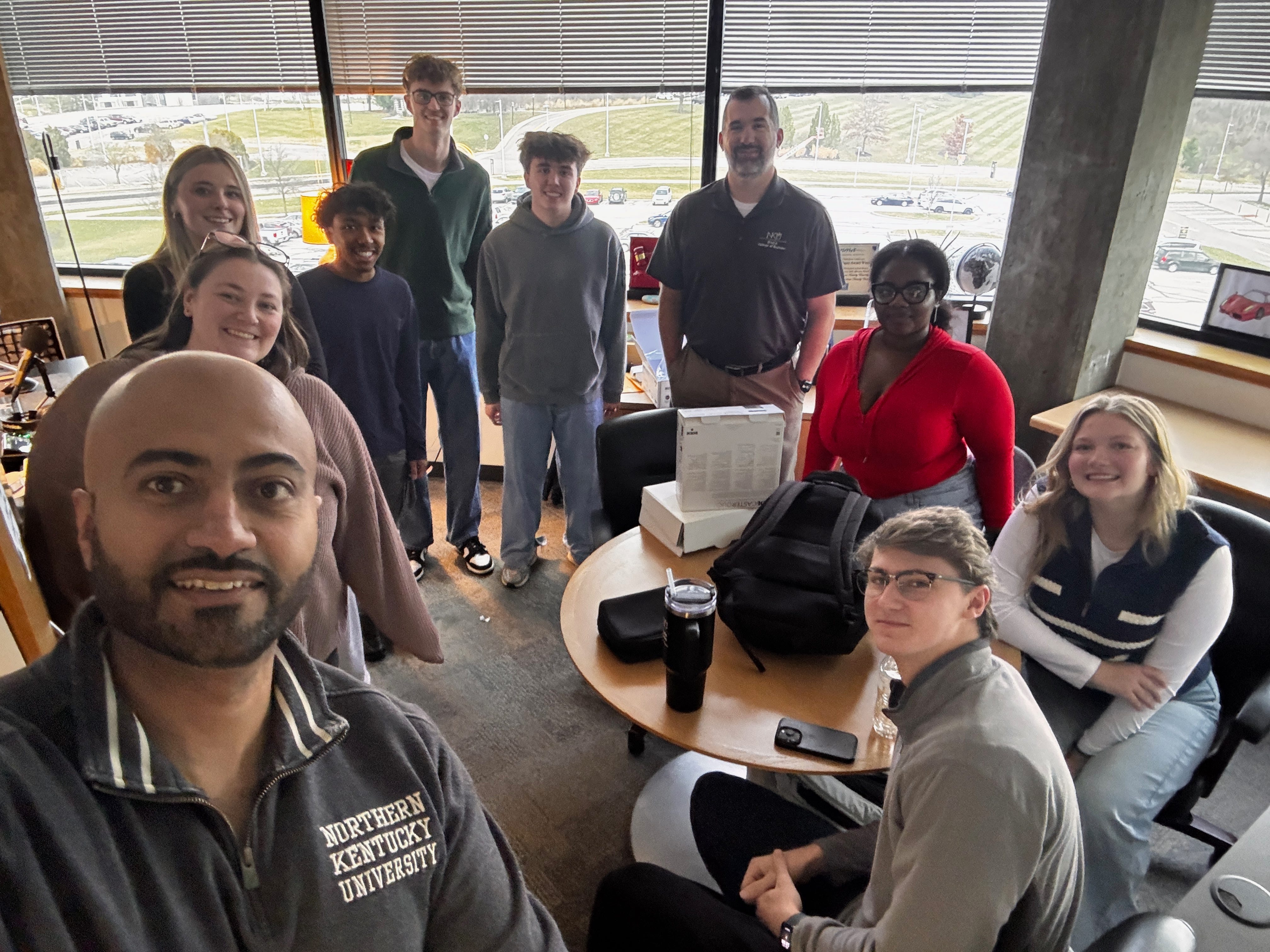
But it doesn’t start that way. At the beginning of every semester, things start slowly, and I have developed an approach to inviting students that I want to share with you. The method is simple, but you have to genuinely believe that office hours matter and truly want to connect with students. Dr. Jeni Al Bahrani followed my blueprint and improved on it. Her office hours are even better than mine now. Maybe I’ll have her on the podcast to discuss her approach.
Here’s How it Works:
Invite them. Repeatedly. The first two weeks, no one shows up. That’s normal — students aren’t used to being genuinely invited. Keep inviting anyway. I am not beyond sounding desperate. Here is an Instagram post where I creatively express that office hours are underutilized. It worked! I am not saying you have to create your own Instagram plea, but I am saying that your initial invites will seem desperate. You have to be ok with that.
Get to know them before you try to help them. When the first student walks in, ask three or four questions about them, not about the assignment. People show up where they feel seen. Think connections before content. If a student shows up and your first question is “how can I help you?” you aren’t building a community. You have communicated that this space is transactional. My approach goes something like:
“ Hey, thanks for stopping by, remind me of your name again”
“ Come on in, have a seat. How are classes going for you?”
“Other than my class, do you have a favorite?”
“What’s your major?”
“What year are you?”
“Do you like it here at NKU?”
“Are you from the area?”
“What high school did you go to?”
“Thanks so much for stopping by to see me today, it’s nice to have someone visit office hours. Did you have a specific question or did you want to just hangout?”
That last question is important because it signals that it is okay to just show up and hang out.
Close the loop in class. Mention, without embarrassing anyone, that a student stopped by and how valuable that conversation was. Publicly signal that office hours matter and that they’re not a waste of your time.
The real secret? Students show up when they genuinely believe you care, not that you’re just tolerating them.
Relevance
Beyond office hours, your content needs to be relevant to students. That means investing in learning what they care about. Social media has been useful for me to research what my students are thinking about. But I also just ask them at office hours.
BELONGING AS AN ECONOMIC STRATEGY
Belonging was what I sought as a student. I needed to feel like I belonged in the space and that my surroundings reflected a piece of me. I have a paper on how to create exactly that kind of environment.
But other ways I’ve leaned on recently include community building: an Oreo party for the student in my class who mentioned her birthday was coming up and that she’d never had a chance to celebrate it. Or the student art projects hanging in my office. Or my presence on social media and how students encounter me there. Or the Haile Research Lab and the research assistants who work with me.
All of these efforts started because I wanted to create a space for students, but they ended up helping me more than they did them.
THE ENROLLMENT CLIFF IS COMING — AND IT REQUIRES A DIFFERENT RESPONSE
As we approach the enrollment cliff and as AI takes over answering students’ basic questions, our direct interactions with students may decrease. But the future requires us to be more present, more intentional about connections, and more focused on helping our students grow beyond the content. The content is the vehicle through which we carry their professional growth. If we present ourselves as content providers, we are replaceable.
A couple of months ago, I was on a panel on the future of labor markets in Northern Kentucky. One audience question was: “How do managers adjust to the changing landscape of talent and working with new hires?”
My answer to that question is no different from what I say to faculty:
Genuinely care about the people you serve. Trust is the new currency — build it with the people you care about.
The institutions that survive the enrollment cliff will be the ones that built genuine relational infrastructure while they had the chance. Large class sizes without an investment in relationships result in transactional education and are exactly the wrong investment in this environment. And the students who need this most- first-generation students, students from under-resourced high schools, students working full-time- are precisely the students most likely to be at institutions facing the steepest enrollment pressure. We should be asking, how do we make education personalized? How do we build trust?
WHAT THIS MEANS FOR YOU
If you’re an educator, at any level, in any institution, the AI question isn’t “will it replace me?” It’s “what do I offer that it can’t?” The honest answer is: relationships, judgment, accountability, and the experience of being genuinely invested in. The BLS data backs this up. Focus there.
If you’re a manager or team leader, the same principle applies. The people who feel like someone at work actually sees their potential show up differently. That’s not a morale program; that’s a retention and performance strategy with real economic returns.
If you’re a student, especially one wondering whether your tuition is worth it, ask yourself whether you’re using the human infrastructure you’re paying for. Go to office hours. Not because you have a question. Go because that’s where the actual education lives and opportunities begin.
The Takeaway
The labor market isn’t asking for better content delivery. It’s asking for humans who can adapt, connect, and lead other humans. Those skills aren’t built in a lecture hall. They’re built in relationships. That’s what an educator who’s paying attention is now in the business of building.
YOUR TURN
I want to hear from educators navigating this:
What are you doing differently in the classroom because of AI, and what are you doubling down on?
And if you’re a student reading this, I genuinely want to know: what made you feel like you belonged in an academic space? Reply to this email or leave a comment: I read everything.
Social Proof - When a student/co-worker/partner sees someone else asking questions they are more likely to engage. Especially when they get outside of a feedback loop and "feel" they are being heard.
When any relationship gets caught up in individual indentity (like "Good Student"), they need to be repositioned to see their own perception within the framework of whatever "gain" they receive by engaging. If the student, etc sees themselves as outside of the system, they misalign what outcome we need from them.
*I like the "begging" option. It basic reciprocity, you're asking your students to maximize the utility of your time by adding value with their presence. The function is the coordination payoff. Love it!
Personally i am trying to find the right balance. I feel the classes i teach are easy enough they wouldn't need it, but im biased. I have not experimented yet plan to do so this fall.