


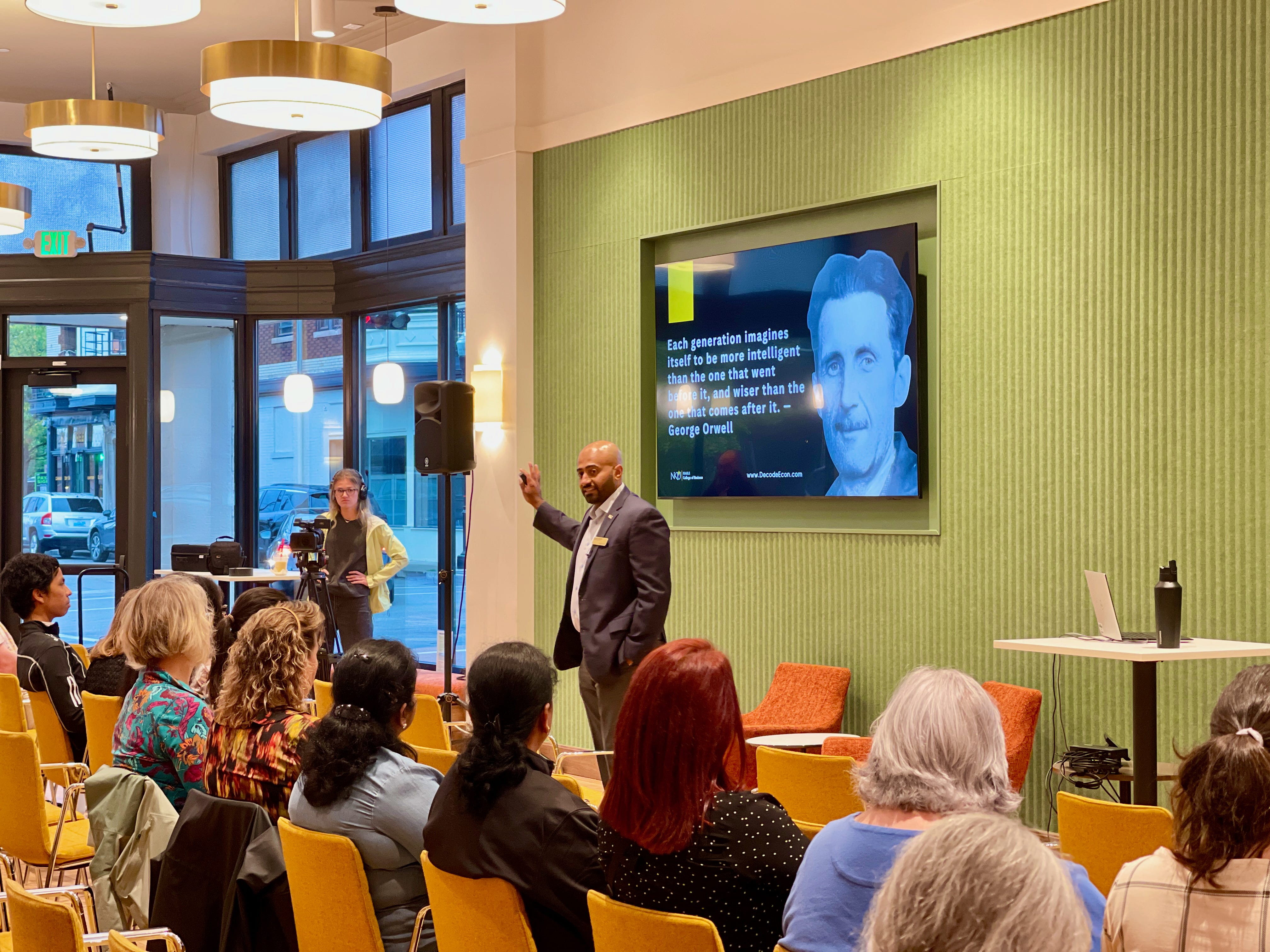
I give a lot of presentations. Most are in economics. But a second, and growing, category is skill development and leadership.
As a professor, I’ve taught and mentored thousands of students. Economics is what I teach, but professional and career development is what I do. As a mentor and in my leadership role, the career development of others is a big part of my work. It is what I love about what I do.
In a recent workshop, a student asked me a deceptively simple question:
“What’s the one skill I should focus on right now?”
My answer didn’t change based on their major, career stage, or ambition. It’s the same answer I give students, managers, founders, and senior leaders. It is what I think most people struggle with.
Storytelling.
At the end of this post, I share some storytellers who influence my work. Check them out.
Why storytelling matters more than you think
Storytelling is how you share a vision. It’s how you build buy-in, and it’s how you create a sense of community around an idea. Over my career, I have overindexed on community development.
Whether you’re in sales, leading a team of 50, presenting regression results and causal identification strategies, or building a personal brand, you need to know how to tell a story.
Please do not confuse storytelling with presentation skills; they are not the same thing.
Presentation skills help you deliver information. Storytelling helps people care about it. It leverages emotion, meaning, and connection. Most people are taught to present; few learn how to tell a story.
And that’s where most leaders and young professionals struggle.
The part people avoid: vulnerability
Storytelling requires vulnerability. And vulnerability is often misread as weakness.
About 15 years ago, I was going through a difficult period in my life. A close friend kept asking how I was doing. I dodged the questions. Changed the subject. I wasn’t ready to talk.
Finally, my friend stopped me and said something that stuck:
“You’re making it hard for me to be your friend. You’re not allowing me to support you.”
I think of that response often. That moment reframed everything for me.
Vulnerability wasn’t a liability. It’s an invitation.
The same is true in leadership, teaching, and communication. When you refuse to be vulnerable, you don’t look strong, you look distant. And distance kills trust.
That's a clip from our recent podcast. Make sure to check it out.

Storytelling is a force multiplier
Storytelling isn’t a “soft” skill. It amplifies everything you already know.
1. It improves understanding
People don’t remember isolated facts. They remember patterns. Stories create mental models that make complex ideas stick. Whether you’re explaining inflation, organizational change, or research findings, the stories help make the connection.
2. It persuades without coercion
Data informs. Stories persuade. When people see themselves in a narrative, they move from passive listeners to engaged participants.
3. It builds trust and credibility
Clear stories signal clear thinking. If you can explain something simply and coherently, people infer competence before they ever check your math. Still, make sure the math is correct!
4. It travels
Stories spread. Charts and memos rarely do. If you want your idea repeated accurately when you’re not in the room, it needs a narrative spine.
5. It differentiates you
In fields where technical skill is common, storytelling is the separator. Two people can know the same material; the one who tells the better story leads the room.
Why this matters now
We live in an environment of information overload. Attention is scarce. Storytelling is how you earn and keep it, ethically, by respecting how people actually think and learn.
In that same workshop, another student asked me a different question:
“If you could go back, what other major would you study?”
I wouldn’t change economics. Econ is life. But I would add videography or graphic design.
I love visual storytelling.
The storytellers I study
I spend a lot of time studying people and brands who do this exceptionally well. I wanted to share with you some of them that I am invested in right now, and whose content speaks to me. Give them a follow; I would love to learn which ones you liked.
Muhannad Films — A young Omani filmmaker with an incredible ability to capture emotion in 30–90 seconds. His work proves that feeling can be captured and expressed through the right sounds and music.
Blake of Today — A master at telling quiet, human stories about heartbreak, pivotal life moments, and about being a dad. His spoken word is powerful. If you ever watched my “Prof Life” videos, then you will notice Blake’s influence.
Timm Chiusano-Timm is an accomplished executive leader with production and creative experience at all levels, as well as a track record of solving complex business problems. He shares the human side of leading work teams. As I think about business education, his words help influence and shape the work I do.
Huckberry — My latest obsession on YouTube.
Huckberry sells gear, but it doesn’t act like a traditional retailer. They act like an inspirational company.
Their videos aren’t about products. They’re about identity, curiosity, and craft. They feature conversations with people like Matthew McConaughey, and they carry the narrative torch once held by Anthony Bourdain—storytelling rooted in humanity, not performance.
The Bottom Line
If you’re deciding what skill to invest in right now, don’t default to another credential or technical tool.
Learn how to tell a story.
Because in every profession, in every industry, and in every stage of life, the people who shape outcomes are the ones who garner buy-in, who make you feel connected, and who you can trust because you know they are authentic.
They’re the ones who know how to make meaning stick.
Be a storyteller! What’s your story?
Personal Invite
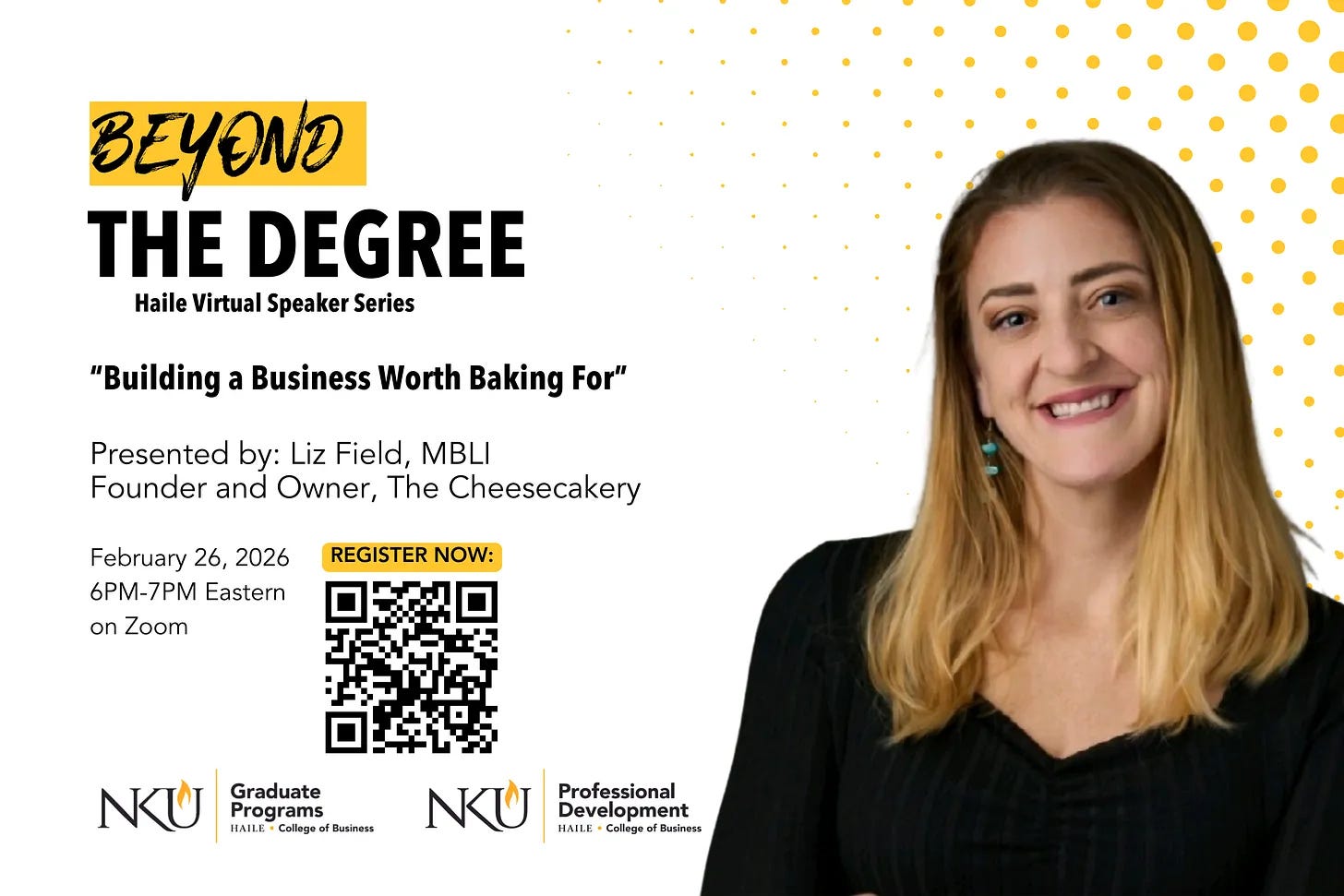
I would like to invite you to this discussion with Haile Graduate Programs, join us and learn more about building a business worth baking for.
This is a live podcast recording. Let’s meet up and learn together. Open to all. Sign up below.
Liz Field (MBLI ‘24) didn’t just dream about entrepreneurship. She built it.
While earning her Master of Business Leadership and Innovation at NKU, Liz was simultaneously growing The Cheesecakery into one of Cincinnati’s most beloved bakeries. Now she’s pulling back the curtain on what it actually takes to turn passion into profit.
Join us February 26th for our next Beyond the Degree session where Liz sits down with Dr. Abdullah Al-Barani and Dr. Sandra Spataro for a conversation about building a business in today’s chaos.
Here’s what we’re diving into:
The exact moment she stopped treating The Cheesecakery as a side hustle and went all-in. How she makes tough calls when supply chains explode, costs spike, and the “right answer” isn’t obvious. How graduate-level frameworks hold up when you’re making real decisions with real money on the line.
This is real talk from someone who’s juggling production schedules, team management, and business strategy all at once.
Thursday, February 26, 2026
6:00-7:00 PM Eastern | Virtual on Zoom
Open to everyone: grad students, alumni, aspiring entrepreneurs, anyone hungry to learn and engage. Bring your questions, this will be a live and interactive session and a conversation you don’t want to miss!
Great summary, Dr. A. One of the pieces of advice I offer up to students asking for "the next class to take" is to take another speaking course or another writing course. They often groan at the suggestion, but I use that as evidence that they need to improve. If they didn't like the last one they did, it was probably because they weren't very good at it and needed to work on it more.
I like the idea of reframing this as storytelling.
I used to challenge students to participate in NaNoWriMo, National Novel Writing Month (prior to the AI generated scandal!) It was a method to have them express their thoughts creatively without the concern about grades. I had benefited from taking a Creative Writing class sophmore year that allowed me to deal with some anxiety issues by creating differing narratives.
Tailering that narrative to the audience is also an important skill. Students react differently that 53 yr olds to the same topic. Pulling from experiences realitive to that audience creates a better connection. Universal truths.