


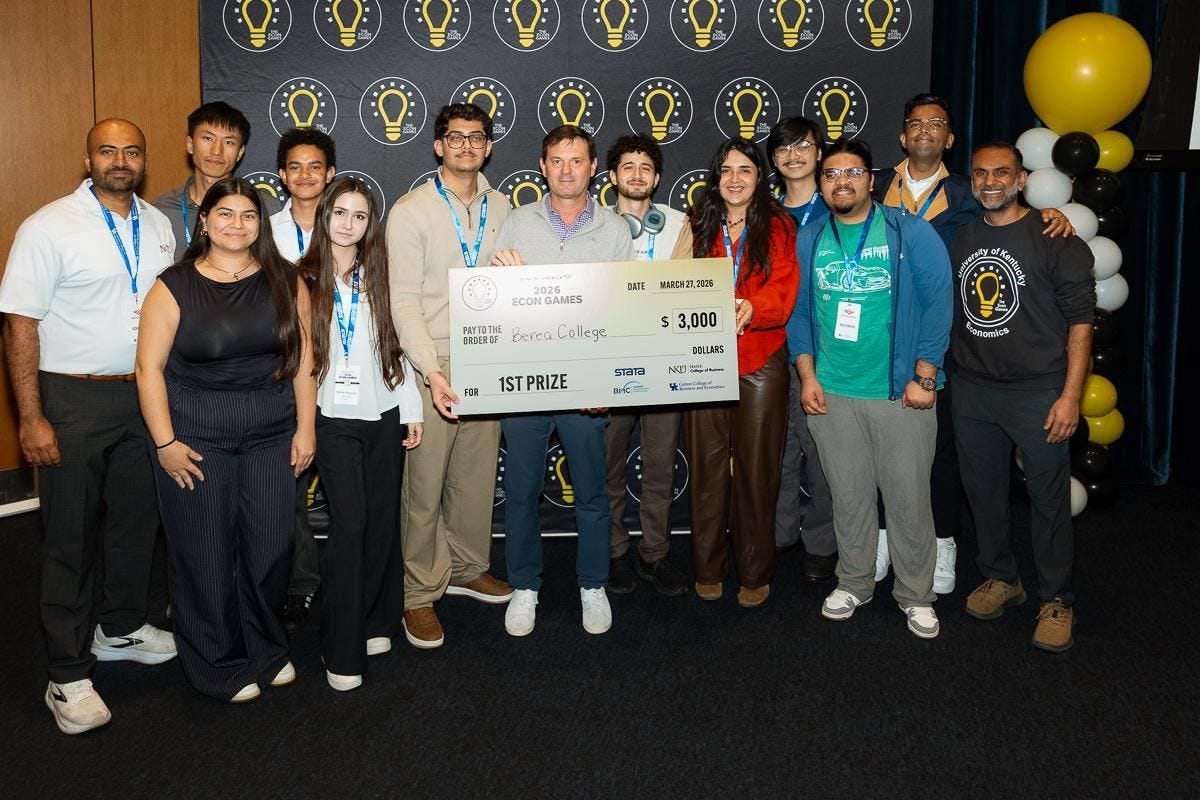
This year’s winner of The Econ Games is Berea College!
That alone is impressive. But what stood out more was not just the win, it was the institution behind it. Berea College has been a staple at The Econ Games from its early years. Their faculty advisors, Dr. Volker Grizmek and Dr. Nabila Biju, have been great supporters of The Econ Games.
The Econ Games were designed to test something beyond theory. They emphasize practical application, decision-making, and real-world problem-solving — the kind of skills often discussed in economics classrooms but not always fully developed there.
Berea students did not just compete. They excelled in an environment built around applied thinking.
That makes their win worth a closer look.
Berea College operates on a model that feels almost out of place in today’s higher education system. Students do not pay tuition. Every student works. And most graduate with little to no debt.
At a time when the average cost of college continues to rise, that raises a simple question:
How does this model work, and what does it tell us about the way we think about higher education?
A Different Starting Point
Berea College was founded in 1855 with a mission that challenged the norms of its time: to provide education to students regardless of race or gender. It became the first interracial and coeducational college in the South.
That founding decision matters, not just historically, but economically.
From the beginning, Berea was built around expanding access, not maximizing revenue. That constraint shaped everything that followed.
No Tuition, By Design
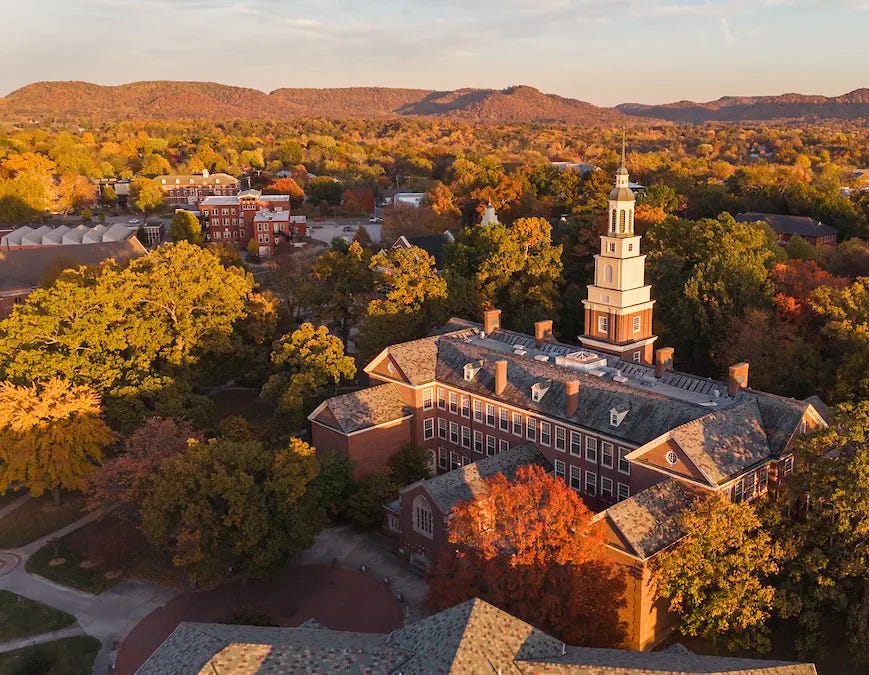
In 1892, Berea made another unusual decision: it stopped charging tuition.
Today, that decision still defines the institution.
Instead of relying on student payments, Berea funds its operations through a different mix:
A large endowment, built over decades through donations and estate gifts, now exceeding $1 billion
Government support, such as Pell Grants, FAFSA-based aid, and Work Study funding, accounts for a portion of operating costs
Ongoing contributions from donors
Endowment earnings alone cover the majority of the College’s operating budget.
This shifts the financial model entirely.
Most colleges depend on tuition as their primary revenue source. Berea does not. That changes the incentives for the institution and for the students.
Work as Part of the Model
Berea’s approach is not just about removing tuition. It replaces it with something else.
Every student works.
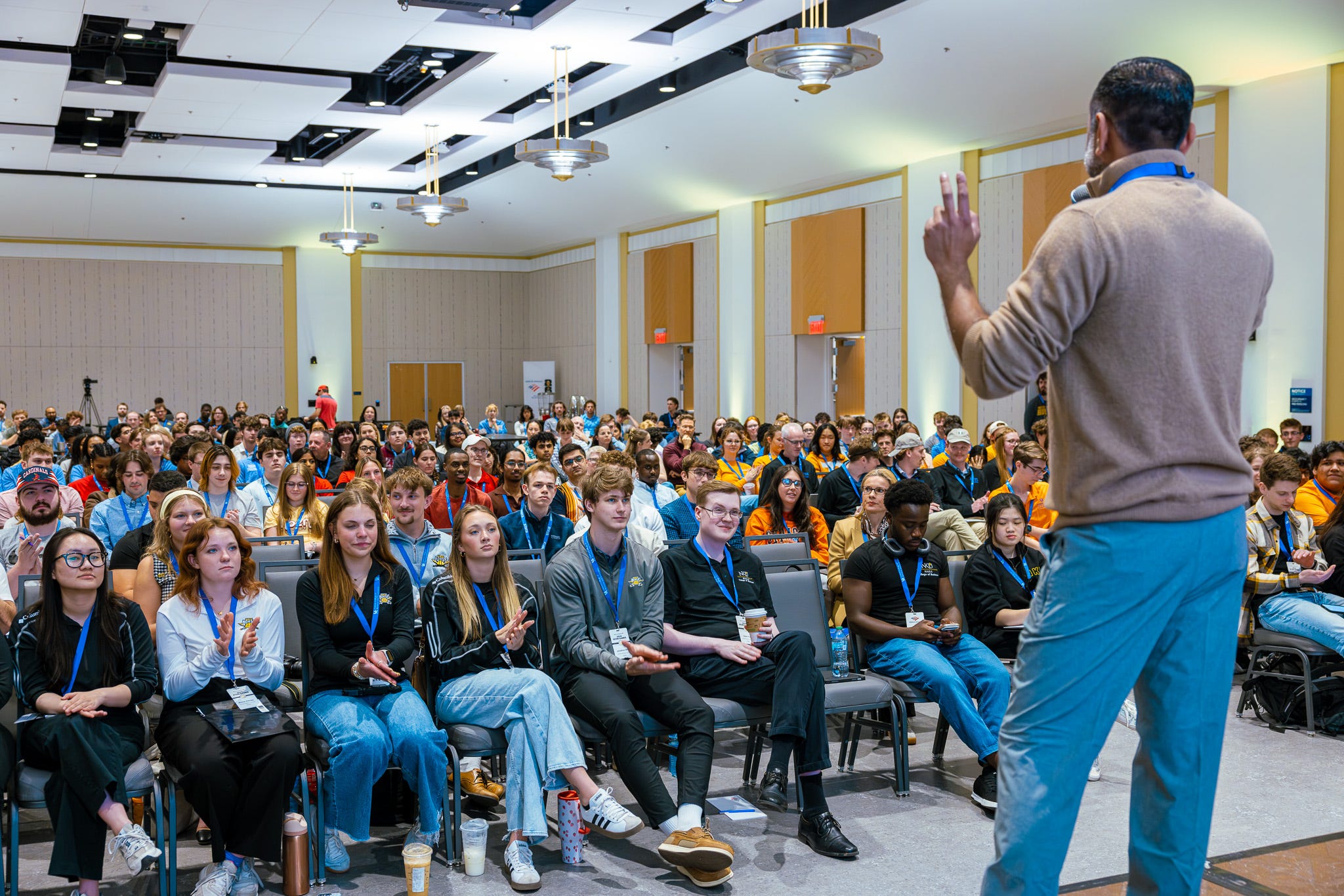
Students are required to work at least 10 hours per week in roles across more than 130 departments. These are not symbolic jobs. They range from agriculture and maintenance to software development and business operations.
This does two things at once.
First, it supports the institution's functioning.
Second, it changes how students experience education.
Work is not separate from learning. It is part of it.
Incentives Matter
From an economic perspective, Berea’s model is not just different — it is structured around a distinct set of incentives.
At most institutions, the transaction is simple: students pay tuition in exchange for education. At Berea, the structure is different. Students contribute labor and effort as part of their education.
This creates a different kind of engagement.
When students are working, contributing, and participating in the institution’s operations, they are not just consumers of education. They are participants in it.
That shift helps explain outcomes like the Econ Games. When students are trained in environments that reward applied thinking, responsibility, and decision-making, they are better prepared for settings that demand those same skills.
As Volker said
“Many of our students had to overcome great challenges to even make it to college. They are well aware that their time at Berea is a unique chance to set them up for success in life, and many take full advantage of the opportunity we offer them, which includes events like the Econ Games.”
And just as importantly:
“The Berea model allows students to focus on their academic (and Econ Games) success without being distracted by the harsh economic realities of having to figure out how to make the next rent check or term bill.”
Human Capital, Not Just Credentials
There is also a human capital story here.
Traditional college models emphasize classroom learning. Work experience often comes later, through internships or first jobs after graduation.
At Berea, that timeline is compressed. Students graduate not only with academic knowledge, but with documented work experience and demonstrated skills. They have already operated in real environments, solved real problems, and developed workplace habits.
For employers, that changes the signal. A degree shows what a student has studied.
Work experience shows what a student can do.
Berea students graduate with both.
A Note on Liberal Arts
There is another pattern worth noticing.
The top two teams in this year’s Econ Games came from liberal arts colleges.
That may not be an accident.
A liberal arts education emphasizes broad thinking, adaptability, and the ability to connect ideas across disciplines. In competitive environments that reward applied reasoning, those skills matter.
Berea’s team reflected that balance, with a strong presence of economics majors, but grounded in a broader educational framework.
Depth matters. But so does range. If you ever wondered why general education courses matter, this explains it.
Reducing the Cost of Entry
The most visible outcome of this model is financial.
Many Berea graduates leave with little to no student debt. For those who do borrow, the amounts are far below national averages.
This matters beyond individual outcomes.
High tuition and rising debt levels shape decisions long before graduation. They influence:
What students choose to study
Whether they attend college at all
What jobs they feel pressured to take afterward
By reducing or eliminating that financial burden, Berea changes the decision-making environment.
Students have more flexibility. And flexibility has economic value.
Why Isn’t This More Common?
If the model works, a natural question follows:
Why don’t more colleges operate this way?
The answer is not simple. Berea’s model depends on a combination of factors that are difficult to replicate:
A large and well-managed endowment
A long history of donor support
A clear and consistent mission
Institutional willingness to structure education around work
Most institutions are built on a different foundation, with different financial pressures and constraints.
The Bottom Line
Berea College is not just an alternative model of higher education. It is a different way of thinking about how education can be structured.
Instead of separating learning from work, it combines them.
Instead of relying on tuition, it relies on long-term investment and support.
Instead of treating students purely as customers, it treats them as contributors.
The result is not just lower cost. It is a different set of incentives and a different set of outcomes.
At a time when the value, purpose, and cost of higher education are being questioned, Berea offers something rare: A working example of how the system can be designed differently.
The more important question is not whether every college can become Berea. It is what we can learn from a model that has already rethought the rules.
About the Author
Darshak Patel, Ph.D., is an Assistant Professor of Economics and Director of Undergraduate Studies at the University of Kentucky’s Gatton College of Business and Economics. He is also the Co-founder of The Econ Games.

Thanks Dr. Darshak Patel for a great contribution and covering a wonderful higher education model. Many lessons and I love “work is not separate from learning. It is part of it.” Berea College is an excellent model with strong mission. It made me feel proud and full of hope. I hope to see more higher education institutions learn from this experience not only in the USA but globally. Congrats to Berea College for wining in the Econ Games.
Do you think Berea's model is capable of scaling upwards to a larger student body? Given the mission and the tax loopholes (lower than 500 full-tuition paying students) that allow for better investment in students, I'm not sure a school of 17.5K and an endowment of $12B can follow the lead.
The need for lower-income students to have access to quality higher education is important. Berea offers a model based on ownership of businesses in the area that create the job opportunities far beyond the average college/university. (Not knocking this model, I learned something new about the school and it's mission.)
*Duke's employment is inclusive of the hospital system and the Admin staff (43K). But they also offer a far wider range of programs and post-grad degrees.
Possibly if schools went back to offering more targeted education opportunities, like magnet schools, we could find ways to lower costs?