


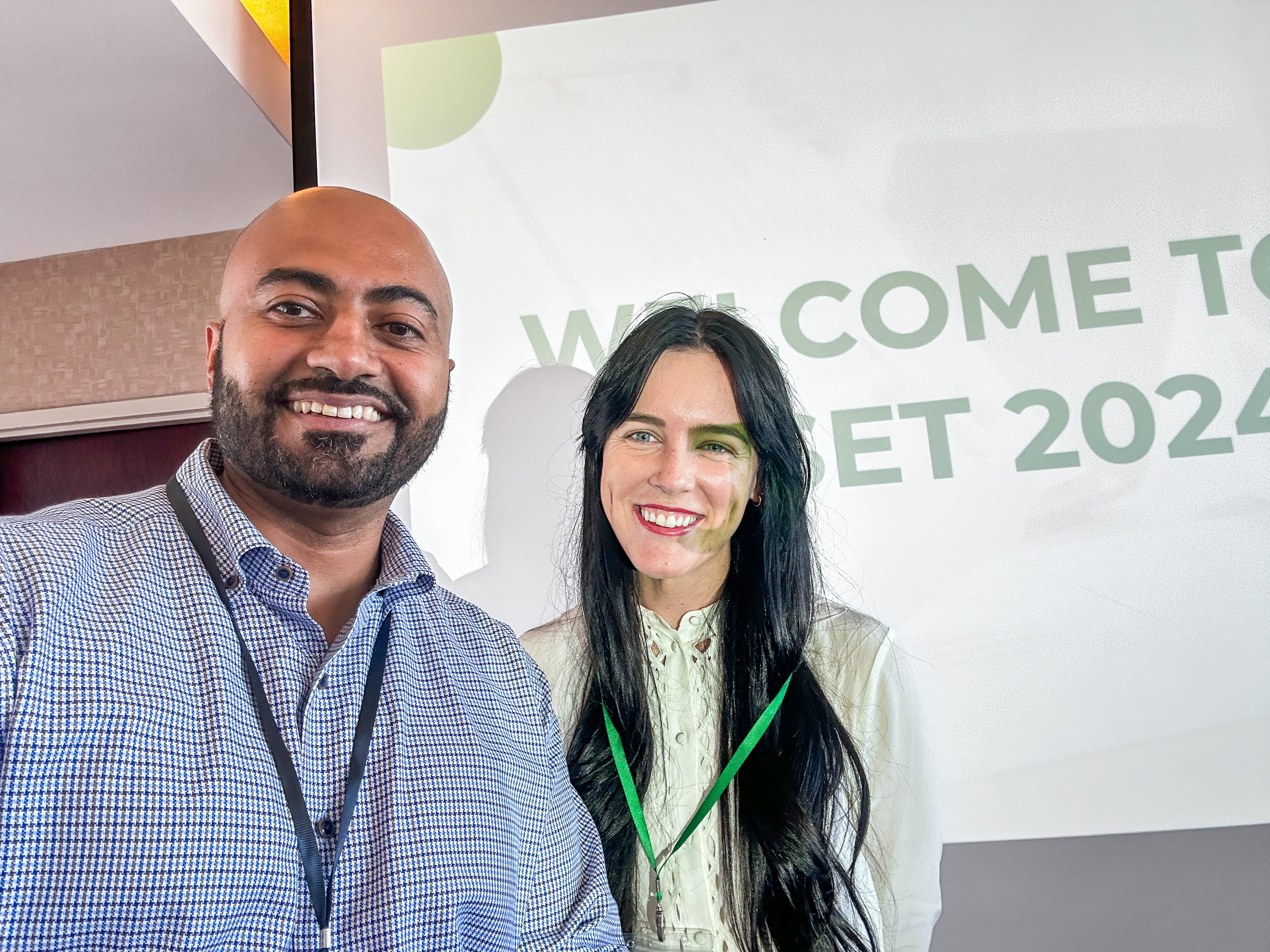
There are some writers whose work I will always read. kyla scanlon is one of them. Her growth as an economist, her clarity, and her willingness to share her views are encouraging. You can tell she thinks deeply before forming an opinion, and that shows in her latest column for The Wall Street Journal.
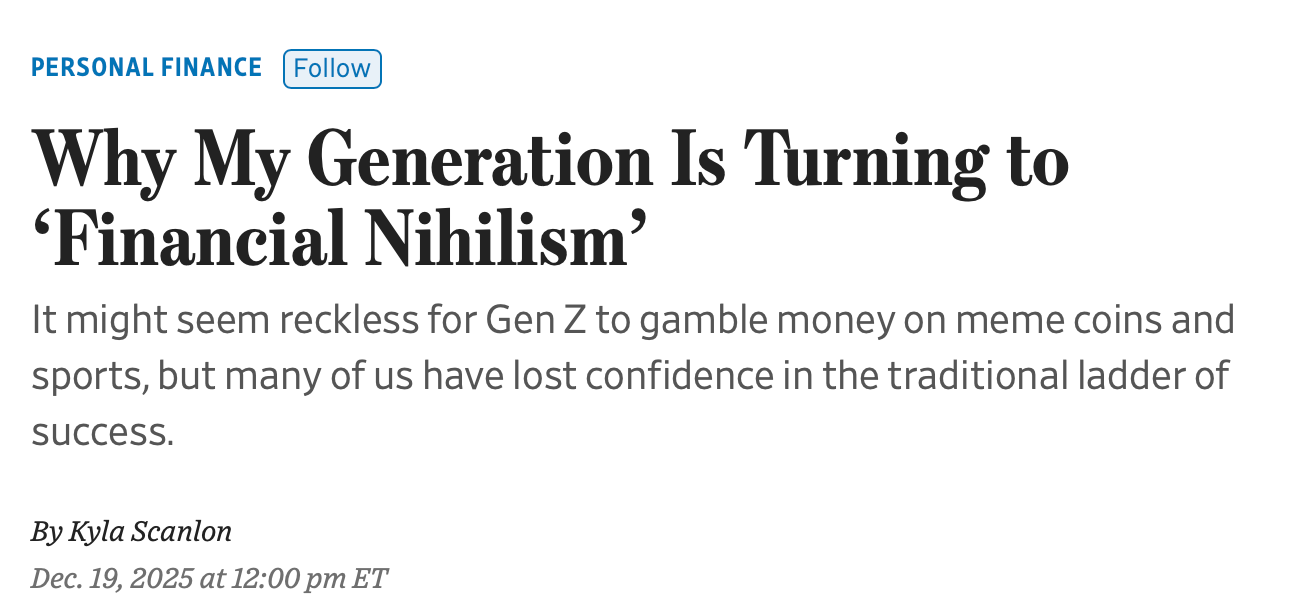
Her piece articulates something I’ve been thinking about for a while: financial nihilism.
Kyla credits Demetri Kofinas with the term. It describes a growing belief that the economic system no longer rewards prudence, patience, or long-term planning. If playing by the rules doesn’t lead anywhere, why play at all?
Lost Hope
You have been reading Decode Econ for a while, and you know that I’ve been calling this the loss of hope.
Hope is the belief that effort today increases the probability of success tomorrow. That belief is foundational to capitalist systems. People invest, work, save, and take risks because they expect the system to reward those behaviors over time.
When that belief weakens, behavior changes.
If effort no longer feels connected to outcomes, patience disappears. Long-term planning breaks down. Financial decisions shift from investment to speculation.
That is what financial nihilism looks like.
We haven’t lost ambition. We’ve lost confidence that the system converts effort into opportunity, and that loss of hope is what ultimately threatens capitalism’s stability.
The Economics Behind the Feeling
Economically, this shows up as a shift in time preferences.
Time preferences describe how much we value consumption today versus consumption in the future. When time preferences rise, we discount the future more heavily. In plain English, we become less patient. We want outcomes now because the future feels less reliable.
Kyla explains why this shift makes sense:
“The postwar idea of upward mobility was always contingent on strong institutions, affordable education, accessible homeownership and stable work. Now those conditions are buckling.”
She highlights several failures of the modern American economy:
Education is no longer affordable
Homeownership is out of reach for many young Americans
Real wage growth has been largely stagnant
When traditional wealth-building paths disappear, there is no future to discount. If saving, working, and planning don’t move you forward, risk-taking starts to feel rational. Gambling becomes a substitute for opportunity.
Kyla’s key insight is crucial: this isn’t a moral failure or a change in values. It’s a structural one.
My Take: Why the Economy Feels Broken
First, we’ve distorted what success looks like.
Everyone wants to be Elon. But Elon is an outlier. By definition, most people cannot live outlier lives. When success is defined by extreme wealth and visibility, a normal, stable life starts to feel like failure. We are measuring and defining success in unattainable ways.
Second, the system does favor the wealthy—and people know it.
Yes, the system favors the wealthy. When money and politics are tightly linked, rules tend to favor those who can finance the system. The economic consequence isn’t just inequality; it’s mistrust. Trust in institutions erodes when outcomes feel predetermined. Right now, that is how it feels.
Third, we may be teaching financial education the wrong way.
After the Great Recession, financial education expanded rapidly. That’s a good thing. But much of it focuses on precision, calculations, budgeting, and hitting retirement targets decades away.
For young people who don’t believe the future is stable, that message doesn’t resonate. In fact, it can increase risk aversion in a world where some risk is unavoidable. We are creating a generation of financially anxious individuals who continuously feel like they aren’t getting ahead, or worse, being left behind.
Fourth, the career ladder is clogged.
Gen X and Millennials are staying in the workforce longer, often by necessity. Longer life expectancy means they need more retirement savings to cover the rising healthcare costs, and economic uncertainty keeps workers in mid- and late-career roles longer than previous generations. They are occupying spaces and keeping young workers out.
This is a structural shift in how we work and develop the next generation. But it has consequences.
When senior and mid-level workers don’t move out, young workers don’t move up either. Promotions slow. Entry-level positions disappear or quietly morph into “junior-plus” roles. This is what we are seeing happen in the market. Take a look at entry-level postings; they read as mid-career opportunities.
Employers respond by shifting more risk to young workers, requiring internships, credentials, unpaid experience, and proof of productivity before anyone gets a real shot. Pressure on students is high, and perceived returns from education have decreased due to these additional requirements. Why go to college if I also need experience, and a degree doesn’t open the doors to a career?
Automation is often blamed for this dynamic, but that explanation is too convenient. Many of these jobs still exist. What’s changed is the standard for access.
Gen Z isn’t facing a lack of work. They’re facing higher hurdles to enter the workforce. Entry-level jobs now demand experience, resilience, and certainty in a labor market defined by uncertainty.
Finally, wealth transfer has stalled.
Boomers are holding on to $85 trillion in wealth. The Great Wealth Transfer is expected to pass on $60-84 trillion to younger generations by 2045, but the framing assumes that money will remain intact.
People are living longer and drawing down their savings for healthcare and long-term care. Fewer resources, opportunities, and positions are being passed down. Intergenerational wealth transfers are either delayed or depleted, and that matters more than we like to admit.
The Bottom Line
Kyla Scanlon is right: the system has real flaws. But rebuilding trust requires more than policy fixes. It requires redefining what progress looks like and reviving economic mobility.
At the core of this breakdown is declining economic mobility. Absolute mobility—whether people are better off than their parents were at the same age—has weakened. Relative mobility—whether people can move up the economic ladder compared to others—has stalled. Together, they shape whether effort feels rewarded or futile.
When both forms of mobility decline, effort no longer feels connected to outcomes. People still work hard, but they lose confidence that hard work will meaningfully change their trajectory. That erosion of belief doesn’t just affect individual decisions; it reshapes how an entire generation views saving, investing, risk-taking, and the future itself.
That loss of hope fuels financial nihilism, and that is why restoring mobility is not just an economic challenge but a social one. It will revive hope!
In 2019, billionaire Ray Dalio told 60 Minutes that the growing wealth gap was a “national emergency,” warning that it “threatens to split us.”
That split is what we are feeling today.
I think your point about time consistency is incredibly important. I would blame social media for this shift, if that wouldn't make me sound old and crotchety. From my vantage point, many young people believe that if they don't immediately have a house, at least two cars, and six weeks vacation, they are failures. The idea of building up your financial resources over time has escaped them. Gambling their current resources, makes that future reality that much more difficult to achieve. When I started out, I lived in a one bedroom apartment, clipped coupons and managed every penny. I was fortunate to be married so we had two incomes coming in, but there were student loans to pay off and a second car payment. I don't want this to sound like an old person rant, but too many students don't understand that most people start off on the poorer end. They aren't MrBeast, or Taylor Swift. Perhaps we need to teach them what to expect. An education will be worth it (in most cases). Blowing your money on sports gambling or Doge coin isn't going to make it better.
The assertion that the economic system no longer rewards prudence reflects a widely held perception, but taken at face value it overstates the empirical claim. What has shifted is not the fundamental relationship between effort and reward, but the distribution, timing, and visibility of returns to prudent behaviour. The pathways through which sustained effort translates into economic security have become narrower and more contingent on initial conditions, while the variance of outcomes has increased. Under these conditions, long‑term planning and cautious decision‑making continue to dominate nihilistic alternatives in expected value terms, yet the weakening of the perceived effort–outcome linkage undermines their credibility. This erosion of belief is consequential, as it alters behaviour in ways that can further entrench disengagement and risk‑seeking.
Changes in time preferences are similarly shaped by informational and cultural dynamics, not solely by structural economic constraints. Contemporary media environments disproportionately highlight extreme successes and compress narratives of achievement into short time horizons, obscuring the slower, cumulative processes through which economic advancement more commonly occurs. As a result, conventional markers of stability and incremental progress are increasingly interpreted as insufficient or indicative of stagnation. This distortion amplifies uncertainty about the future and reinforces the perception that patience is irrational, even in contexts where long‑term strategies remain viable.
Within this framework, the turn toward speculation and gambling should be understood as a broader response to diminished agency rather than a simple substitution for lost opportunity. High‑risk financial behaviours offer a simplified causal narrative in which individual action appears immediately consequential, counteracting the diffuse and delayed feedback mechanisms characteristic of traditional economic advancement. Their appeal lies not only in the prospect of outsized returns, but in their capacity to restore a sense of control and coherence in decision‑making. In this sense, speculative behaviour reflects an attempt to reconstruct meaning and agency under conditions where established institutional pathways no longer provide a convincing connection between effort and outcome.