
Pick a PhD program for fit and for the teaching it will give you, not only for its ranking. And if you have any doubt about going, wait. Haley Wilder is on the academic job market right now, and she'd give that advice to anyone you're advising.
Three takeaways
- Choose the program you'll finish, at the school that will teach you how do to the job. Not every department puts its PhD students in front of a class. Haley has been the instructor of record for nine sections across four courses at Kentucky. When picking a program, look at each program's placement list, and pick the one where you have the best chance of finishing, not the one with the highest ranking.
- Most of the job market is waiting. Haley had her materials written by July because she thought postings would start in August. They didn't. Drafts by the end of summer are enough. Once interviews start, the hard part changes: you have to picture yourself at every school you talk to, and then let it go.
- The pay gap among economics professors is U-shaped. Haley's job market paper finds the gender pay gap is smallest at R1 universities and small liberal arts colleges, and widest at the schools in the middle. Her explanation is visibility. Pay at big public universities is often public, and small departments talk to each other.
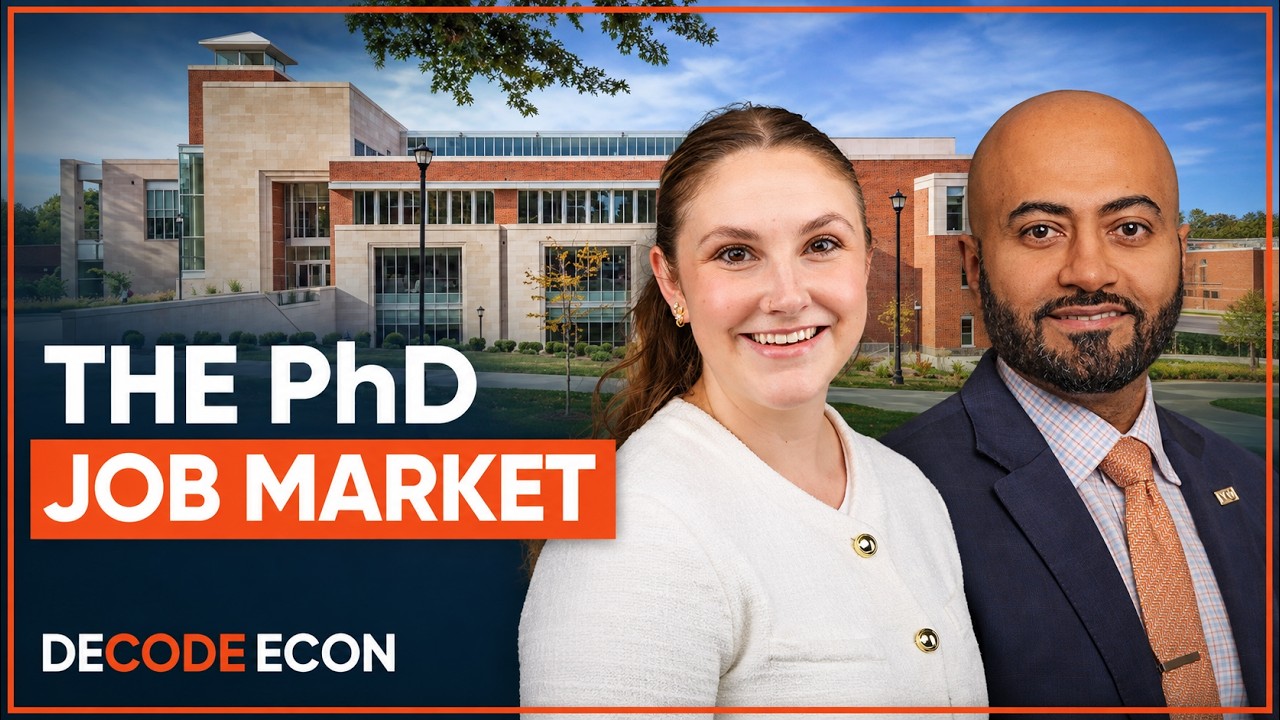
About this episode
This is a first for the show. My guest is on the academic job market right now. Haley Wilder's applications are out, and when we recorded she was in the stretch every candidate knows: the work is done, and all you can do is wait. If you've been there, you remember it. If you advise students who are headed there, this one is for them.
We start with her research. Haley studies the gender pay gap among economics professors, and she looks across every type of school instead of only the elite ones. The gap is smallest at the two ends and widest in the middle. As an associate dean, I wanted to know what chairs and deans can do about it, so we talk about initial offers, negotiation and pay transparency, and how the WNBA players used Claudia Goldin's math to close part of their own gap.
Then we get into how she ended up on our Econ Games paper. She asked Darshak Patel to work with him, he told her there wasn't anything yet, and she asked again. Grad students, take note. We also talk about the teacher she wants to be on day one of her first job, and what she'd tell a student who is thinking about a PhD.
Two disclosures. Haley is my co-author, along with Darshak Patel. And Kentucky is where I got my PhD too, so some Wildcat bias may sneak in.
Our guest
Haley Wilder is a PhD candidate in economics at the University of Kentucky's Gatton College of Business and Economics, on the market for faculty positions starting August 2027. She is a labor economist who studies the economics of education and economic education, working with Chris Bollinger as her dissertation chair. She has been the instructor of record for nine sections across four courses (principles and intermediate micro and macro), both in person and online, and received Gatton's 2026 Teaching Excellence Award for graduate students. She earned her B.S. in economics at Belmont University. Connect with Haley on LinkedIn
Hiring this year? Haley presents two papers back to back at the Southern Economic Association meeting in Houston on Sunday, November 22: our Econ Games paper in session 2G37 at 2 p.m., then her job market paper right after. Go say hello.
What we cover
- 00:39Welcome, and a first for the show
- 02:12Headline: the midterms, AI and voters pushing back on data centers
- 04:42Labor economist or higher education economist?
- 07:01The 30-second pitch: the gender pay gap among economics professors
- 09:15Why the gap is U-shaped across types of schools
- 11:09What chairs, deans and provosts can do about it
- 17:25The WNBA, Claudia Goldin and negotiating with data
- 18:20Our paper on The Econ Games, and the horse racing prompt
- 27:21How Haley got on the paper: ask, and then ask again
- 31:16The teacher she wants to be on her first job
- 33:23Instructor of record versus TA, and how small is "small"
- 36:22Advice for anyone advising a future PhD student
- 41:38Her state of mind on the job market
- 43:16When the market moves, and the emotional cost of interviewing
- 44:51Wrap-up
For the classroom and your conversations
- Haley finds the pay gap is smallest where pay is public. Would you want your coworkers to know what you earn? Would you want to know what they earn?
- WNBA players got a raise of nearly 400% after they brought data to the table. Before you negotiate your first job offer, where would you find the number to ask for?
- One Econ Games team got horse racing GPS data and had to help a company attract younger fans. Where is the economics in that problem?
- Haley's advice on grad school is that any doubt means wait. Think of a big decision you made. Would waiting have helped or hurt?
If you've been on the academic job market, what do you wish someone had told you about the wait? Leave it in the comments for Haley and everyone on the market this year.
Instructor resources
Use it Monday
Advising · 20 minutesThe next time a student tells you they're thinking about a PhD, sit down with them and their list of programs and go through three questions from this episode:
- Where did this program's last few graduates land? Find the placement list on the department website.
- How many courses will you teach as instructor of record before you finish, not as a TA?
- Is there anything else you'd rather be doing? If the answer is yes, it's okay to wait a year.
Pair it withThe segment of this episode starting at 36:22, where Haley explains why she'd pick fit over prestige.
Research mentioned in this episode
Wilder, H. (2026). Demographic determinants of wage and tenure in economics: Do institutional characteristics matter? [Job market paper]. University of Kentucky. Not yet peer reviewed. Haley's site
Wilder, H., Patel, D., & Al-Bahrani, A. (2026). Bridging theory and practice: Evaluating the impact of The Econ Games on student skill development [Working paper]. Presented at the Southern Economic Association meeting, November 2026. Not yet peer reviewed.
DeSmith, C. (2026). A Nobel laureate's assist to women's basketball pros. Harvard University. How Claudia Goldin helped the WNBA players' union. Read it
Planet Money. (2026, May 9). Diary of a WNBA negotiator [Audio podcast episode]. NPR. The episode I recommend on air. Listen
UK's PhD program
If this episode has a student of yours thinking about a PhD, the University of Kentucky is where Haley is finishing hers and where I earned mine. The economics PhD at Gatton takes about five years. The first year covers core theory and econometrics and ends with a preliminary exam. In the second year, students take field courses and a Teaching Methods course, which matters if you heard Haley talk about getting real teaching experience before the job market. Students can also work with the Kentucky Research Data Center, which gives access to restricted federal data on firms and individuals. The program page links to its list of initial placements, which is the first question on the advising checklist above. Applications are due February 1.
Questions about the program go to Steven Lugauer, the Director of Graduate Studies. He's a macroeconomist who studies population aging, climate change and the economics of outer space exploration.