



The U.S. economy is growing faster than expected.
According to the Bureau of Economic Analysis, real GDP accelerated from 3.8% in the second quarter to 4.3% in the third. Consumer spending remained strong. Exports picked up. Government spending increased.
On the surface, this is what a healthy economy looks like.
But growth alone doesn’t tell us who benefits, and that’s where the story starts to break down. Today, we will cover poverty in the U.S.A.
The Economics
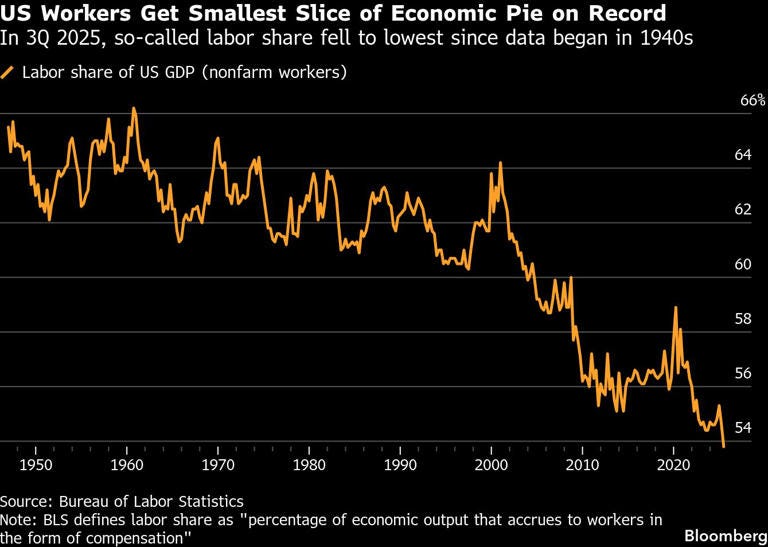
While GDP surged, the labor share of U.S. income fell to its lowest level since records began in 1947.
This matters because GDP measures total production, not how income is divided. An economy can grow rapidly while workers receive a shrinking portion of that growth. When that happens, output rises, but economic security doesn’t.
Strong growth paired with a falling labor share is a warning sign. It indicates that gains are increasingly accruing to capital rather than to wages. This may explain the K-shaped economy and contribute to increasing income inequality.

Poverty in the USA
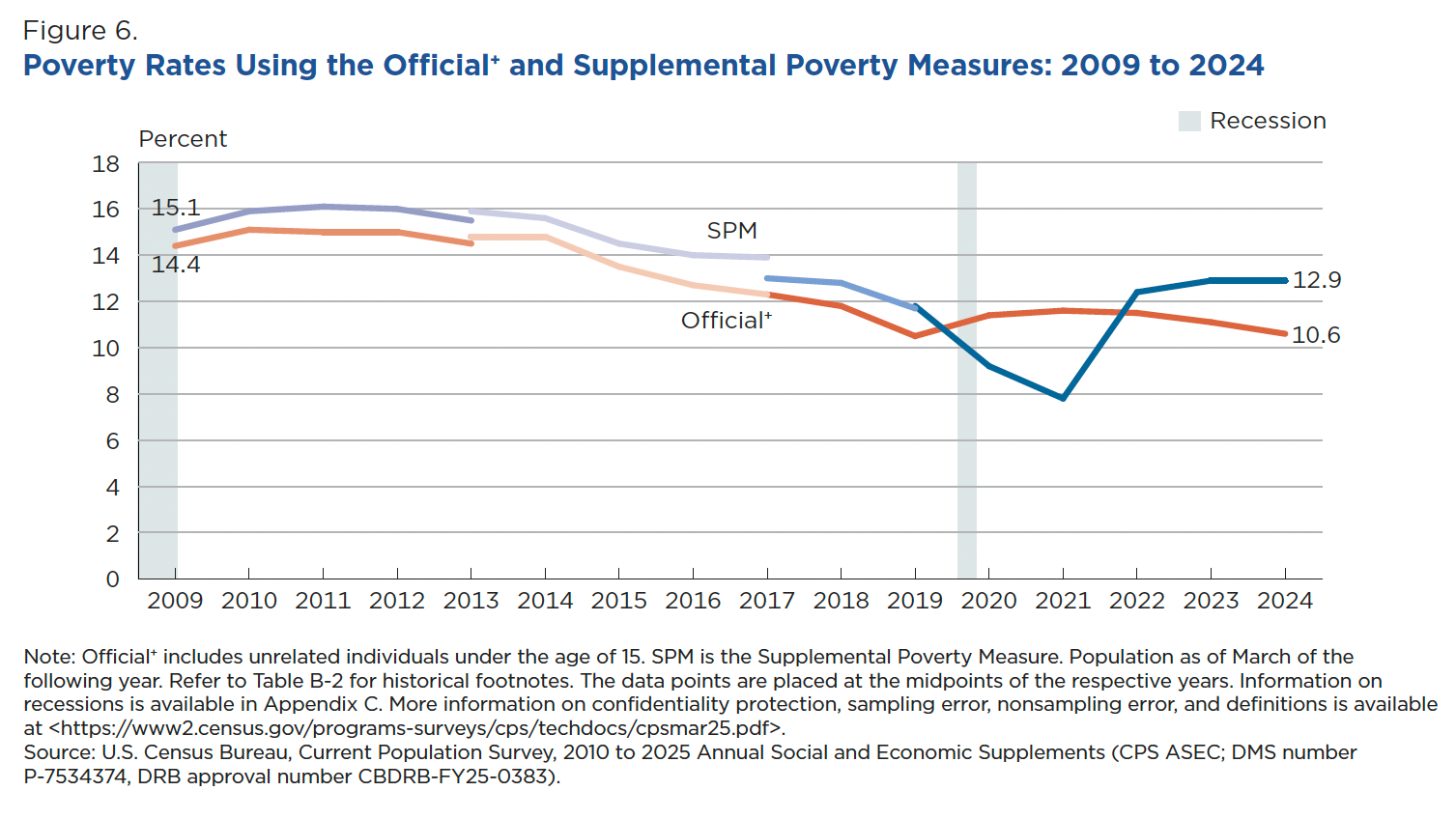
This disconnect is evident in poverty data from the U.S. Census Bureau.
In 2024, the official poverty rate fell to 10.6%, suggesting improvement. But the Supplemental Poverty Measure (SPM) remained at 12.9%, showing no statistically significant change.
These two measures tell different stories:
The official rate looks only at pre-tax cash income.
The SPM accounts for taxes, housing costs, medical expenses, and government assistance.
The Supplemental Poverty Measure (SPM) rate in the United States increased in 2022 primarily due to the expiration of temporary pandemic-era government assistance programs and tax credits. High inflation also contributed to higher poverty thresholds.
Poverty by Demographics
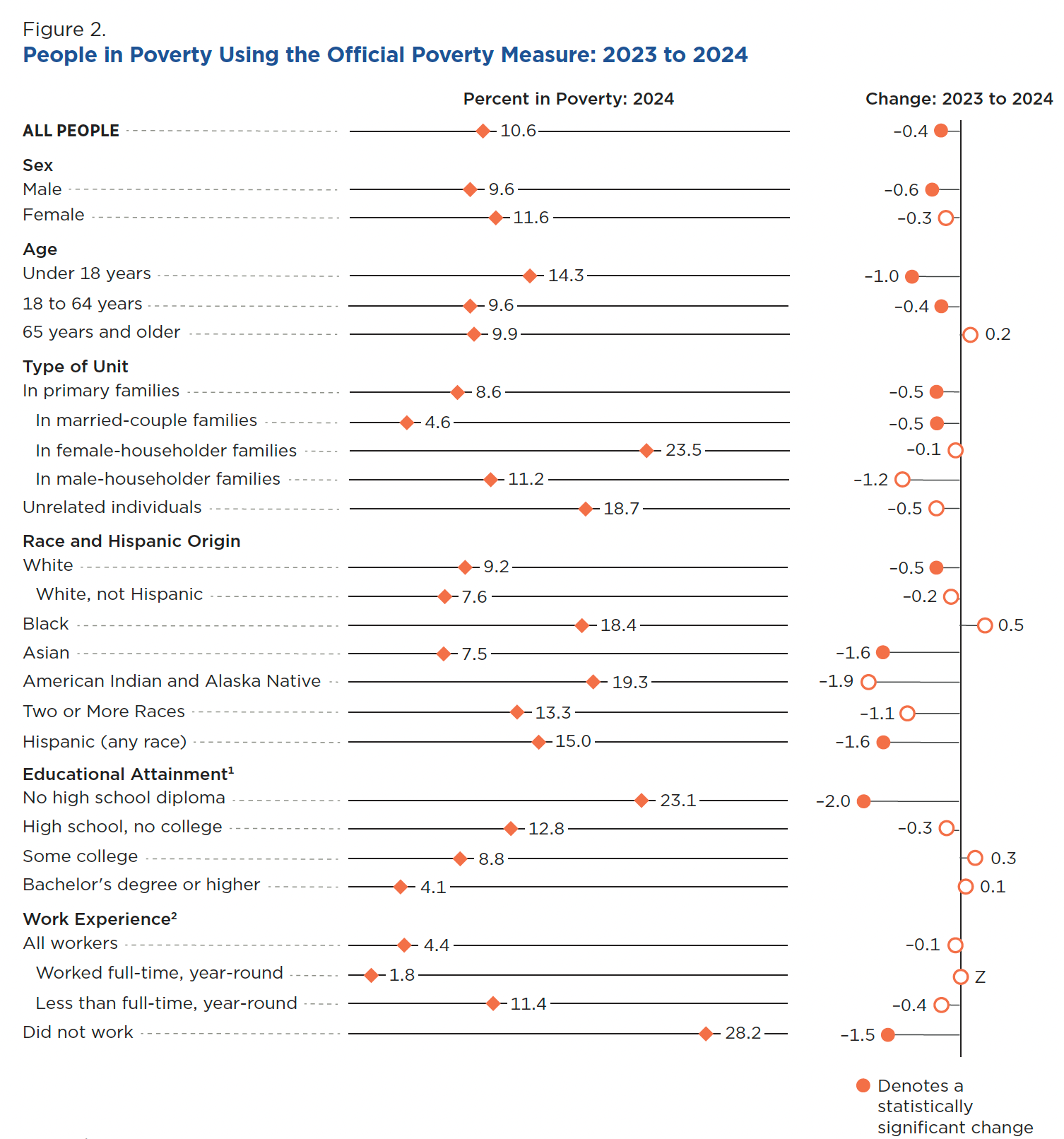
In 2024, Poverty declined for most categories. Poverty increased among adults 65 and older, a group less connected to labor market gains and more exposed to rising healthcare and housing costs. The SPM also rose for Black Americans, while remaining statistically unchanged for many other groups.
Economic growth centered on employment and capital income does not reach all households equally, and these disparities persist even during expansions.
Policy and Poverty
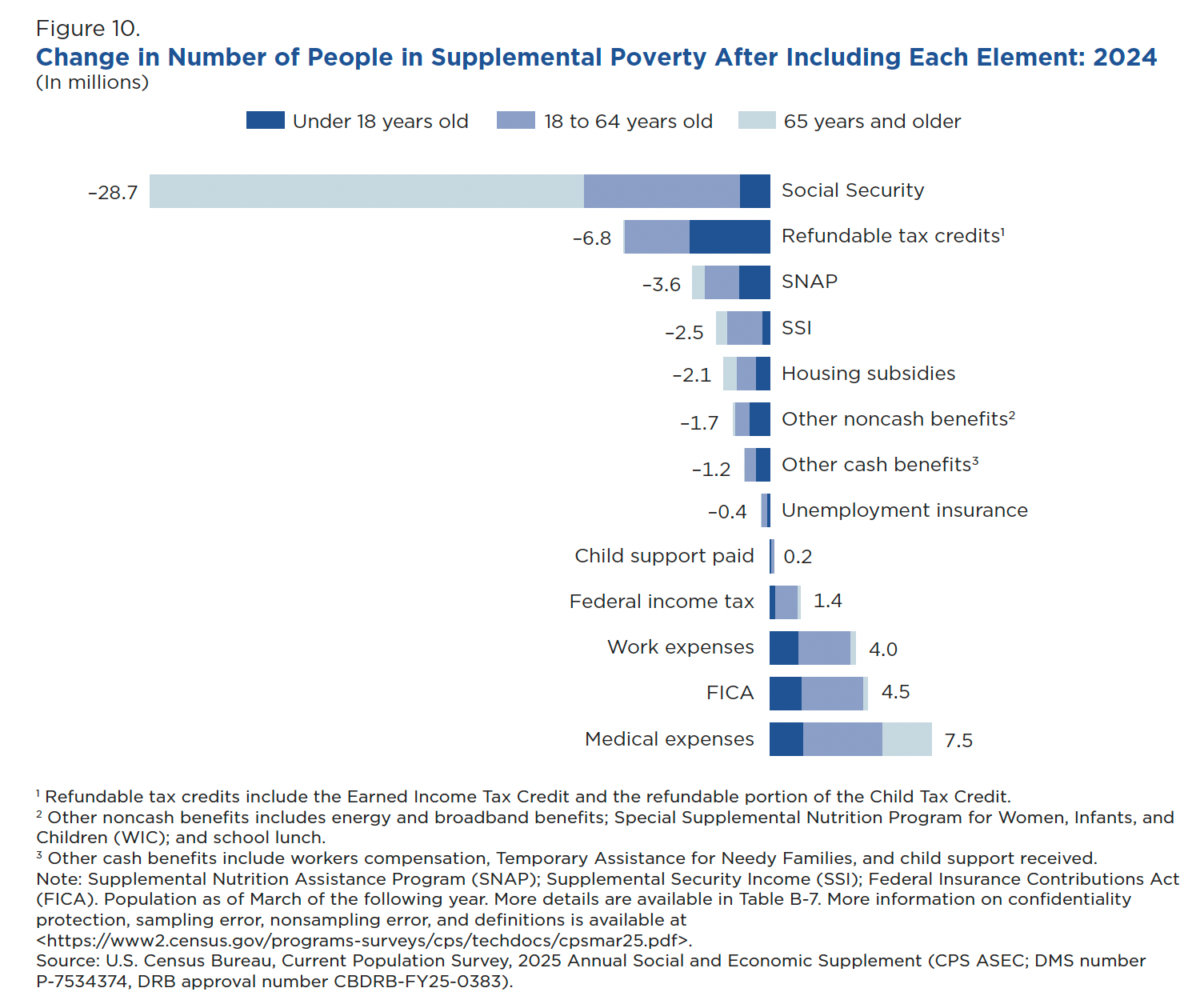
In 2024, Social Security lifted 28.7 million people out of poverty, by far the largest impact of any government program. SNAP, which is often discussed by our contributor Michael Prunka, lifted 3.6 million people out of poverty.
This tells us something critical: poverty reduction in the U.S. is increasingly driven by policy, not growth alone.
When labor income weakens relative to GDP, government transfers become the primary buffer against hardship. Over the past year, we have seen fewer resources devoted to transfers and programs shuttred. And, this is why I expect that poverty measures will increase this year.
The Bottom Line
Economic growth is not the same thing as economic well-being.
GDP tells us how much the economy produces. Poverty measures tell us whether people can afford stability. When labor’s share of income falls, growth becomes less effective at reducing poverty, even when headline numbers look strong.
Poverty data lag economic shifts, recent policy changes around programs like SNAP matter, and the continued decline in labor’s share suggests the benefits of growth are not reaching everyone. Keep an eye on poverty pressures, will they increase this year despite solid growth? We will find out in September when the Census releases their poverty report.
Great piece! I think this is especially relevant given a Trump admin official — Kevin Hassett, I believe — made a claim in a Fox News interview that a 4.3% growth in GDP means we’re all earning 4.3% more.
Obviously, as you state, GDP isn’t a measure of how income is distributed. There is much work to be done on the poverty front.
"Economic growth is not the same thing as economic well-being." This should be shouted from the mountain top!!!!