
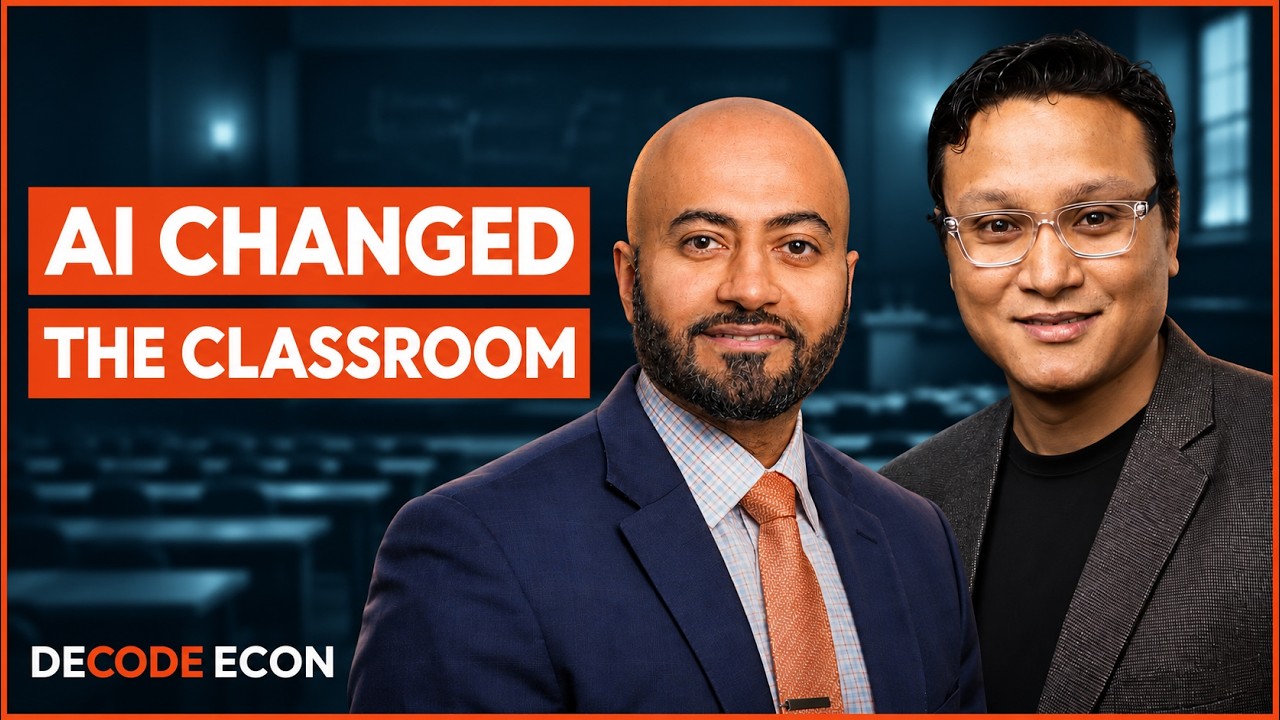
Shishir Shakya dropped homework, midterms and finals. His students now have to explain what they know out loud, and they don't touch agentic AI until they've mastered the basics.
Three takeaways
- Teach the absolute minimum, and teach it well. Shishir cut econometrics down to the handful of tools students can't do without, then made sure every student owns them.
- Make students defend their work out loud. An AI-led oral check early in the semester, then face-to-face oral exams, some of them over lunch. A polished essay can hide a gap that a follow-up question exposes.
- AI comes after the fundamentals. Once students know the basics, he teaches them to build with agentic AI, because that's what the job market of 2028 will expect.
Why I wanted this conversation
AI is disrupting our world, and nowhere is that more evident than in education, especially higher education. How will our students learn? How will we assess them, and how will we teach them in this new technological environment? I get these questions as an administrator and as an economic education researcher.
To learn how some faculty are adjusting, I reached out to Shishir Shakya, Assistant Professor of Economics at Appalachian State University. Shishir has redesigned his econometrics and statistics courses to answer one question: what happens if we stop preparing students for the job market of 2022 and start preparing them for 2028?
What replaced homework and exams?
Shishir borrowed an idea from physics. The Soviet physicist Lev Landau trained his students on a "theoretical minimum," the core they had to master before anything else. Shishir got a taste of it watching Leonard Susskind's free cosmology lectures online, and with no physics background, he followed along. So he asked whether he could do the same for econometrics.
In the data management unit of econometrics, students learn select, filter, mutate, group by, summarize, pivot longer, pivot wider and merge in R. For visualization, five plots: a trend line, a histogram, a density plot, a scatter plot and a map. Once students own those tools, they can open free books like Nick Huntington-Klein's The Effect or Scott Cunningham's Causal Inference: The Mixtape and keep going on their own.
Instead of homework, students defend each topic orally. Early in the semester, an AI system built on Shishir's reading material asks them questions, and they have 45 to 60 seconds to answer. Around midterms, he switches to face-to-face oral exams with his 10 to 15 students, sometimes over lunch. Students evaluate themselves and tell him what they'll do in the coming weeks. He cited Keith Ferrazzi's Never Eat Alone: sharing a meal builds trust, and trust makes a stressful topic easier to talk about.
The assignment that broke his old model
Last year, Shishir asked his econometrics students to write about what causal inference means. They turned in answers on compliance, instrumental variables and synthetic control. At that point in the semester, he had only taught them dummy variable regression.
"Students tend to confuse understanding with familiarity."
He doesn't want to play detective, either. John Paul Rollert's essay in The Atlantic, "A Society of Cheats," had just come out when we recorded, and Shishir worries about false positives: accusing a student of using AI when they didn't. So he'd rather design an assessment that holds up without the accusation. He used an economist's argument here. Gary Becker (1968) showed that people weigh the expected costs and benefits of breaking a rule, and when the benefit is high and the chance of getting caught is low, more people cut corners. Rebecca Winthrop of Brookings makes the same point with a two-year-old left alone at the table with a birthday cake. Shishir's version is a bridge. You don't build it for good drivers on sunny days. You build it for the worst winter and the worst driver.
That reminded me of a colleague who studied insurance. He used to say that the average person doesn't buy insurance for the average day. An assessment system is the same.
If students can't use AI, why can professors?
I pushed Shishir on this one, because it's the question I hear from students. His answer: professors earned their domain expertise. Years of work tell you when an AI is hallucinating or producing slop, and a student who is still learning the material can't catch that yet. I liked this answer because it's different from what I usually hear in higher ed conversations, and it sold me on trying an oral component in my own classes.
Shishir also coordinates the Walker College of Business AI working group, and he admits the line on AI use is fuzzy. Is the design button in PowerPoint AI use? What about running an agent over a code base you spent years writing? He thinks universities should worry less about those lines and more about the job society gave them: validating, authenticating and credentialing what students know.
Preparing students for 2028
Once students have the minimum, the course moves fast. In his statistics class, students load their résumé into an agentic AI system, connect it to what they're learning about hypothesis testing, and pitch a business idea. One student who works at a daycare wanted to model the rush of parents at pickup. A former barista wanted to measure long wait times and send coupons to the customers who got stuck in them.
In his forecasting course, he taught Harry Markowitz's portfolio theory in about seven lines of R, and the only programming students needed was a for loop. His final exam took Scott Galloway's The Algebra of Wealth and turned it into math: download about 125 years of S&P 500 data, draw random 30-year windows, invest a dollar a year, and figure out when you're unlikely to ever lose your principal. Undergraduates built that Monte Carlo simulation themselves.
His case for why rests on the law of demand. Code is getting cheaper, so we'll use a lot more of it. He quotes Andrew Ng, who argues students should think like engineers: a marketing major becomes a marketing engineer who understands the process from end to end and can build a working product. Shishir adds two things no AI will replace: domain knowledge you're passionate about, and the agency to go find the right people and figure things out. His phrase for it is being "persistently pleasant."
I tell my students that learning happens in thirds: read it, write it, then say it out loud. Most students do one of the three. Shishir's class makes them do all three, and I think that's the real lesson of this episode, with or without AI. He ended on Edmund Phelps's idea of flourishing. AI brings creative destruction, and with it a chance for students to build talents they didn't have before. If you're a student, start with the minimum and get good at explaining it. If you teach, try one oral check this semester and see what it shows you.
Our guest
Shishir Shakya is an Assistant Professor of Economics in the Walker College of Business at Appalachian State University, where he teaches applied econometrics, time series forecasting and business statistics. His research looks at healthcare labor markets, occupational licensing and regulation. He co-coordinates the Walker College of Business AI working group and is a founding engineer of MyMeritGuide, an AI-assisted oral assessment platform. Shishir grew up in Nepal, started out in architectural engineering, and earned his PhD in economics at West Virginia University. Learn more about Shishir
What we cover
- 00:49How AI is disrupting education
- 02:17No homework, no midterms, no finals: what replaced them
- 11:22The moment AI broke his old teaching model
- 16:05Inside his AI-powered oral exam system
- 24:33"If students can't use AI, why can professors?"
- 39:06Preparing students for the job market of 2028
For the classroom and your conversations
- If an AI writes a great answer to a question you couldn't explain out loud, did you learn it? How would you know?
- Gary Becker said people weigh the costs and benefits of breaking a rule. If you ran a school, what would you change so that doing the work yourself is the better deal?
- Code is getting cheaper. What does the law of demand predict about how much of it gets written, and which jobs grow because of that?
- One of Shishir's students thought about long waits at a coffee shop. Pick a line you wait in every week. What data would you collect to test whether some hours are worse than others?
Tell me in the comments: have you tried oral exams or oral check-ins in your classes? What did they show you that a written test missed?
Instructor resources
For teachers bringing this episode into class.
Use it Monday
Activity · 10 minutesRun a 60-second defense. Pick one concept from this week's reading and write three questions about it. Pair students up. Each student draws a question and has 60 seconds to explain the answer to their partner without notes. The partner asks one follow-up "why?" Then switch. Close by asking the class which question was hardest to explain and why. You'll see the gap between recognizing an idea and understanding it, and so will they.
Try it at scaleMyMeritGuide, the oral assessment platform Shishir helped build Visit
Research and resources mentioned in this post
Becker, G. S. (1968). Crime and punishment: An economic approach. Journal of Political Economy, 76(2), 169–217.
Rollert, J. P. (2026, August 30). A society of cheats. The Atlantic.
Huntington-Klein, N. (2021). The effect: An introduction to research design and causality. CRC Press. Read free
Cunningham, S. (2021). Causal inference: The mixtape. Yale University Press. Read free
Markowitz, H. (1952). Portfolio selection. The Journal of Finance, 7(1), 77–91.
Galloway, S. (2024). The algebra of wealth: A simple formula for financial security. Portfolio.
Phelps, E. (2013). Mass flourishing: How grassroots innovation created jobs, challenge, and change. Princeton University Press.
Ferrazzi, K., & Raz, T. (2005). Never eat alone: And other secrets to success, one relationship at a time. Currency Doubleday.