
The first job used to be where young people got mentored. That rung is getting harder to reach, so the mentoring has to happen before graduation, and that puts it on us—higher education.
Three takeaways
- Remote work, not AI, is to blame for entry level jobs disappearing. A new working paper covering 243 million hires in four countries finds the AI effect mostly disappears once remote work is in the model. When supervision costs more, firms hire someone who's already trained.
- Experience is now the signal. Jobs open to someone with no experience fell from about one in 15 to one in 50. Prior experience is a higher burden of proof for college graduates.
- Good mentoring is small. Five minutes asking students what they're working on, one piece of real work, and a conversation afterward about what they'd do differently.
About this episode
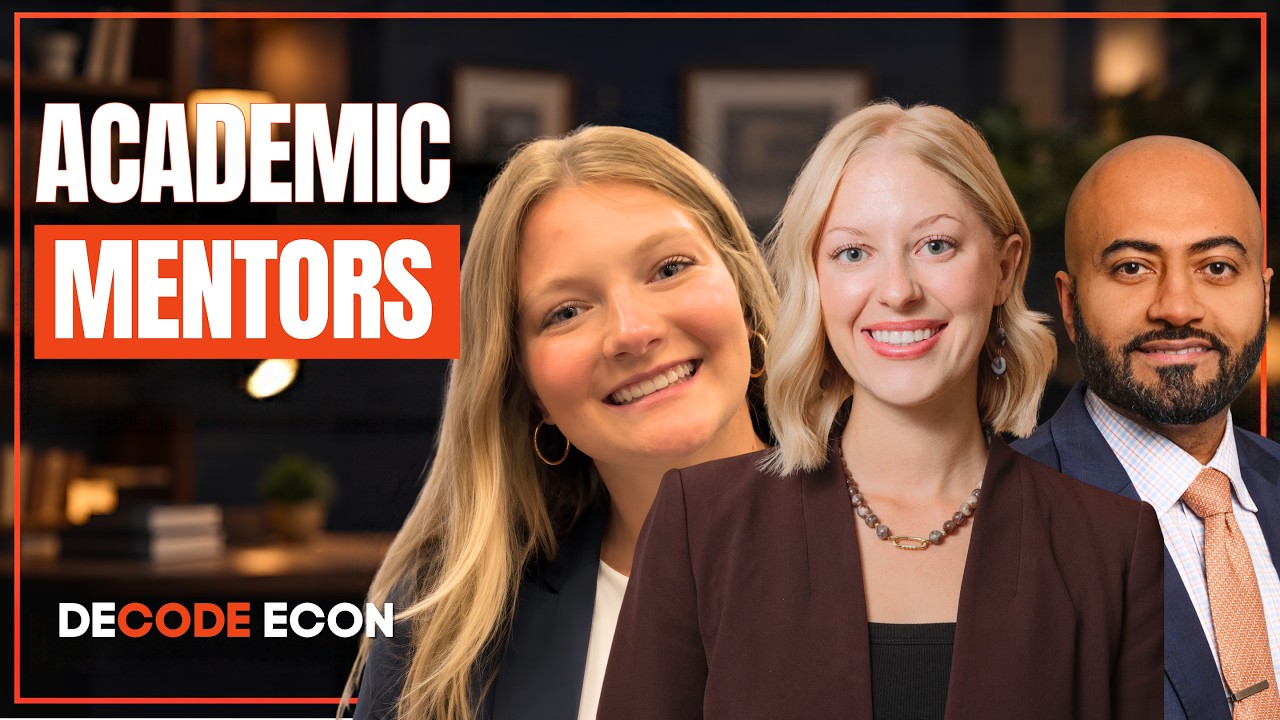
This is our monthly Office Hours episode, and this time we talk about mentorship. I taught Brooklyn, Brooklyn taught Frannie, and the three of us cover mentorship and student development. We start with two headlines about the entry-level job market, then get into how mentoring gets passed from one person to the next, and how a professor with a full load and no budget does it anyway.
Listen if you care about advising students but don't know where to find the time, or if you're a student stuck between needing experience to get a job and needing a job to get experience.
Our guests
Brooklyn Stephens took the first run of my data tools and visualization course in 2021 and now teaches it as an adjunct professor. She earned her MBA, spent several years in corporate roles, and did research with me through the Center for Economic Education. That work became our paper on demographic differences in financial anxiety, Money Worries, published in the Journal of Financial Counseling and Planning. Connect with Brooklyn on LinkedIn
Frannie Staley was one of Brooklyn's students in that same course and now works on the Decode Econ team. She's the closest of the three of us to today's entry-level job market. Connect with Frannie on LinkedIn
What we cover
- 00:00Welcome, and Brooklyn and Frannie introduce each other
- 03:00Headlines: the broken ladder and the experience paradox
- 13:00Office Hours: how mentoring gets passed down the chain
- 27:00Office Hours: student development, and the students who never come to office hours
- 40:00What do you tell your students?
Research mentioned in this episode
Lambert, P. J., & Schindler, Y. (2026). The broken ladder: AI, remote work, and early-career hiring (CAGE Working Paper No. 808/2026). University of Warwick. Working paper, not yet peer reviewed. Read it
Stephens, B., & Al-Bahrani, A. (2023). Money worries: Examining demographic differences in financial anxiety. Journal of Financial Counseling and Planning. The research project Brooklyn chose over an internship. Read it
Nietzel, M. T. (2026, August 2). What the changes in entry-level jobs mean for new college graduates. Forbes. Reports Cadient's data on one panel of employers. Read it
For the classroom and your conversations
- Why would a firm that offers remote work hire fewer junior people? Walk through who pays the cost of training a new hire and who gets the return.
- If prior experience signals that someone already took a chance on you, what else could a student show an employer that sends the same signal?
- Who was the first person to hand you real work and then talk with you about it afterward? What do you think they did on purpose?
- Would you take the job with the better title or the one where someone will know your name? What are you giving up either way?
Who did this for you, and what do you still do because of them? Tell me your mentor story in the comments.
Use it Monday
Activity · 10 minutesAsk your class: "Is AI or remote work the bigger threat to your first job?" Take a show of hands. Then share the finding: when economists put both in the same model, remote work holds up and the AI effect mostly disappears. Finish by asking why training a new hire costs more when the senior person isn't in the room.
Pair it withThe Broken Ladder summary, working paper and policy briefing. Get it
Read the full transcript
Why mentoring is now our job
Dr. A: Think about the person who changed the direction of your career. It might not be the smartest person you ever studied with. I'm asking about the one who saw something in you before you did, the person who became your mentor.
Now here's the uncomfortable part. Gallup asked more than 5,000 college graduates whether they had a mentor in college who encouraged their goals and dreams. Only 25% strongly agreed. Most of our students can't say they had someone who encouraged them. And when Gallup asked who those mentors were, nearly two out of three said it was a professor. Not a career counselor. Not a boss. A professor.
Gallup's earlier research found graduates with that kind of support were about twice as likely to be engaged in their work and thriving in their lives years later. So the most powerful thing we can do as educators might not be in the syllabus. It's in the connection between students and faculty.
For a long time, we could leave that to chance. If a student didn't find a mentor in college, they would find one at their first job. They would sit next to someone senior, pick things up in meetings, and learn how the place actually works. But that model is breaking. On-the-job training isn't what it used to be.
A new working paper from economists at Warwick and LSE looked at hundreds of millions of hires and job postings. The drop in entry-level hiring lines up more closely with remote work than with AI. The reason is mentoring. When the senior person isn't in the room, training a new hire costs more. So firms hire fewer people, and employers ask for more experience before they give you a chance to gain any.
The first job was always the mentoring program. Nobody called it that. Now it's shrinking, so the mentoring has to happen before graduation. That puts it on us, college educators. And it requires a mental shift from providing content to providing development.
Today I want to show you what that looks like with two people who are living proof of it. Brooklyn Stephens was in the very first group of students to take a data tools and visualization course I designed. She took it during COVID, entirely on Zoom, which means none of what came next happened by accident. She turned down an internship to do research with me, and years later she went on to teach that same course. One of her first students was Frannie Staley. Frannie now works with me on Decode Econ.
I mentored Brooklyn. Brooklyn mentored Frannie. That's three links in one chain, and today all three of us are in the same conversation. You'll hear what Brooklyn saw in Frannie as a student, what a hallway conversation does that a Zoom call can't, and the time I got so focused on outcomes that I forgot I was working with people.
This one is about the power of mentorship: how to do it, what goes well, and what goes wrong. Mentoring isn't extra. It's the job. So let's get into it.
A community builder in the classroom
Dr. A: Brooklyn, tell me: what was Frannie like as a student?
Brooklyn: Frannie was a community builder. One of my favorite memories from all the semesters I taught was when Frannie helped organize a food day in my ECO 309 class, a class on data tools for economists. She was extremely inquisitive, and she helped build a tight-knit group of students by being outgoing, including people and helping others. She was always one to lean over to the person beside or behind her and help them if they were struggling with a concept.
The students wanted to have a food day, and she helped organize it. I think every single student brought in food on one of our last days, and we celebrated. Frannie brought in apple pie. I believe it was her grandmother's recipe, and it was incredible. That's one of my favorite memories ever.
Dr. A: I love that example. Now that I've had the opportunity to work with Frannie, I see that community building is such an important part of who she is. It shows up in every aspect of her work. Brooklyn, as her professor, why was that so important to you?
Brooklyn: As a professor, you want to see your students thriving and able to have intense discussions. But to do that, they have to feel safe in that space. As much as a professor tries to make that space feel safe, it's also part of the students' responsibility to make their peers feel safe. Everything Frannie did that semester helped cultivate that experience in the class. People felt safe. I had one student cook jambalaya for all of us because it was his favorite meal and he was from Louisiana. It was incredible.
Dr. A: Frannie, you had the privilege of having Brooklyn as your professor for Data Tools and Visualization. What do you remember about her, and how has she changed your life? Not to be dramatic.
Frannie: The first thing was how she could work a room. From the get-go, she set the tone. Everybody knew she was there to help us, not to tear us down. She was always there for everybody. She always recommended things, and she would push us out of our shells. We had to read a chapter and be ready to present it, so you had to be on your toes. Everybody was in the same position, and everybody was nervous. The whole class was amazing, and so was its impact.
Then when we heard from Professor Stephens that the class was getting canceled and she wouldn't be teaching it, we all rallied together. We said, this is the end of it, let's come together. It was a last hurrah.
Dr. A: So the adversity brought the group together, because a class you truly loved was going to be canceled. At that time it was confirmed it would be canceled, but it's coming back. If anybody's listening: Data Tools and Visualization is coming back in the spring semester. Professor Stephens isn't teaching it, but it will still be available for students.
Frannie, you said something I want to dig into. You said she was able to work the room. What does that mean to you?
Frannie: She set the tone from the beginning. She laid out her intentions for the whole term, what we should expect and what we were going to get into. It wasn't "you need to do this perfectly." It was more "here's your assignment, and you're always going to get feedback, always something more you could work on," the way a mentor would.
Dr. A: There's always something else you could improve on, and she challenged you. Frannie, it's powerful that you appreciate that, because a lot of people today, and specifically a lot of our students, run away from being held accountable or challenged. Brooklyn, what sets Frannie apart? Why is she so open to being challenged?
Brooklyn: Frannie might have to answer why she was open to it. But what I saw in class was someone who persevered even when things were frustrating or new to her. I taught coding in Stata. I taught Tableau. It was hard, and most of my students had never touched Stata or Tableau before. Even with those challenges, she could make light of the situation. We could all joke about it. She would keep a good attitude, or she would say, "This is really frustrating," and I'd say, "I know it is. I've done it." But she would persevere.
That open-mindedness continued throughout the whole semester, and it spread to other students. Sometimes Frannie would challenge students who weren't as open-minded, in a very polite, professional way. That helped create a great experience across those 15 weeks.
Remote work and the missing hallway conversation
Dr. A: If you're listening to the Decode Econ podcast, today we're having a really important conversation for educators about the power of mentorship. The common thread between the people on this call: I taught Brooklyn about four or five years ago in a class I designed, Data Tools and Visualization. It was the first time I taught it. She was in the experimental group, and she stood out, for the same reasons we've been talking about: being welcoming and taking on challenges. Several years later, Brooklyn taught that same class, and she taught Frannie Staley.
So it's me mentoring Brooklyn, and then Brooklyn mentoring Frannie. And Frannie works for Decode Econ today because of the relationship we built. We thought it was important to talk about the power of professors in shaping relationships with students, and the value of mentorship.
To get us started, here's a headline I'm watching. Economists Peter John Lambert, from Warwick and LSE, and Yannick Schindler studied 243 million new hires and 407 million job postings across the US, UK, Canada and Australia between 2017 and 2025. They found that remote work is a better predictor of the drop in early-career hiring than generative AI. AI is getting a lot of the blame for early-career employment, but their research points to remote work. Firms that adopted remote work in 2021 and 2022 shifted their hiring toward experienced candidates.
This is a working paper, but it's worth watching. Remote work might be why early-career workers are being hit, and I think that has a lot to do with mentorship. Early in your career, you need mentorship, and right now you're not getting it on the job.
Brooklyn, I want to hear about this from your career, because you've worked in industry and as a professor. But first, Frannie, you're the closest of the three of us to being an early-career job candidate. What are your classmates saying about the labor market today?
Frannie: They think it's down, so they're very discouraged, and I think our generation can get discouraged easily. I also think a lot of them are looking for remote work. They like the individual freedom they don't get working in person. But I think that's ultimately a negative for all of us. You can talk on Zoom, but it's not the same as talking to someone in person. In person, you're more comfortable and more vulnerable. Remote is a barrier.
Dr. A: Frannie, we work closely together through Decode Econ and the Center for Economic Analysis and Development, and I think our most valuable conversations happen randomly in the hallway. I run into you and ask you a question, or you ask me one, and it turns into a deeper conversation. In remote work, that doesn't exist, so we lose that mentorship.
Brooklyn, you've worked in industry, and you're also part of the generation that supposedly loves remote work. I'm calling Gen Z that generation. What's the problem right now for people entering the labor market, and what's your advice to them?
Brooklyn: My advice is to think about your capacity for opportunities, especially early in your career. A lot of times we try to maximize pay, and I was there. Coming out of my MBA program, I tried to maximize for money. That's all anyone in my class talked about or thought about. I wish I could go back and tell myself not to maximize for salary, and instead maximize for the opportunities that could come to me.
I think that would lead you to want to be in person. Like you said, I relate to those hallway conversations. When I worked in corporate, I was in person all the time, and my most valuable conversations, for me and for others, happened when we were casually walking past each other and I'd say, "Hey, I have this idea." It's the classic elevator pitch. That can be scary, but it's where I found the most reward, because people would think of me for new projects. They knew me. They had talked to me outside a traditional meeting. There's something to be said for being around people, especially early in your career.
The experience paradox
Dr. A: One more headline. I'm calling this one the experience paradox. The hiring platform Cadient tracked about 8,000 salaried openings at the same employers from 2022 to 2026. They found that the share of jobs requiring no prior experience fell from 73% to about one in fifty. So more jobs require experience, even for so-called entry level. Brooklyn, you've hired people. Do you see this happening, and can you give us a sense of why?
Brooklyn: I do see it happening. I've sat in on way too many interviews and done many myself, and I've seen it. I've also done it. You want someone with a little experience, but if they have too much, they're overqualified. We could start by acknowledging that this is a legitimate problem. When I talk to students, I don't love telling them to just network more or work harder, because that ignores how difficult this entry-level market can be.
But I do think we need to broaden what we consider experience. I interviewed a lot of recent graduates from master's and undergraduate programs, and many would say, "Well, I just had one internship." You should never say "I just had this one thing." When I look back at my own career, the things that helped me the most weren't traditional jobs. I actually turned down an internship to do research with you, Dr. A, through the Center for Economic Education at NKU.
Students need to keep that in mind. And colleges could do better at creating opportunities for students to graduate with actual work they can point to, not just classes they've completed. Think of it as a portfolio of your work. That is experience.
Dr. A: Like you, Brooklyn, I cringe anytime somebody puts the word "just" in front of anything they do. I hear it a lot from general business students: "I'm just a general business student," as if that's not enough. Don't use "just."
I've been thinking a lot about my career lately. I've got about 15 more years of work to do, and I'm asking what I want those years to look like. You could call it a mid-career crisis. I keep asking myself what it is I do and what my value proposition is. Mentorship keeps coming up, along with content creation and economics. I'm evaluating all of it.
One thing I hadn't realized I was doing is giving my students opportunities that count as experience. I knew what I was doing; I just didn't realize how big a deal it is. Brooklyn, you alluded to it with the Center for Economic Education. Before we go to Frannie, tell me how pivotal that experience working at the Center under my supervision was for you.
Brooklyn: It was my first experience with a true mentor. It was also my first experience with what people would call a "boss," and I'm doing air quotes right now. It was pivotal because it let me help run projects, and it gave me someone who said, "I think you're really capable of these things. Let's try them out," and then gave me space to learn them. It built my confidence.
It wasn't "here's a task, go do it." It was "What are you interested in?" It helped me navigate being a college student trying to figure out what I want to be for the rest of my life. Newsflash: you probably won't figure it out. But it helped me along the way, and it set me up to communicate my value to the labor market.
You can find a really good traditional internship, and I'm not knocking them. If you have a good one, go do it. But a lot of internships are task-based. I've seen it in corporate. It's rare to have a mentor in an internship, or maybe you get a peer mentor. I got to work one-on-one with other students, across a lot of different skills, and build those skills along the way. It was pivotal for my career growth and my professional development.
Dr. A: Frannie, you've followed Brooklyn's footsteps a little differently. We didn't have the Decode Econ student lab back then, or the Haile Research Lab in its current form. What experiences are you investing in right now that are shaping who you are as a student?
Frannie: I have a lot, and that's my problem. Dr. David Rosca came up to me one day and said, "Pick three things you can talk about forever and show your passion behind them." For me, that's my work with the Center for Economic Analysis and Development, my work with Decode Econ, and the olive oil project in Dr. Rosca's class.
It's not just outside experience that counts. The work here at the university is where I grew the most. Then taking what I learned here into a class with a real-world setting, where we worked with a real company and had opportunities outside the school, is where it blossomed.
Dr. A: For anyone listening who doesn't know the Center for Economic Analysis and Development, what does a day of that work look like for you, if there is such a thing?
Frannie: Right now I'm working on a presentation for Eggs 'N Issues at the Northern Kentucky Chamber of Commerce. I'm collecting data, making charts, doing the math and all that jazz, the stuff people don't think is fun but that I've grown to enjoy and love. That's my day-to-day.
With Dr. A, I make posts, which has been a struggle for me lately because my creative juices aren't flowing as we get toward the end of the semester. But it's challenged me to keep pushing when a lot of people would say, "I don't want to do anything besides my schoolwork."
How educators become better mentors
Dr. A: Both of you have gained opportunities. Frannie, you mentioned Dr. Rosca, who's fantastic at spotting and building talent. Brooklyn, you mentioned me encouraging you to do research. So how do educators become better mentors? Let me tell you why I'm asking.
A lot of people in education believe their role is to teach the subject matter. For some of us, it's more holistic. On the first day of class, I tell my students that education is about relationships. We don't learn in spaces where we don't feel safe; Brooklyn, you mentioned that already. And I always say education is about lifelong relationships. Brooklyn, you took my class in 2021, and we work closely every semester. I really stand by that.
But there's also a belief in education that some people have that skill and some don't. What can educators do to become better mentors or create a safer space in their classroom? Frannie, I'll start with you because you're in the classroom right now, and then Brooklyn, I want your perspective as an educator.
Frannie: It's always great to start with expectations that set the tone, but not in a way that tears someone down, like "you're going to get a bad grade in this class, I'm just letting you know." That's when you think, I don't know if I want to do this anymore. When someone comes in with an open mind about their students, gets to know them, learns each student's weaknesses and strengths, and gives advice based on that, that's very impactful. So is understanding that we have things going on, and that you're there to support us even when those things are going on. That opens the door for mentorship.
Dr. A: Frannie, that's great. Let me push for something more tangible. What has a faculty member done that made you feel seen, or that challenged you but still lifted you up? That's a delicate balance. Someone listening right now might say this generation just wants to be made to feel good. I've heard critiques of my own teaching like "you just make the students feel good," and I think, no, you're not seeing the challenging part, how I help them grow through tasks and assessment. Give me an example. You don't have to name the faculty member.
Frannie: One of my professors, and I don't think he'd mind if I named him, would go a little Darth Vader on us. He kept it lighthearted, but he came in with critiques: this is not what I told you to do, this is what you need to fix, here's how you can change it in less time. We struggled with time frames. We did a huge project on a short timeline, and we were relying on AI, which a lot of us struggled with because we weren't used to it. The time frames and expectations were hard for all of us.
But toward the end, he opened up an opportunity, because he knew each of us had something to contribute. He basically said, "I want you to do this. I know you can." We had to email him a letter saying why we wanted to be part of it and why he should pick us. One person had to redo it zero times. The rest of the class had to redo it twice. I had to do it three times to get into that group. At the end, he told me most people would have given up after the second time. But I didn't.
Dr. A: So he showed you there was a path, believed you could do it, and gave you more chances to prove yourself, and you were willing to jump through those hoops. Brooklyn, what about you? What tips would you give an educator?
Brooklyn: It's difficult. Where's the line between professionalism and asking students questions they might not want to answer? But I think the smallest things make an impact. Say hi to your students every single time they come into the classroom: "Hello, how are you today? What's going on?" I spent the first ten or so minutes of every class walking around and talking to nearly every student. What are you doing this week? How's your other class? A lot of my students were coming from the same class, so I'd ask, "What did you learn in your previous class? I'm curious, tell me." It was always an open discussion, and I think that made people more comfortable.
I knew when students had an interview coming up. I knew when they really wanted an internship and had just applied, because I would ask, they would tell me, and I would follow up. At the start of the semester I sometimes had to pull it out of them. But it mattered, and it compounded through the semester. Eventually they'd come in and say, "I'm so excited, I got this internship," or "I really need help with my resume. Can I come to your office hours?" And of course I'd say yes.
It's those very small things that help. As an educator, you might think you need a big project or a big presence, or a lot of extra time, in order to mentor. But sometimes people are just looking for someone to confide in, someone to listen to the struggles they're having in their career or internship. "I have this internship and my boss really sucks, and I don't know what to do." That's a conversation I've had with a student. Those are your chances to mentor, and it doesn't have to take a lot of extra time or effort.
Don't shortchange the community building
Dr. A: It's almost as if, when you create a space where people feel comfortable, you can actually challenge them to do more. Here's an example. Brooklyn, when you were in the CE Fellows program and we had our econ club, we always started with "anything to celebrate?" Sometimes we'd take 10 to 15 minutes just to let people share what they were proud of.
Now something that happened to Frannie and me in the Haile Research Lab. For the past seven weeks, I've been struggling with the lab. I love this environment. If you're wondering what it is, it's a space for 22 students and seven faculty members. They show up every Friday. None of them are required to; they just come to talk about research and work on their projects. It's a mentorship program built around research, and it's probably one of the strongest communities we've developed.
But the past seven weeks have been a challenge. We did everything the textbook says: challenge your students, bring in speakers, assign work. Where I felt detached, and I think Frannie did too, is that we had lost our community. We had lost why we show up. We got so focused on the task at hand, that a paper needs to be done by the end of the semester and that students need exposure to cutting-edge research, that we forgot the human aspect.
This past Friday was one of my favorite Haile Research Lab meetings. Why? Frannie brought in Terri Masue, which goes back to her community-building approach. And we leaned on my community-building approach too. It's a two-hour meeting, and for the first 45 minutes we just went around asking, "What are we celebrating?" Every time somebody shared a celebration, we clapped. Then we added context: Frannie talked about something she did, and I shared my perspective on it. That brought us closer than any other activity this semester.
The second half of the meeting was actually high-stakes. Every student had to present their research project. Had we not started with community building, I don't think it would have been as productive. The lesson for me is: don't shortchange the community building. Sometimes we get so focused on the outcome that we forget we're working with human beings. If we create a nurturing space, people will surprise you with what they're capable of. Frannie, did I explain that correctly, or is there anything you'd add?
Frannie: I totally agree, but you're leaving out what happened before the research lab. Dr. A, a couple of other students and I are in a mentorship group; Dr. A is my mentor for the research lab. We started that meeting just talking. We got to the important stuff at the end, and it was like, okay, what do I need to say up there? I felt unprepared.
While we talked, we bounced ideas around, and I was jumping between them. I don't think I've ever come in with a different idea than the one I always bring, which is marketing and entrepreneurship. This was completely outside my realm. But you said, "You got this. Just explain the story behind it. People will understand." That helped, just guiding us into the research lab that day.
Dr. A: That is so powerful. If you're wondering what happened last Friday: before the Haile Research Lab, Frannie and the mentorship group met with me. In that meeting, I barely said anything. I let them sit down and talk, and they talked my ear off for an hour. In the last 10 minutes, they all stopped and looked at me like, "What am I supposed to do when I get to this meeting?"
I think that question was easier to ask because they had let their guard down. They weren't coming to me for directions. They genuinely wanted to know what to do next. That's the power of mentorship. As I reflect on my career, I'm trying to figure out how to package this, because there are no tips for educators on how to be better mentors. Even worse, there's a perception in the field that if you invest in building up the whole student, you're sacrificing content. Brooklyn, what are your thoughts on that split?
Burnout, boundaries and pushing too hard
Brooklyn: You have to do your job. You can't just say, "I'm not teaching, we're going to have fun all class." I've had professors who did that, and there's a thin line. I took my education extremely seriously, maybe more seriously than I should have. In classes where a professor wasn't teaching the content or was always off schedule, I'd think, "I thought we had a plan, and I don't feel like I'm getting much from this class."
So you still have to do your job. But there has to be room for both. You can do your job, be a mentor and run a really engaging class. Does it take work? Absolutely. Is it hard sometimes? Absolutely. Are there students who just don't want to be in that space or be mentored? Yes. Sometimes you can't reach them, and you have to be okay with that, or at least able to live with it.
One question I want to pose to you, Dr. A, because I think these go hand in hand: how do you be that mentor and not burn out? A lot of the time you're doing this unpaid. You're providing extra opportunities for students without extra recognition. It's often a thankless job. How do you do it without burning out?
Dr. A: I'm not the best person to answer this. In our household, the other Dr. A and I have a saying every August: "See you in 16 weeks." Her semester is 15 weeks long and mine is 16. At the start of August, we say the next 16 weeks are devoted to our students, and we'll catch up in December. At home, we put our oxygen masks on and connect. I go to her with problems I'm facing, and she comes to me. But the priority is being there for the students. It's what we chose to do.
To me, education is about building people up. Sometimes that's not the student; it's faculty, your colleagues. The goal of a higher ed institution is to invest in the professional development of the people around it, and that includes staff and community members too. So I'm not a good example, because I don't have those boundaries. I have deliberately not set them.
But sometimes I do get burnt out, and that's where honest conversations come in. When you're burnt out, you're more likely to lapse in judgment. That's why it's important for me to know my core values and remind myself of them.
One question I was going to ask you both is: what happens when it goes bad? How does mentorship go wrong? Here's something I've been struggling with. When you hire students as mentees, the job is secondary. The primary objective is to build them, which means sometimes you sacrifice on the actual task. Brooklyn, you made it clear there's an optimal level: how much fun you're going to be and how much of a challenge.
The same goes for professional development: how much are you going to push? This is where my problem is, and Frannie, I'd love your perspective. Sometimes I see a student's potential more than they see their own. How do I slow down the development process until they see it? Just because I see it doesn't mean they're ready to get there. But we still need to pour into the student and give them the resources, so that when they're willing to grow, they can. So Frannie, is there such a thing as pushing too hard as a mentor?
Frannie: I don't know. I can see both sides. You could push too hard and push someone over the edge, and that can go both ways. But I'm a different case. I like to be pushed. I try to be open-minded because I know a ton of people aren't like me. We talked about this the other day. I strongly believe it's because of the way I was raised. But I can't say for sure.
Dr. A: It's tough. Not knowing the right answer is exactly what every mentor struggles with. What's the right outcome here? I'm not sure there's one fixed outcome, which means every mentee needs their own development plan.
Brooklyn, to answer your question, that's where burnout can happen: when you're managing too many students' development plans. That's why it's important to have many community members involved in the organization. If only one person is doing it and it all falls on their shoulders, that's a tax on them.
To bring in some perspective from the econ ed world: when it comes to building students up and mentoring, most of that responsibility tends to fall on female faculty members. They write the recommendation letters, they run the econ club, they're pouring into the nurturing side of the profession, and they need support. We need to make sure we provide it. I don't know where my nurturing side came from. It definitely goes against gender stereotypes, but I think it has differentiated me.
Frannie, you were about to say something and I cut you off. I apologize. Go ahead.
Frannie: I'm sorry, I didn't mean to do that. I lost my train of thought. It was about how much you can push. I also think students need to find that within themselves first. That's hard, because some people say they're willing to take on a challenge, but when it gets pushed at them, they back out. I think they need to be able to say, "I don't think I should take that challenge."
A different ladder, not a broken one
Dr. A: Brooklyn, a couple of takeaways from today. First, as a student, develop your experience. As a faculty member, your job is to give students more experiences outside the classroom that go on their resume. Second, mentorship is a skill that can be developed, and faculty members should be thinking about it in their course content.
When I teach principles of macroeconomics, I give a lot of professional development advice, because macro actually lets you have those conversations. When we talk about labor markets, we talk about signaling: how to build your resume so it signals to the market that you're ready to take on challenges. When we talk about investment and long-term planning, we can talk about what you want to do in life and how to get there. My principles of macroeconomics class can actually be thought of as a professional development class. And the Data Tools and Visualization class we developed together lets students walk away with a portfolio to show employers.
Brooklyn: Absolutely. For at least the past two semesters I taught it, the final presentation was a consulting project. I have students work in teams, because that's real life. A lot of them don't like the team aspect, but I do it anyway. They have a mock consulting client and have to give a consulting presentation. I've had guest judges come in, which makes it a little more high-stakes. It's very much real life, with professional development woven throughout the whole course.
Dr. A: In higher education and in the broader economy, we hear a lot about the broken ladder to entry-level jobs. I agree there are challenges. But I don't think the ladder is broken. It's a different ladder, and we have to adjust. Students need skills they can show the labor market, signaling that they'll be productive.
That won't happen unless faculty switch their mindset from content providers to mentors and people builders. That's what I think higher education needs more today than ever. We've lost sight of our return on investment because we've focused only on "you're going to learn from experts." What we haven't been clear about is what you're going to learn.
I couldn't do the work I do today without students like Brooklyn and Frannie, who have shaped me as an educator. We talk a lot about how much we invest in our students. But if you create the space and invest in them, they will invest in you. That's my closing remark for today.
Thank you all for listening to Decode Econ. If you're new here, my name is Abdullah Al-Bahrani. I run Decode Econ, but I couldn't do it without Frannie, and now Brooklyn is on the team helping us out. Make sure to like, subscribe and give us a five-star rating. But most importantly, because we believe in community, send us an email and tell us what you thought of today's episode. We'd love to hear from you. See you all next time.