
AI isn't taking anybody's job right now. Uncertainty is keeping firms from hiring, and "we're investing in AI" gives them a story the market rewards.
Three takeaways
- "It's weird out there" is an accurate read of the data. If you own stocks, this economy has felt good. If you live on your paycheck, wages haven't kept up with inflation. Unemployment sits at 4.2%, low by historical standards, and people looking for work still can't find it. Everyone is holding still, waiting for something to break.
- AI can be a real productivity gain and still be a bubble. A bubble is when the price we pay for an asset stops reflecting the cash it will actually produce. Right now a firm can announce an AI strategy and watch its stock jump, whether or not it knows what it'll do with it. And the productivity gains will take years to show up. You can't find the personal computer or the internet in the productivity data either.
- Uncertainty, not AI, is why firms aren't hiring. We're in a low-hire, low-fire labor market. Saying "we're investing in AI" sends a better signal than "we don't trust the policy environment." New graduates get hit hardest because they're an expensive hire with no track record.
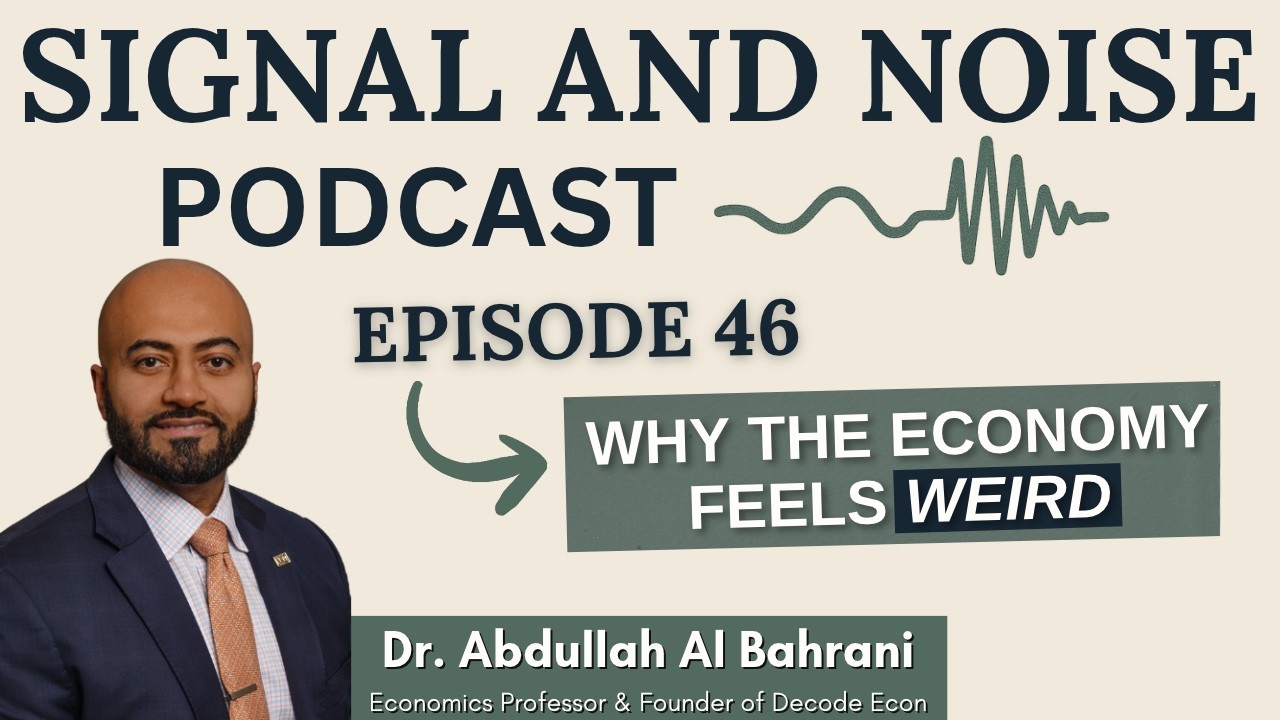
About this episode
Brian Lamar and Andrew DeCilles host Signal and Noise, a podcast from ROI Rocket for people who work in marketing research. Brian told me the idea for this episode came from a monthly meeting of business owners and research leaders. They went around the room, and everyone described their business the same way: up and down, hard to predict, weird out there. So they wanted an economist to explain why.
We start with the vital signs I check every month and the one that has me puzzled: people say they feel broke, and they keep spending anyway. From there we get into why I call AI a bubble even though I use it every day, what the JOLTS report says about who's hiring, and what an industry facing an AI disruption should do about it. That last part applies to higher education as much as it does to market research, and I share how we rebuilt the Haile MBA around what I call the CASE framework: critical thinking, agility and adaptability, storytelling, and emotional intelligence.
Listen if you run a business and you're trying to decide whether to hire, invest or wait. Or if you're a student wondering why the job search feels so much harder than a 4.2% unemployment rate says it should.
The hosts
Brian Lamar co-hosts Signal and Noise and works at ROI Rocket, where his focus is the quality of online research panels and how the source of a sample changes the data it produces. Connect with Brian on LinkedIn
Andrew DeCilles co-hosts Signal and Noise and leads business development at ROI Rocket. He and Brian have built their careers studying sample sourcing bias, and ROI Rocket is the third company they've worked at together. Connect with Andrew on LinkedIn
What we cover
- 00:00Welcome, and how Signal and Noise got its name
- 04:17How is the economy doing? "It's weird out there"
- 06:52Economics is political: policy uncertainty and what it does to hiring and investing
- 09:38The vital signs I check every month, and why people who feel broke keep spending
- 13:21Is AI a bubble? Prices, fundamentals and irrational exuberance
- 20:53Lessons from 1999, productivity lags and the true cost of AI
- 27:45Is AI taking jobs? The JOLTS report and the low-hire, low-fire economy
- 35:00What market research (and higher ed) should do about AI
- 48:22Competing on value, the CASE framework and our human-versus-AI writing experiment
- 54:22Community as the next frontier, and wrapping up
Research and data mentioned in this episode
Baker, S. R., Bloom, N., & Davis, S. J. (2016). Measuring economic policy uncertainty. Quarterly Journal of Economics, 131(4), 1593–1636. The Economic Policy Uncertainty Index I mention, updated monthly. See the data
U.S. Bureau of Labor Statistics. Job Openings and Labor Turnover Survey (JOLTS). Monthly openings, hires, quits and layoffs. See the data
University of Michigan. Surveys of Consumers. The consumer sentiment numbers behind the "vibecession." See the data
Greenspan, A. (1996, December 5). The challenge of central banking in a democratic society [Speech]. American Enterprise Institute. Where "irrational exuberance" comes from. Read it
For the classroom and your conversations
- People say the economy is bad, and they keep spending. What would have to happen for the spending to catch up with the mood, or the mood to catch up with the spending?
- A company announces an AI strategy and its stock jumps the same day. What is the market paying for? How would you tell a bubble from a good bet while it's happening?
- Why might a firm say "AI" when the real reason it isn't hiring is uncertainty? Who is that message for?
- A healthy economy has more people quitting their jobs. Why would more quits be a good sign?
- If a degree tells an employer what you'll cost, what can you show them that tells them what you'll be worth?
Does it feel weird where you work? Are you hiring, holding still or waiting for something to break? Tell me what you're seeing in the comments.
Use it Monday
Activity · 15 minutesPut this month's JOLTS numbers on the board: job openings, hires, quits and layoffs. Ask your class, "Is this a strong job market or a weak one?" Then point out that hires, quits and layoffs have barely moved. Finish by asking why a low-hire, low-fire market is harder on a new graduate than on someone who already has a job.
Pair it withThe latest JOLTS release from the Bureau of Labor Statistics. Get it