
What Personal Finance Teachers Should Take From This Year's Nobel Prize
Two macroeconomists won the prize. Personal finance teachers should be paying attention.
Earlier this week I wrote about why this year's Nobel Prize matters. Robert E. Hall and Michael Woodford won for showing how much the economy depends on what people expect to happen next.
I kept thinking about it, because personal finance runs on the same idea. A household budget is a set of guesses about the future, whether students realize it or not. Below are six ideas from this year's prize that I would put in any personal finance course.
The six principles
- Ask whether income is temporary or permanent.
- Write down what you expect to earn, and when.
- Expect real people to fall short of the model.
- Get students to say their forecast out loud.
- Watch where rates are expected to go.
- Build credibility with yourself.
1Is this income temporary or permanent?
Hall's work implies that a one-time windfall should barely move your spending, while a raise you expect to keep should move it a lot. Most 19-year-olds get their first tax refund without ever learning the economics behind permanent versus temporary income.
Temporary
- A $1,200 tax refund
- A signing bonus
- A great tip week
Save, invest or pay down debt.
Permanent
- A raise you expect to keep
- A salary
- Steady hours
Spend from this column.
A $1,200 refund is not a raise, and one great week of tips doesn't set a new normal. The question I'd teach students to ask about every dollar is simple: how often will this happen in the future? If the honest answer is "probably never again," or “rarely," that money belongs in savings or on a debt balance.
2What do you expect to earn, and when?
Almost every money decision a student makes trades today against tomorrow. Do I spend now or save? Do I borrow now and pay it back later? Economists call these intertemporal decisions, and the interest rate is the price of moving money across time. Want me to give up spending today? Then you need to pay me for waiting.
Those trades only make sense relative to what you expect to earn later. And if the interest rate is too low, saving today may not be worth it at all.
Hall's framework looks at a household over its whole life. Income starts low, climbs through a career, then falls in retirement. Someone planning ahead borrows when income is low, saves when it's high and spends down later. Economists call this consumption smoothing, and it's a sensible plan, not a lack of discipline.
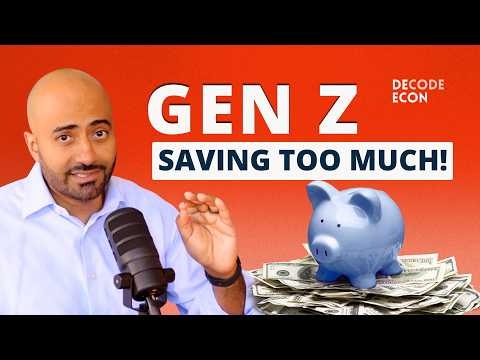
There's another side to this. I don't think saving aggressively at 22 is automatically the right call. A dollar locked away early can't pay for a certification, a move to a city with better jobs, or the experience that raises what you earn for the next forty years. The goal is to save the right amount for your stage of life and to maximize lifetime income. Most personal finance education misses that part. It often pushes the narrative of saving as much as possible and as early as possible, neglecting the value of investing in increasing lifetime income.
We discussed this on the podcast, and the comments on the video clearly indicate that many have been taught to save at the expense of increasing lifetime income.
 Watch
Is Gen Z Saving Too Much? The Opportunity Cost of Retirement
Watch on YouTube
Watch
Is Gen Z Saving Too Much? The Opportunity Cost of Retirement
Watch on YouTube
A student loan is a bet on your future income.
Most students are guessing at the income number. When economists asked college students what they expected to earn in different majors, a lot of those beliefs were wrong, and students changed their plans after seeing real earnings data (Wiswall & Zafar, 2015).
Wiswall, M., & Zafar, B. (2015). Determinants of college major choice: Identification using an information experiment. Review of Economic Studies, 82(2), 791–824.
Think about what that means. Students pick majors, sign loan paperwork and choose first apartments based on an income forecast they've never written down, let alone checked.
We can fix that in class. Have students sketch a 10-year income path for the career they want: starting salary, salary at 30, salary at 35. Then put their planned loan payments, rent and savings next to it. Nobody gets the forecast exactly right, and that's fine. What matters is having one they can look at, question and revise.
I share an example of an assignment you can implement in your classroom below. Using BLS data, you can help students identify careers and sketch income paths.
Plan on the income you expect, but keep a cushion for the version of the future that doesn't cooperate. I think of an emergency fund as insurance against your own forecast being wrong.
3Do people actually behave this way?
Mostly, no, and for teachers that's the useful part. Economists tested whether households really smooth spending the way the model predicts. When the 2001 tax rebates went out, households spent a sizable share within a few months, even though the checks had been announced well in advance (Johnson, Parker, & Souleles, 2006).
Johnson, D. S., Parker, J. A., & Souleles, N. S. (2006). Household expenditure and the income tax rebates of 2001. American Economic Review, 96(5), 1589–1610.
So the model tells us what a forward-looking person would do, and the data tell us how far real people fall short. Personal finance education lives in that space.
4What forecast is hiding in this decision?
Every financial choice has an assumption about the future built in.
- Lock in a mortgage rate or wait? You're forecasting interest rates.
- How much to ask for in a salary negotiation? You're forecasting inflation or labor market strength.
- Variable-rate loan or fixed? Rates again.
Students make these forecasts all the time without noticing, which means nobody ever checks them.
One activity I like: ask students how much they think prices will rise next year. Then pull up what households across the country expect in the New York Fed's Survey of Consumer Expectations, and compare both numbers to what actually happened. Seeing how far off their own guess was will stick with them longer than my lecture on inflation would.
5Why watch the future instead of today's rate?
Woodford showed that what the central bank does today matters less than what people expect it to do over the next few years. Mortgage rates, car loans and savings yields all move with where rates are expected to go.
If students only pay attention on Fed decision day, they're reacting to old news. Rates usually move weeks before, on speeches and hints.
So the better habit is to skip "What's the rate today?" and ask "What is the market expecting?"
6Can a household have credibility?
I rarely see this connection made, and I think it's the most useful one.
In the 1970s, central banks learned the hard way that a promise only works if people believe it. When the Fed kept changing course, it lost its ability to shape expectations and inflation got away from it.
Students run into the same problem with themselves. "I'll start saving next month" is forward guidance nobody believes, including the person saying it. Central banks fixed this by committing to rules that are hard to break, and households can borrow the idea: an automatic transfer to savings every payday, a 401(k) contribution that rises by default each year, or a personal rule that half of every raise goes to savings before it hits checking.
Pick a rule that fits the plan. Credibility comes from sticking with the right commitment, which isn't always the biggest one.
The Fed earns credibility by doing what it said it would do. A 22-year-old with a new paycheck earns it the same way.
For the classroom
- Add one forward-looking question to every budgeting lesson: "What do you expect to change in the next 12 months, and how sure are you?"
- Cover temporary versus permanent income before students see their first tax refund, bonus or financial aid refund check.
- Using the BLS Occupational Outlook Handbook, have students sketch a 10-year income path for the career they want, then lay their planned loans and living costs on top of it.
- Bring in real expectations data. Students forecast inflation, then check their number against national surveys and against what happened.
- Present automatic savings as a credibility tool. When students understand why commitment works, they're more likely to stick with it.
How do you teach expectations in your personal finance class? Tell me what has worked for you.