
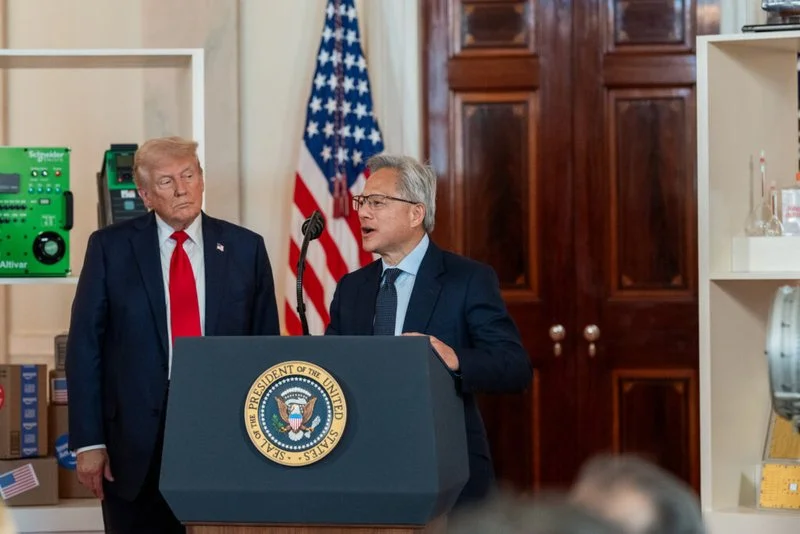
NVIDIA CEO Jensen Huang delivers remarks as President Donald Trump looks on during an “Investing in America” event in April 2025. (Official White House Photo by Joyce N. Boghosian)
The president of the United States interfered in private markets again. On November 23, Nvidia's board reinstated Jensen Huang as CEO, less than a week after saying it did not intend to bring him back. The president had repeatedly urged the board to reinstate Huang, and he took credit when it did. This fits his ongoing effort to prop up the stock market. What has become known as the Trump put is the market's belief that the president will do anything to keep the stock market afloat.
The term "put" comes from finance. A put option gives you the right to sell a stock at a specific price, so it acts as a floor to your losses. When investors reference a Trump put, they mean they believe the president will act as a floor and support prices.
A CEO, a selloff and a reversal
President Trump has made it clear that his number one measure of economic success is the strength of the stock market. When Huang was pushed out on November 12, Nvidia dropped as much as 14% in a single morning and dragged the broader market down with it. The stock was already falling. It had dropped about 30% from its October 6 record, one of the main reasons the S&P 500 was off its own high. That market change threatened the president's goals. When the board reversed course, Nvidia closed up 31% in one day.
The president has done this before. In April 2025, after liberation day sent stocks tumbling for days, he paused most of them for 90 days. The S&P 500 rebounded more than 9% in a matter of hours, and President Trump called it "the biggest day in financial history." Whenever markets show weakness, he jumps in to adjust or reverse his own policy to support prices.
Why should this worry you?
The president's fixation on the stock market, and the market's belief that he will always step in to support prices, threatens the future stability of the U.S. economy.
We have seen this before with the Federal Reserve. Research on the "Fed put" finds that the Fed has eased policy after the stock market falls, and investors learned to count on it (Cieslak & Vissing-Jorgensen, 2021). The Fed put works through interest rates. The Trump put now applies similarly and determines who runs a private company.
As long as investors believe the Trump put exists (and we now have more evidence that it does), the stock market will stay inflated. If you believe someone will catch you when you fall, you take bigger risks and pay more for stocks than the risk justifies. Economists call that moral hazard.
The inflation lasts until the market believes the put no longer exists, and that will most likely happen with the transition to a new administration. Unfortunately, the correction will be blamed on whoever comes next, when in reality it has a lot to do with current policies.
Choosing the stock market over values
Even more important for the country as a whole, we've decided that bad personal behavior, or behavior that might threaten national security, can be overlooked as long as market values keep rising, or to avoid a collapse. Nvidia's own chair said Huang resigned after disclosing personal behavior that broke the company's code of conduct. Now the board says that, based on input from senior levels of the U.S. government, bringing him back poses no national security risk. That assurance came from the same administration that wanted him back.
More than 175,000 people signed a letter supporting him. Even if this was the right decision, it belongs to the board and the shareholders, not the White House.
So this raises a question for every one of us: can you be bought? How much would you need to be paid to overlook your values?
If you have a 401(k) in an S&P 500 index fund, you own Nvidia whether you picked it or not, and you're living with the Trump put either way. Tell me in the comments below: what's your number?
References
Cieslak, A., & Vissing-Jorgensen, A. (2021). The economics of the Fed put. The Review of Financial Studies, 34(9), 4045–4089. Read it
S&P Dow Jones Indices LLC. (2026). S&P 500 [SP500]. Federal Reserve Bank of St. Louis. https://fred.stlouisfed.org/series/SP500