
The short version
- For decades, nonalcoholic beer was what you drank when you couldn't drink. O'Doul's and Sharp's solved a problem, but nobody wanted to be seen holding one.
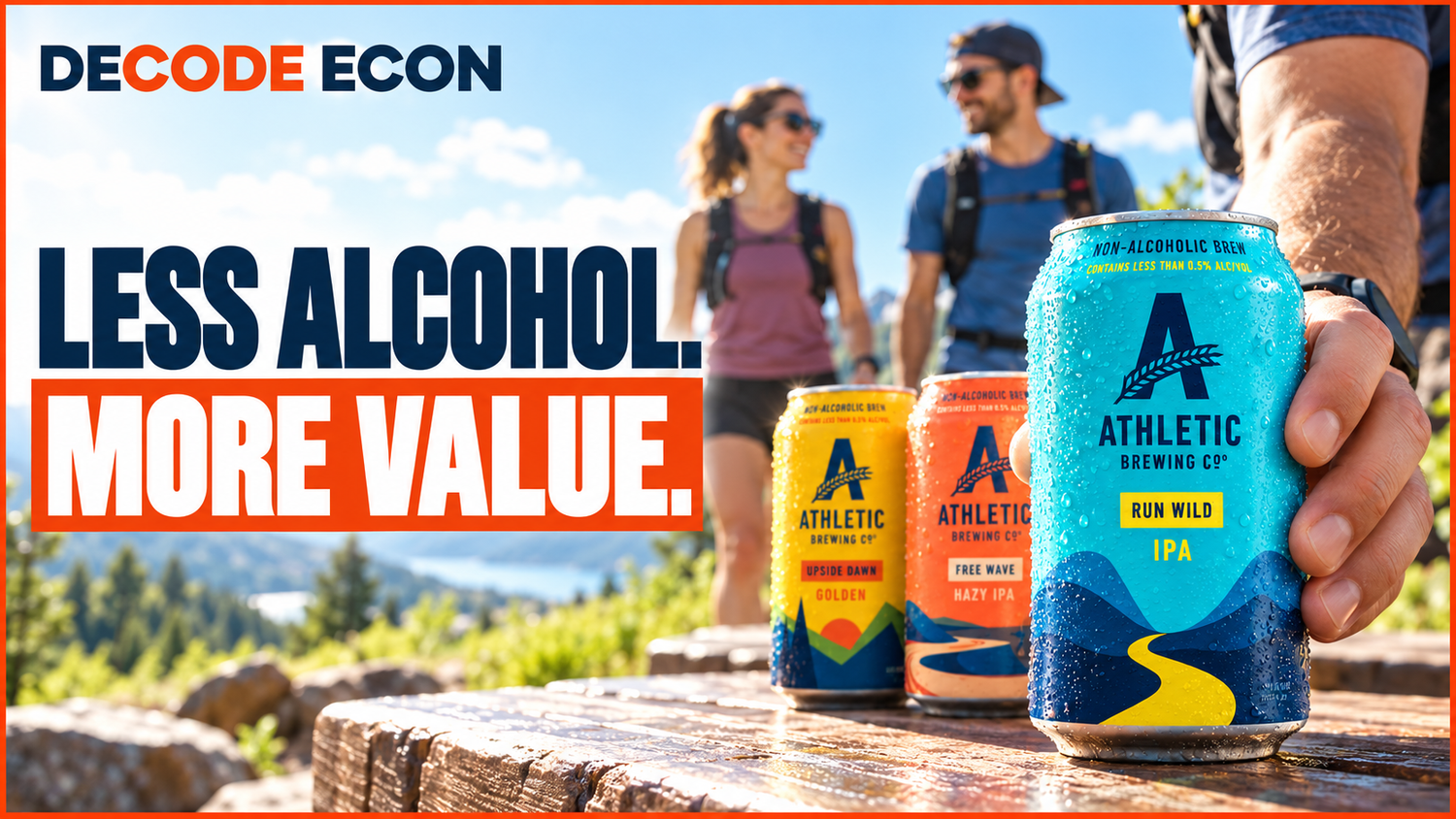
- Athletic Brewing sold the same idea as a choice instead of a sacrifice. In 2025 it ranked as the sixth-largest craft brewer in the country, and it charges craft-beer prices.
- People buy what a product says about them. When a brand becomes part of someone's identity, they stop comparing it on price.
If you had asked a beer executive in 2017 whether a brewery that makes only nonalcoholic beer could become one of the biggest craft brewers in America, the answer would have been quick: no chance.
In my last company story, we looked at how Liquid Death took water, about as close to a commodity as it gets, and charged more for it by making substitutes feel like they weren't substitutes. Athletic Brewing pulled off something similar with a product that had a worse starting point. Water was boring. Nonalcoholic beer was a little embarrassing.
The awkward corner of the beer aisle
For a long time, NA beer was for designated drivers, people with a medical reason to skip alcohol, and anyone who wanted something beer-shaped without the beer. O'Doul's and Sharp's did that job well enough. They gave you something to hold.
But beer is rarely just a drink. It shows up at the cookout, the game, the concert and the happy hour after a long week. In those settings, ordering an old-style NA beer often meant explaining yourself. The product solved the "what do I hold" problem and left the "what will people think" problem alone.
When Athletic launched in 2018, nonalcoholic beer made up about 0.3% of U.S. beer sales, and Athletic sold 875 barrels in its first year (Entrepreneur, 2025).
From substitute to signal
Co-founder Bill Shufelt studied economics and went into finance before starting Athletic with brewer John Walker in 2017 (Middlebury Campus, 2023). They picked a name with a positive, aspirational feel that would work anywhere in the country (CT Mirror, 2025). That choice sheds light on their strategy.
The old NA beer
A substitute for people who had to give something up. Functional, cheap, a little apologetic. You bought it because of what you couldn't have.
Athletic
A signal for people gaining something: energy, a clear head, a good run in the morning. Runners, parents, people with a 6 a.m. alarm. You buy it because of who you are.
The name, the cans, the race and sports sponsorships all push the same idea. This is beer for people who want to feel good tomorrow.
By 2025, the Brewers Association ranked Athletic sixth among all U.S. craft brewers by volume, up from eighth the year before (Wolfe, 2026). That's a list of companies selling alcohol, and a brewery that sells none is near the top of it.
What people say vs. what they buy
Ask someone why they drink beer and you'll hear "I like the taste" or "it's social." Both answers are true, but neither explains why people pay craft-beer prices for a beer with no alcohol in it.
So watch what they buy. Scanner data from January 2025 found that 34% of households buying Athletic earned more than $150,000 a year, compared with 18% for the top 20 alcoholic beer brands (Earnest Analytics, 2025). Whole Foods sells more Athletic than any other beer, with or without alcohol (CNBC, 2024). These shoppers can afford anything in the beer aisle, and they're choosing this.
Income tells you who is buying, but it can't tell you why. Marketers separate demographics (age, income, location) from psychographics (values, lifestyle, identity), and Athletic is a psychographic brand. A 26-year-old marathoner and a 50-year-old parent with a 6 a.m. alarm don't share a demographic, but they can buy the same six-pack for the same reason: they see themselves as disciplined and in control.
Athletic sells compatibility: with a workout, a workday, a kid's soccer game and a good night's sleep.
The economics behind it: revealed preference
Economists have a name for learning what people want by watching what they choose: revealed preference (Samuelson, 1938). What people tell a survey and what they do at the register often disagree, and the register is the better guide.
Athletic's customers revealed that they'll pay a premium for a beer that helps them feel like a better version of themselves. That fits a line of research showing that identity shapes economic choices. We pay to act like the person we believe we are (Akerlof & Kranton, 2000).
How less alcohol commands more money
This is where it connects to elasticity. A plain NA lager competes on price and availability. If it goes up a dollar, you grab the other one. Its demand is elastic because shoppers see plenty of substitutes.
Athletic made itself harder to replace. If the can says something about you, a cheaper can that says something else isn't a real substitute. Fewer substitutes mean less elastic demand, and that means room on price. A six-pack of Run Wild IPA sells for around $10 online, in the same range as a craft IPA, and more per can than a 12-pack of O'Doul's.
The Five Whys
To see what that $10 buys, customer discovery analyst use an exercise called the Five Whys. You take the reason a customer gives you and keep asking "why?" until you reach something about who they are. For an Athletic drinker, it might go like this:
- 1"I like the taste." Why?The stated preference. This is where most surveys stop.
- 2"It's a real IPA, not a watery near-beer." Why does that matter?Taste is the ticket in. Without it, nothing else works.
- 3"I can bring it to the cookout and nobody asks questions." Why?Social permission. It looks and feels like everyone else's beer.
- 4"I don't want to explain that I'm not drinking." Why?Now we're at the emotion: skipping the awkward moment.
- 5"I want to be the person who shows up, trains in the morning and is in control."Identity. A competitor can copy the recipe, but this rung is much harder to copy.
A survey would have stopped at the first why, but the real pricing power is at the fifth why.
To be clear, I'm not saying taste doesn't matter. Shufelt and Walker spent years reworking the brewing process to get a fully fermented NA beer that people would actually want to drink (Middlebury Campus, 2023). Branding couldn't have carried a bad beer. Taste got people to try it, and identity is why they keep paying more.
A generational shift, not a niche
I think the smartest thing Athletic did was read the market correctly. A niche would have been a small group of nondrinkers who needed a better option. What Athletic saw was a generation rethinking alcohol without wanting to give up the rituals that come with it.
The data has caught up. In Gallup's 2025 poll, 54% of U.S. adults said they drink, the lowest in the survey's history and down from 63% in 2023 (BevNET, 2025). In January 2025, NA beer hit a record 4.2% of beer sales in grocery stores (Brewbound, 2025a). And January is Athletic's biggest month of the year (Brewbound, 2025b).
The founders didn't talk anyone out of drinking. Consumers were already renegotiating their relationship with alcohol, and Athletic gave that behavior a positive identity and a premium package. Athletic is winning because they gave an ignored segment of the market an identity. That is what consumers are paying for.
What this means for you
The next time you reach for the more expensive option, ask yourself what you're paying for. Sometimes it's quality. Often it's the person the product helps you feel like. That isn't irrational, but it's worth knowing when it's happening.
If you run a business, a nonprofit or a side hustle, flip the question around. What does buying from you say about your customer? If the answer is nothing, you're competing on price, and someone will always be cheaper.
For the classroom and your conversations
- Heineken and Budweiser sell alcohol-free beers too. Why couldn't the biggest brewers in the world just copy what Athletic did? What makes a brand hard to copy?
- Athletic's best month is January. What does Dry January tell you about who's buying and why?
- Run the Five Whys on yourself. Pick something you pay extra for and keep asking "why?" Where did you end up: the product, or what it says about you? Would you admit that on a survey?
- Is paying more for identity irrational? Make the case both ways.
Read and watch more
- How a Can of Water Escaped the Commodity Trap, the first company story, on Liquid Death.
- Understanding Sober-Curious: Consumer Mindsets in the Move to Healthier Beverages, from the Yale Center for Customer Insights, on what makes shoppers see a drink as healthy.
- Planet Money on the boom in nonalcoholic drinks, a short listen on Dry January and the businesses chasing it.
- CT Mirror's conversation with Bill Shufelt and John Walker, on how they started in a garage and built a brand around the name.
What's something you pay extra for because of what it says about you?
Leave a commentReferences
Akerlof, G. A., & Kranton, R. E. (2000). Economics and identity. The Quarterly Journal of Economics, 115(3), 715–753.
BevNET. (2025). Gallup poll: Record low 54% of US adults drink alcoholic beverages. https://www.bevnet.com/spirits/2025/gallup-poll-record-low-54-of-us-adults-drink-alcoholic-beverages/
Brewbound. (2025a). Non-alcoholic beer grabs 4.2% share of beer grocery sales in January. https://www.brewbound.com/news/non-alcoholic-beer-grabs-4-2-share-of-beer-grocery-sales-in-january-sales-23-5-volume-20
Brewbound. (2025b). Athletic Brewing posts ‘biggest dollar growth year’ heading into 2025, launches ‘Athletic January.’ https://www.brewbound.com/news/athletic-brewing-posts-biggest-dollar-growth-year-heading-into-2025-launches-athletic-january-campaign
CNBC. (2024, March 11). How Athletic Brewing Co. dominates the booming nonalcoholic beer market. https://www.cnbc.com/2024/03/11/how-athletic-brewing-co-dominates-booming-nonalcoholic-beer-market.html
CT Mirror. (2025, March 20). Athletic Brewing Company: This could work. https://ctmirror.org/2025/03/20/athletic-brewing-company-this-could-work/
Earnest Analytics. (2025). Athletic Brewing taps into Dry January, continues momentum. https://www.earnestanalytics.com/insights/athletic-brewing-taps-into-dry-january-continues-momentum
Entrepreneur. (2025). How this founder turned ‘Dry January’ into a year-round movement and built America’s #1 non-alcoholic beer brand. https://www.entrepreneur.com/starting-a-business/how-this-founder-made-dry-january-a-yearly-movement/502331
Middlebury Campus. (2023, February). Bill Shufelt ’05’s Athletic Brewing Co. makes Vermont beer culture inclusive to non-drinkers. https://middleburycampus.com/article/2023/02/bill-shufelt-05s-athletic-brewing-co-makes-vermont-beer-culture-inclusive-to-non-drinkers
Samuelson, P. A. (1938). A note on the pure theory of consumer’s behaviour. Economica, 5(17), 61–71.
Wolfe, P. (2026, April 17). 50 biggest craft breweries in the US, ranked. The Daily Pour. https://thedailypour.com/beer/50-biggest-craft-breweries-us/