
The short version
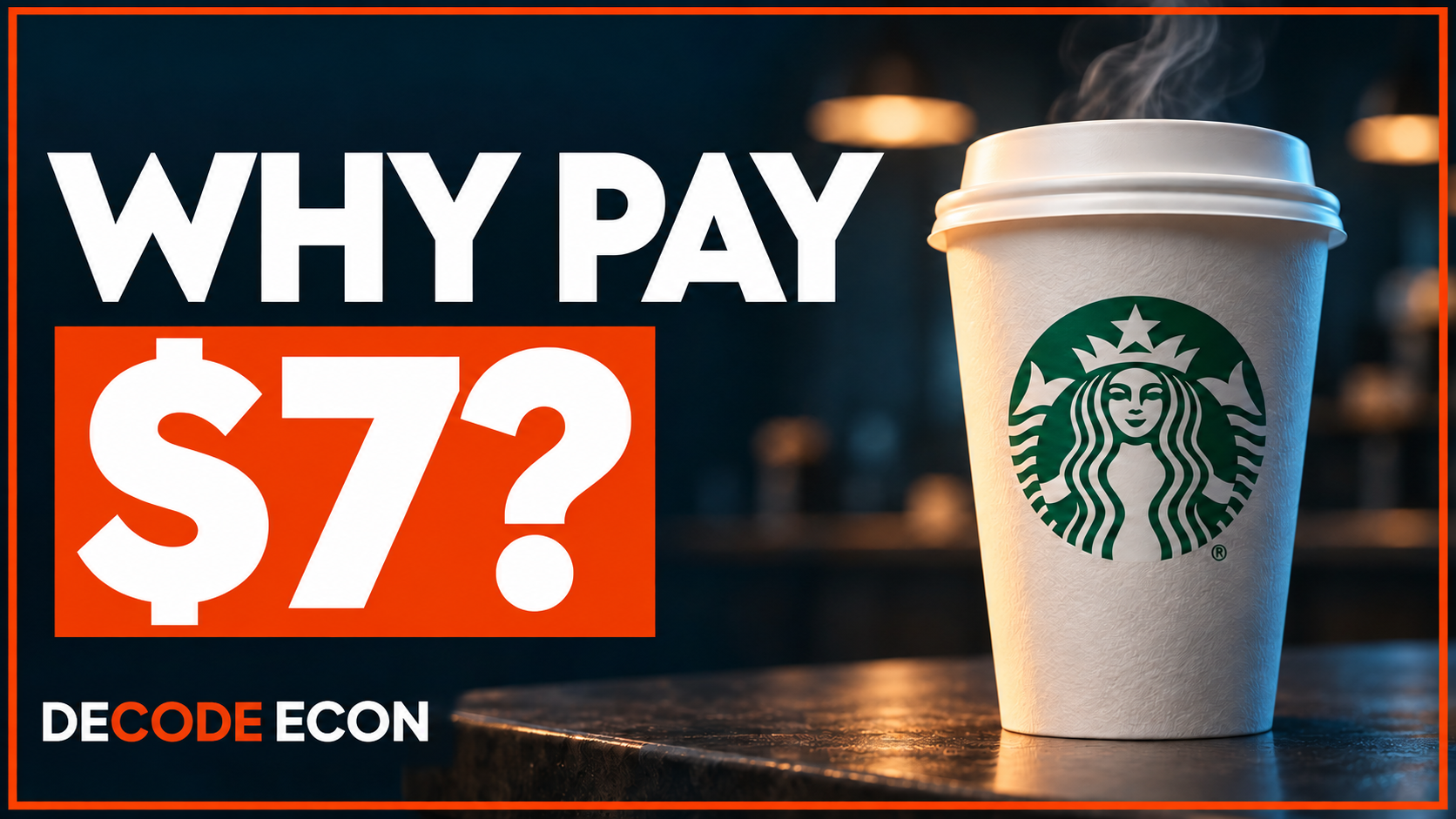
- A cup of coffee costs cents to make. The diner next door sells one for $2, and millions of people still pay about $7 at Starbucks.
- The premium comes from design: size names you can't compare, endless customization, a rewards program built on loss aversion and seasonal drinks that disappear on a schedule.
- None of it changes the coffee. It changes how much customers care about the price, and that is what elasticity measures.
Coffee is a commodity. A pound of green Arabica beans trades on global markets for a few dollars, and the marginal cost of a cup, once you account for water, milk, and labor, is a matter of cents. And yet, on any given morning, millions of consumers walk past a diner, a gas station, and an independent coffee shop selling a nearly identical product for two dollars, in order to pay seven dollars for a Starbucks. That gap is not explained by the coffee. It is explained by the behavioral architecture built around it.
This is the puzzle at the center of this company story. If consumers were the frictionless, fully-informed optimizers of the standard economic model, Starbucks's price premium should collapse the moment a cheaper, functionally equivalent substitute appears next door. It doesn't. To understand why, we have to stop treating consumer psychology as noise around an otherwise rational decision, and start treating it as the mechanism firms deliberately design for.
Names and Definitions: The Six Mechanisms
Before we open the hood on Starbucks specifically, it's worth naming the tools precisely. Each of the six terms below comes from behavioral economics, not marketing. They describe well-documented, repeatable patterns in how people process price, choice, and time. Knowing the formal definition matters because it's what lets you diagnose the mechanism in any company's strategy, not just this one.
-
1Anchoring
The tendency to rely too heavily on the first piece of information offered (the “anchor”) when making a subsequent judgment. Once a reference price is set, later prices are evaluated relative to that anchor rather than on their own terms.
-
2Framing
The tendency for people to react differently to the same underlying information depending on how it is presented or labeled. A price or product framed one way (e.g., as a personalized creation) is evaluated differently than the identical price or product framed another way (e.g., as a commodity purchase).
-
3Loss Aversion
The tendency to weigh the pain of losing something roughly twice as heavily as the pleasure of gaining something of equal value. First documented by Kahneman and Tversky (1979), it means the threat of losing an earned reward motivates behavior more strongly than the prospect of earning an equivalent new one.
-
4Decoy Effect
A change in preference between two options caused by the addition of a third, asymmetrically “inferior” option (the decoy). The decoy is not designed to be chosen. It is designed to make one of the original two options look more attractive by comparison.
-
5Scarcity
The tendency to assign higher value to a product or opportunity the more limited its availability appears to be. Perceived scarcity (whether of time, quantity, or access) increases desirability independent of any change in the product itself.
-
6Urgency
A time-based pressure that compresses the window in which a decision must be made, reducing the customer's opportunity to deliberate, comparison-shop, or delay the purchase. Urgency is often paired with scarcity but is distinct: scarcity limits quantity or access, while urgency limits time.
What all six have in common
Notice what all six definitions have in common: none of them describe a consumer making an error about the facts. A customer who feels loss-averse about expiring stars, or who rushes to order before a seasonal drink disappears, is not confused about how many stars they have or how long the offer actually lasts. These are documented patterns in how well-informed people weigh and compare options under pressure, which is exactly why they are so reliable, and so valuable, for a firm to design around.
From Commodity to Monopolistic Competition
Start with market structure. Firms escape the zero-profit trap of perfect competition by differentiating their product enough that consumers no longer treat it as interchangeable with the alternative next door. Starbucks is the textbook case of that escape. The underlying product (hot water, ground beans, milk) is nearly identical to what a diner or a gas station sells. What Starbucks has built instead is an experience, a vocabulary, and a set of rituals that make direct price comparison feel almost irrelevant to the customer standing in line.
But “building an experience” is a vague, unfalsifiable claim unless we can name the specific mechanisms doing the work. That is the task of this case: to open the hood on Starbucks's menu design, naming conventions, customization architecture, and loyalty program, and identify exactly which behavioral levers are being pulled, and what each one costs the customer in lost price sensitivity.
Menu Architecture: Naming as Obfuscation and Anchoring
- Short
- Tall
- Grande
- Venti
- Trenta
No Small, Medium, or Large anywhere on the board.
Start with the size names. Short, Tall, Grande, Venti, Trenta: none of these map onto the Small/Medium/Large convention used by every competitor. This is not a branding accident. When a customer cannot directly translate a Starbucks size onto a competitor's menu, the two products become harder to compare on price alone. Comparison shopping requires a shared unit of measurement; Starbucks removed one.
The size ladder also does anchoring work. The existence of a 30-ounce Trenta, or a $9 Reserve pour-over, recalibrates what counts as a “reasonable” price for the Grande sitting in the middle of the menu. Once a customer's reference point shifts upward, a $6.25 latte reads as the moderate choice rather than the expensive one, even though, measured against a $2 gas-station coffee, it is anything but moderate.
Customization: Differentiation at the Individual Level
Perhaps the most economically consequential design choice is customization. A Starbucks order (oat milk, an extra shot, light ice, no foam, three pumps of a seasonal syrup) is not a product a competitor sells. It is not even a product Starbucks itself has a fixed price for in the customer's mental model. By allowing near-infinite customization, Starbucks converts what should be a commodity purchase into a personalized construction that has no direct substitute anywhere else. You cannot price-compare a product that only exists in the moment you order it.
You cannot price-compare a product that only exists in the moment you order it.
This matters because substitutability is the single largest driver of elasticity. A product with many close substitutes faces highly elastic demand: raise the price and customers walk. A product with no close substitute faces inelastic demand. Customization doesn't just build loyalty; it mechanically removes the comparison set a rational shopper would need to discipline Starbucks's pricing.
Loyalty Mechanics: Loss Aversion by Design
Starbucks Rewards converts an ordinary transaction into an ongoing psychological relationship. Stars accumulate, streaks build, and for Green members, the entry tier, stars expire after six months. The threat of losing something already earned activates loss aversion, a far stronger motivator than the prospect of an equivalent gain. A customer who has 150 stars sitting in their account is not making a fresh, rational decision about whether a $6 latte is worth $6 today; they are protecting an asset they feel they already own.
The March 2026 overhaul moved the lever rather than removing it. Gold and Reserve members' stars never expire, but the status itself lasts 12 months and has to be earned again. Now the thing to protect is the tier.
The mobile app compounds this. Frictionless reordering, personalized offers, and habitual purchase patterns raise the psychological switching cost of choosing a competitor, even when the competitor is objectively cheaper and physically closer. Switching costs, like differentiation, are one of the core structural tools firms use to move up the market-power ladder.
Scarcity and Urgency: Manufacturing a Deadline
The final lever operates on time rather than on money. Starbucks's seasonal menu (the Pumpkin Spice Latte's annual return, holiday cup designs, limited-run Reserve roasts) is not primarily a product strategy. It is a scarcity strategy. By explicitly limiting how long a drink is available, Starbucks converts an ordinary purchase decision into a closing window: buy now, or wait a full year for the next chance.
Urgency operates alongside scarcity but works on a shorter clock. App-only “today only” star multipliers, limited-time double-star days, and countdown language in push notifications (“order by 2pm”) compress the customer's decision window so there is no time to comparison-shop, wait for a better price, or simply decide the purchase isn't worth it today. The urgency doesn't change the coffee. It changes how much time the customer has to think about the price.
Both mechanisms share the same economic function as anchoring, framing, loss aversion, and the decoy effect: they don't lower the price, they lower the customer's resistance to paying it. A limited-time offer doesn't need to be a good deal to work. It only needs to feel like a closing opportunity.
The Elasticity Payoff
Put the pieces together and a coherent economic story emerges. Naming conventions and customization reduce the customer's ability to make a clean price comparison. Anchoring, via the size ladder and premium tiers, resets what counts as a fair price. Loss aversion, via the rewards program, converts a repeated transaction into an asset the customer feels obligated to protect. Scarcity and urgency, via the seasonal calendar and time-limited app offers, remove the customer's opportunity to pause and deliberate at all. None of these mechanisms change the cost of a cup of coffee. What they change is the shape of the demand curve.
Elasticity is not a fixed property of a product category. It is a scorecard of how effective a firm's marketing has been.
Starbucks does not sell coffee at a markup because customers are irrational. It sells coffee at a markup because it has spent decades engineering the specific psychological conditions under which price becomes secondary to experience, identity, and habit.
The Question This Case Leaves Open
None of this is presented as a verdict. Behavioral design sits on a spectrum, and reasonable people disagree about where “shaping demand” ends and “manipulating a customer” begins. A loyalty program that rewards genuine repeat customers looks very different from one engineered specifically to exploit loss aversion in people who can least afford the premium. Hold both truths at once: these mechanisms are financially effective, and they are not ethically neutral. The skill I want you to walk away with is naming the mechanism precisely, and then taking a position on what a responsible marketer does with that knowledge.
For the classroom and your conversations
- Which of the six mechanisms have you noticed on a menu or in an app this week? Did any of them change what you bought?
- Starbucks made stars non-expiring for its Gold and Reserve members in 2026. Did that weaken loss aversion, or move it from the stars to the status?
- This post defines the decoy effect but never points to one at Starbucks. Look at the menu. Is there an option that seems built to make another one look better?
- Where does “shaping demand” end and “manipulating a customer” begin? Would your answer change if the customer were a college student on a tight budget?
Read more
Which of the six levers works on you the most? Tell me in the comments.
Leave a commentInstructor resources
For educators using this story in class.
References
Huber, J., Payne, J. W., & Puto, C. (1982). Adding asymmetrically dominated alternatives: Violations of regularity and the similarity hypothesis. Journal of Consumer Research, 9(1), 90–98. https://doi.org/10.1086/208899
Kahneman, D., & Tversky, A. (1979). Prospect theory: An analysis of decision under risk. Econometrica, 47(2), 263–291. https://doi.org/10.2307/1914185
Starbucks. (2026). Starbucks Rewards FAQ. https://about.starbucks.com/starbucks-rewards-faq/
Starbucks overhauls loyalty program as U.S. visits rebound. (2026, January 29). Axios. https://www.axios.com/2026/01/29/starbucks-rewards-program-changes-2026
Tversky, A., & Kahneman, D. (1974). Judgment under uncertainty: Heuristics and biases. Science, 185(4157), 1124–1131. https://doi.org/10.1126/science.185.4157.1124
Tversky, A., & Kahneman, D. (1981). The framing of decisions and the psychology of choice. Science, 211(4481), 453–458. https://doi.org/10.1126/science.7455683
Worchel, S., Lee, J., & Adewole, A. (1975). Effects of supply and demand on ratings of object value. Journal of Personality and Social Psychology, 32(5), 906–914. https://doi.org/10.1037/0022-3514.32.5.906